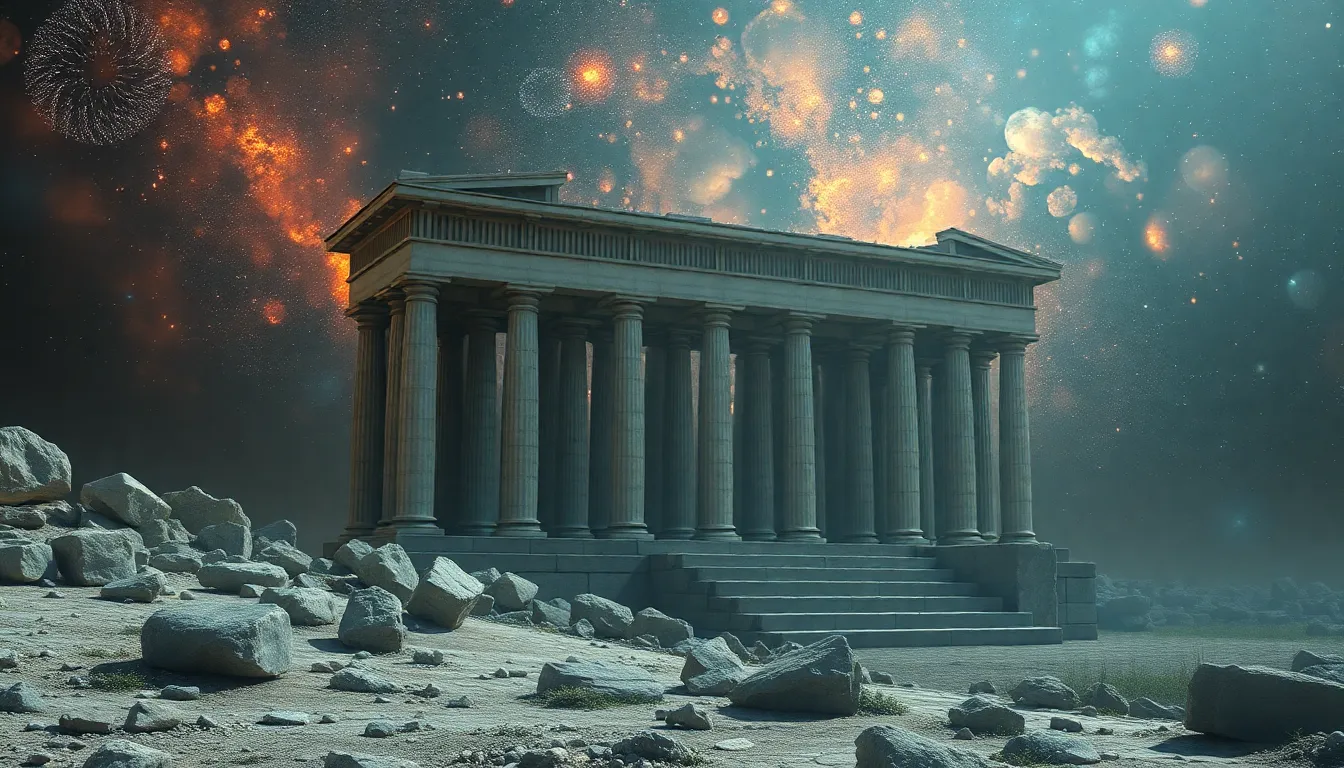
The Chaotic Nature of the Universe: Insights from Greek Philosophers
I. Introduction
The concept of chaos has fascinated humanity for centuries, serving as both a philosophical inquiry and a scientific exploration of the universe. In Greek philosophy, chaos is not merely a state of disorder but a complex idea that intertwines with the notions of creation, existence, and the nature of reality. As we delve into the thoughts of ancient Greek philosophers, we can glean valuable insights that still resonate with contemporary understanding of the cosmos.
This article aims to explore the perspectives of key Greek philosophers on cosmic chaos, highlighting their contributions to philosophy and science, and examining how their insights continue to shape modern thought.
II. The Philosophical Foundations of Chaos
In the context of Greek philosophy, chaos is often defined as a primordial state of disorder, from which order and structure emerge. This concept is contrasted with the notions of harmony and order, which are central to the understanding of the cosmos.
Chaos, in many ways, is seen as the backdrop against which the universe unfolds. It represents both potential and uncertainty, a fertile ground for creation but also a source of fear and confusion. Mythology plays a crucial role in illustrating these ideas, depicting chaos as both a destructive force and a necessary component of the cosmic cycle.
III. Pre-Socratic Philosophers and the Chaos Concept
The Pre-Socratic philosophers laid the groundwork for later philosophical thought regarding chaos. Their inquiries into the nature of reality often revolved around the fundamental substance of the universe.
- Thales: Thales proposed that water was the primal substance from which all things arise. His idea implies a fundamental unity in chaos, suggesting that diversity in the universe originates from a single chaotic source.
- Anaximander: Anaximander introduced the concept of the “apeiron,” or the infinite. He posited that this boundless entity existed before the cosmos, representing a chaotic, undifferentiated state from which all things emerge and eventually return.
- Heraclitus: Heraclitus famously stated that “everything flows,” emphasizing the perpetual change inherent in the universe. He viewed conflict and strife as essential components of existence, suggesting that chaos is a vital force driving transformation.
IV. Plato and the Duality of Order and Chaos
Plato’s contributions to the understanding of chaos are encapsulated in his dialogue “Timaeus,” where he explores the creation of the cosmos. Plato introduces the idea of the Demiurge, a divine craftsman who imposes order on chaos.
The Demiurge serves as a mediator between the chaotic realm and the ordered universe, shaping the cosmos according to eternal Forms or Ideas. This duality between chaos and order reveals deep philosophical implications for understanding the nature of reality.
Plato’s theory suggests that while chaos is ever-present, there exists a higher order that governs the universe. This interplay between chaos and order provides a framework for comprehending the complexities of existence.
V. Aristotle’s Perspective on Chaos and Order
Aristotle’s approach to chaos and order is rooted in his metaphysical inquiries. He introduced the principle of causality, which seeks to explain the phenomena of the universe through a framework of cause and effect.
Key concepts in Aristotle’s thought include:
- Potentiality and Actuality: Aristotle posited that everything in the universe has the potential to become something else. Chaos, in this sense, can be viewed as a state of potentiality that transforms into actuality through natural processes.
- The Natural Order: Aristotle believed in a natural order that governs the universe. While chaotic phenomena exist, they are part of a larger, ordered system that can be understood through reason and observation.
VI. Stoicism and the Acceptance of Cosmic Chaos
The Stoics viewed the universe as a rational entity, governed by a divine reason or logos. For them, chaos was not something to be feared but an integral part of the natural order.
The Stoic perspective on chaos includes:
- Chaos as Integral: Stoics believed that chaos and disorder are natural elements of the cosmos, necessary for the unfolding of life and existence.
- Response to Chaos: The Stoic response to chaos involves cultivating virtue and inner peace. By accepting the chaotic nature of the universe, individuals can maintain tranquility and resilience in the face of life’s uncertainties.
VII. The Influence of Greek Philosophical Thought on Modern Chaos Theory
The ideas of ancient Greek philosophers have left a lasting imprint on contemporary science, particularly in the realm of chaos theory. Modern chaos theory explores complex systems that exhibit unpredictable behavior, echoing the philosophical inquiries of the ancients.
Connections between ancient philosophy and contemporary scientific theories include:
- Emergence of Chaos Theory: Modern physics recognizes that chaos is an inherent aspect of many natural systems. This understanding parallels the ancient views that chaos is a fundamental component of the cosmos.
- Reevaluation of Chaos: Contemporary scientists are revisiting ancient insights, finding relevance in the philosophical discussions of chaos and order as they apply to modern scientific exploration.
VIII. Conclusion
In summary, the exploration of chaos through the lens of Greek philosophers reveals a rich tapestry of thought that has shaped our understanding of the universe. From the primal chaos envisioned by Pre-Socratic thinkers to the ordered cosmos articulated by Plato and Aristotle, these insights continue to resonate in today’s scientific discourse.
As we reflect on the interplay between chaos and order, we recognize its relevance not only in philosophy but also in the ever-evolving fields of science. The ancient Greek perspectives provide a foundation upon which we can build our understanding of the complex, chaotic nature of the universe.