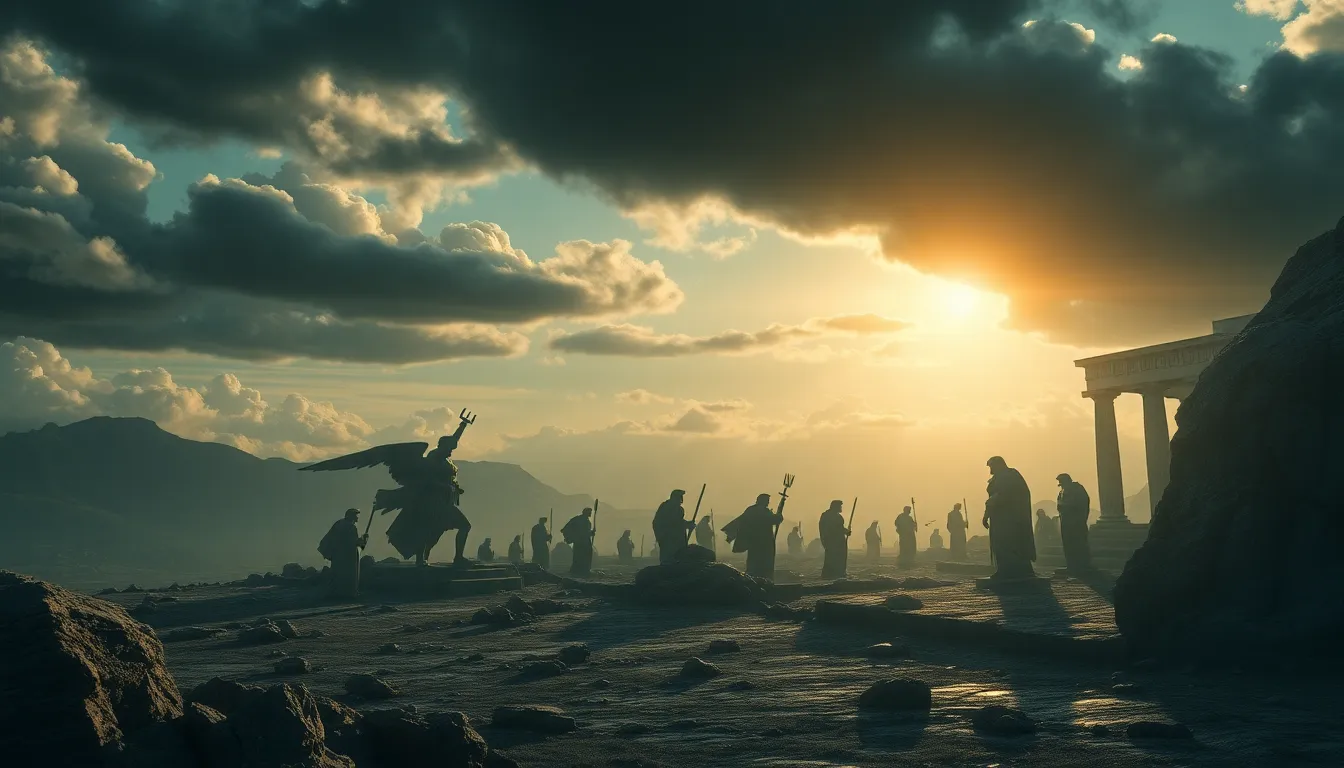
The Titanomachy: The Titans’ Last Stand Against the Olympians
I. Introduction
The Titanomachy, a pivotal conflict in Greek mythology, marks a significant turning point in the divine hierarchy of the ancient Greek pantheon. This epic struggle between the Titans, the primordial deities, and the Olympians, who would come to dominate the heavens, sets the stage for many of the myths and legends that followed. The importance of this conflict extends beyond mere tale, as it symbolizes the transition from an older, chaotic order to a new regime of gods who would govern the cosmos with justice and order.
This article aims to delve into the Titanomachy, exploring its origins, key figures, and implications within Greek mythology. By examining the characters and events that shaped this monumental battle, we gain insight into the cultural significance of the Titans and Olympians, whose legacies continue to resonate in modern interpretations of myth.
II. The Titans: Origins and Significance
The Titans were a race of powerful deities who preceded the Olympian gods. They were the children of Gaia (Earth) and Uranus (Sky) and represented various aspects of the natural world. The Titans embody the forces of nature and the primal elements that govern existence, making them central figures in early Greek cosmology.
A. Who were the Titans?
In Greek mythology, the Titans were twelve in number, and they included:
- Cronus
- Rhea
- Oceanus
- Tethys
- Hyperion
- Theia
- Coeus
- Phoebe
- Crio
- Iapetus
- Mnemosyne
- Themis
– The leader of the Titans, associated with time and the harvest.
– The mother of the Olympian gods and goddess of fertility.
– The Titan of the ocean, representing the vastness of the sea.
– Oceanus’ wife, symbolizing nourishment and the source of fresh water.
– The Titan of light, often associated with the sun.
– Hyperion’s wife, goddess of sight and the shining sky.
– The Titan of intellect and the axis of heaven.
– The Titaness of prophecy and oracles.
– The Titan associated with the constellations.
– The Titan of mortality and craftsmanship.
– The goddess of memory and mother of the Muses.
– The Titaness of divine law and order.
B. Key figures among the Titans
Cronus and Rhea stand out as the most notable Titans due to their pivotal roles in the rise of the Olympians. Cronus, fearing a prophecy that he would be overthrown by one of his children, swallowed each of them at birth. Rhea, distraught over the loss of her children, saved Zeus by hiding him in a cave and giving Cronus a stone wrapped in swaddling clothes.
C. Role of the Titans in pre-Olympian mythology
The Titans played a crucial role in the mythology that preceded the Olympians. They were often seen as embodiments of natural phenomena and were integral to various creation myths. Their reign, known as the Golden Age, was characterized by peace and prosperity, contrasting sharply with the tumultuous rule of the Olympians that followed.
III. The Rise of the Olympians
As the Titans reigned in the pre-Olympian era, a new generation of gods was born, destined to challenge their authority. The Olympians, led by Zeus, emerged from the shadow of the Titans to claim their rightful place in the cosmos.
A. Background of the Olympian gods
The Olympians were the children of Cronus and Rhea, and their emergence marked a significant shift in power dynamics within the pantheon. They included:
- Zeus – The king of the gods, god of the sky and thunder.
- Hera – The queen of the gods, goddess of marriage and family.
- Poseidon – God of the sea and earthquakes.
- Demeter – Goddess of agriculture and fertility.
- Hestia – Goddess of the hearth and home.
- Athena – Goddess of wisdom and war.
- Apollo – God of the sun, music, and prophecy.
- Artemis – Goddess of the hunt and wilderness.
- Ares – God of war.
- Aphrodite – Goddess of love and beauty.
- Hephaestus – God of fire and craftsmanship.
- Dionysus – God of wine and festivity.
B. Key figures among the Olympians
Zeus, as the foremost of the Olympians, played a crucial role in the Titanomachy. His leadership, alongside his siblings, was instrumental in rallying the Olympians against the Titans. Each Olympian brought unique powers and skills to the battlefield, contributing to their eventual victory.
C. The shift in power from Titans to Olympians
The rise of the Olympians can be attributed to a combination of factors, including their unity, the strategic advantages they held, and the support they received from other deities and beings, including the Cyclopes and Hecatoncheires, who were imprisoned by the Titans.
IV. The Causes of the Titanomachy
The Titanomachy did not arise spontaneously; it was the culmination of deep-rooted familial tensions, prophecies, and the struggle for supremacy among divine beings.
A. Family dynamics and rivalries
The conflict was largely driven by the familial dynamics between the Titans and their offspring. Cronus’s fear of being overthrown by his own children led to a cycle of betrayal and conflict that ultimately sparked the war. Rhea’s desire to see her children free sparked resistance against Cronus, setting the stage for the impending clash.
B. The prophecy and its implications
A significant prophecy foretold that Cronus would be overthrown by one of his children. This prophecy fueled Cronus’s paranoia and his drastic measures to prevent its fulfillment. The survival of Zeus, hidden away by Rhea, would eventually lead to the realization of this prophecy.
C. The role of power and control in the conflict
The Titanomachy was fundamentally a struggle for power and control over the cosmos. The Titans represented an older order that was being supplanted by a new generation of gods who sought to establish a more just and orderly universe.
V. The Course of the Titanomachy
The Titanomachy unfolded over a span of ten years, characterized by numerous battles and shifting allegiances. The conflict was marked by fierce confrontations between the two factions, each vying for supremacy.
A. Major battles and strategies employed
The Olympians initially struggled against the might of the Titans, but they eventually devised strategies to turn the tide of battle. Key strategies included:
- Alliances with the Cyclopes, who gifted the Olympians powerful weapons.
- Releasing the Hecatoncheires, who aided in the battles with their immense strength.
- Utilizing the element of surprise and guerrilla tactics to disrupt Titan formations.
B. Key events and turning points in the war
Several key events marked turning points in the Titanomachy:
- The release of the Cyclopes and