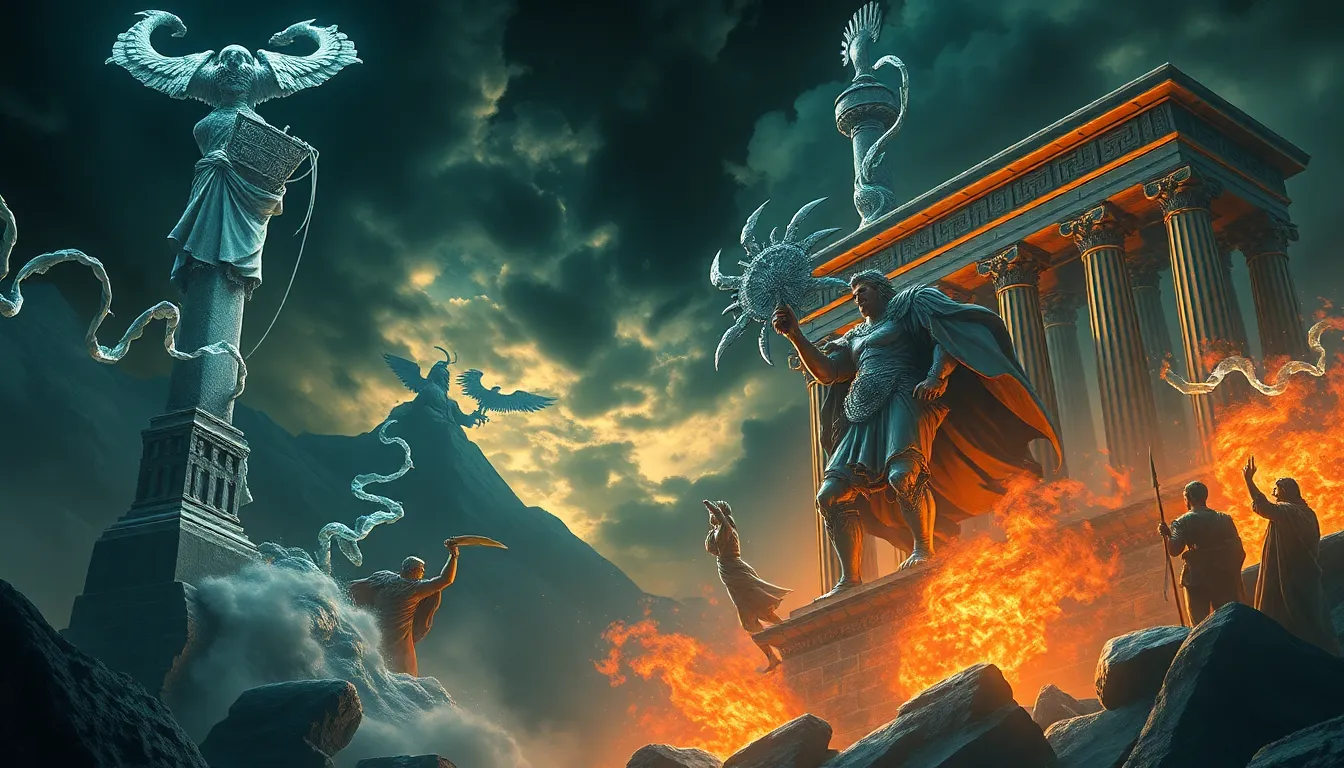
The Titanomachy: Unveiling the Myths of the Legendary War
I. Introduction to the Titanomachy
The Titanomachy is one of the most significant and dramatic narratives in Greek mythology, depicting the epic struggle between the Titans, the elder gods, and the Olympians, the younger generation of deities. This monumental conflict not only represents a fundamental shift in the power dynamics of the divine world but also encapsulates key themes such as rebellion, authority, and the cyclical nature of power.
At its core, the Titanomachy symbolizes the struggle between the old guard and a new order, showcasing the inevitable rise and fall of civilizations and dynasties. It serves as a rich tapestry illustrating the complexities of familial relationships, loyalty, and the consequences of hubris.
II. The Titans: Origin and Characteristics
The Titans were the primordial beings who ruled during the Golden Age, preceding the Olympian gods. Born from the primordial deities Uranus (Sky) and Gaia (Earth), the Titans embodied various aspects of nature and human experience, often representing raw elemental forces.
- Cronus: The leader of the Titans, associated with time and harvest, known for overthrowing his father Uranus.
- Rhea: Sister and wife of Cronus, the goddess of fertility and motherhood, who played a crucial role in the survival of her children.
- Oceanus: The Titan of the ocean, representing the vast and uncharted waters.
- Tethys: The goddess of the nourishing flow of fresh water, spouse of Oceanus.
- Hyperion: The Titan of light, father of the sun, moon, and dawn.
Before the war, the Titans ruled the cosmos with an iron fist, but their reign was marked by fear and tyranny, particularly under Cronus, who feared being overthrown by his own offspring.
III. The Olympians: Rise of the New Generation
The Olympian gods were the descendants of the Titans, led by Zeus, who sought to overthrow the oppressive reign of his father Cronus and the Titans. The Olympians included notable figures such as:
- Zeus: The god of the sky and thunder, who became the chief deity after the war.
- Hera: Zeus’s sister and wife, goddess of marriage and family.
- Poseidon: God of the sea and earthquakes, brother of Zeus.
- Hades: God of the underworld, another brother of Zeus.
Zeus and his siblings were motivated by a combination of personal vendetta and the desire for justice, as well as the prophetic warnings that foretold their destiny to reclaim power from the Titans.
IV. The Conflict Begins: Key Events of the Titanomachy
The Titanomachy began with Zeus rallying his siblings and allies, including other deities and even some Titans who were disillusioned with Cronus’s rule. The war lasted for ten years, filled with fierce battles and dramatic confrontations.
Key events of the Titanomachy include:
- The Gathering of Allies: Zeus secured support from the Cyclopes and the Hecatoncheires, monstrous giants with a hundred hands, who were imprisoned by Cronus.
- The Battle of Mount Olympus: The Olympians and their allies clashed with the Titans in a series of epic battles on the plains of Thessaly.
- Divine Interventions: Prophecies played a crucial role, guiding the actions of the gods and influencing the outcomes of battles.
These events marked the turning points in the war, showcasing the shifting tides of power and the inevitable triumph of the Olympians.
V. Notable Figures and Their Roles in the War
Numerous figures played significant roles in the Titanomachy, each contributing uniquely to the conflict’s dynamics.
- Prometheus: A Titan who sided with the Olympians, known for his intelligence and foresight.
- Atlas: A Titan punished by Zeus to hold up the sky after the Titans’ defeat.
- Hecatoncheires: The hundred-handed giants who fought valiantly for the Olympians, using their immense strength to turn the tide of battle.
The theme of betrayal and loyalty was palpable, as some Titans chose to side with Zeus, while others remained loyal to Cronus, showcasing the complexities of familial bonds in times of conflict.
VI. The Aftermath: Consequences of the Titanomachy
The Titanomachy concluded with the defeat of the Titans, leading to their punishment and the establishment of a new order of gods. The remaining Titans were imprisoned in Tartarus, a deep abyss used as a dungeon of torment and suffering.
With the Titans defeated, Zeus, alongside his siblings, established the Olympian order, which brought about significant changes in the cosmos:
- Zeus became the ruler of the sky and the king of the gods.
- Poseidon received dominion over the seas.
- Hades was given control over the underworld.
The ramifications of the Titanomachy were profound, influencing mythology, religion, and culture in ancient Greece and beyond. It marked the beginning of a new era, characterized by a more structured pantheon and the introduction of moral dimensions to divine actions.
VII. Interpretations and Symbolism of the Titanomachy
The Titanomachy can be interpreted as a metaphor for generational conflict, reflecting the struggles between youth and age, innovation and tradition. It embodies the tension between established authority and the desire for change, resonating with themes found in many cultures.
- Power and Authority: The narrative explores the nature of power and its often corrupting influence, as seen in Cronus’s tyrannical rule.
- Rebellion: The Olympians’ uprising signifies the universal theme of rebellion against oppression and the quest for justice.
The Titanomachy has influenced numerous literary and artistic works throughout history, symbolizing the eternal struggle for balance between power and freedom.
VIII. Conclusion: The Enduring Legacy of the Titanomachy
The Titanomachy remains a cornerstone of Greek mythology, symbolizing the powerful narratives that shape human understanding of authority, conflict, and morality. Its significance extends beyond ancient texts, resonating in modern culture through literature, art, and philosophy.
In reflecting on the Titanomachy, we recognize its enduring legacy, highlighting the importance of myth in illuminating the complexities of human nature and the historical cycles of power. As we continue to explore these ancient tales, we gain insights into our own struggles, aspirations, and the timeless quest for justice and balance in the world.