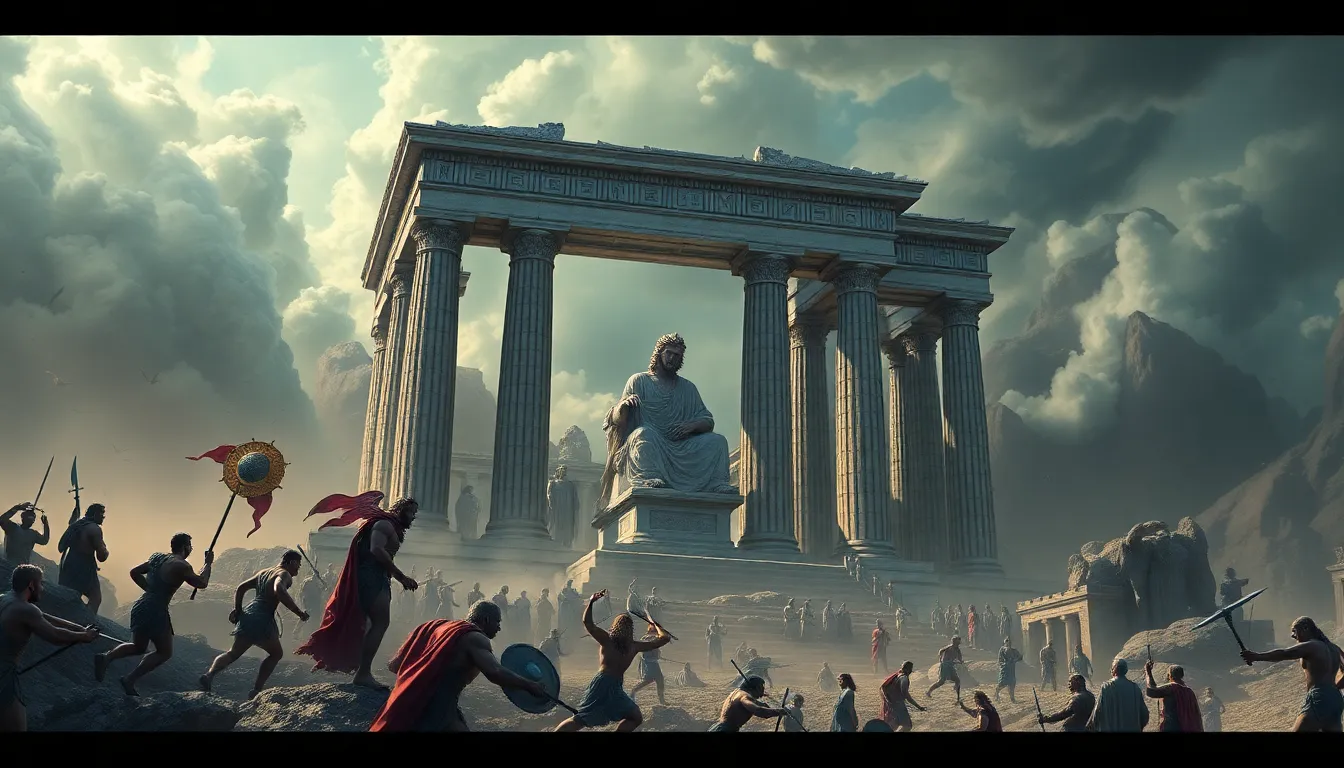
The Titanomachy: The Battle for the Throne of Olympus
I. Introduction
The Titanomachy refers to the legendary ten-year conflict between the Titans, the elder gods, and the Olympians, the younger generation of gods led by Zeus. This monumental clash not only determined the rulers of the cosmos but also set the stage for the mythological narratives that would shape Greek culture and religion.
Significant in Greek mythology, the Titanomachy illustrates the themes of power, rebellion, and the cyclical nature of authority. It is a foundational story that explains the transition from the primordial era of the Titans to the more familiar age of the Olympian gods. This article delves into the origins of the Titans, the rise of Zeus and his allies, the epic battles, and the cultural representations of this legendary conflict.
II. The Titans: Rulers Before the Gods
The Titans were the original deities in Greek mythology, born from the primordial beings Gaia (Earth) and Uranus (Sky). They were powerful entities, each embodying various aspects of the cosmos and nature.
Key figures among the Titans include:
- Cronus
- Rhea
- Oceanus
- Tethys
- Hyperion
- Theia
– The leader of the Titans and god of time, who overthrew his father Uranus.
– Sister and wife of Cronus, associated with fertility and motherhood.
– The Titan of the ocean, representing the vast waters that encircle the world.
– Sister of Oceanus and goddess of the nourishing flow of fresh water.
– The Titan of light, representing the sun and heavenly bodies.
– The Titaness of sight and the shining sky, mother of the sun, moon, and dawn.
During their reign, the Titans held dominion over the universe, embodying natural elements and principles. Their influence was vast, but it was marked by a cycle of tyranny and fear, especially under Cronus’s rule.
III. The Rise of Zeus and His Siblings
The backdrop of the Titanomachy begins with Cronus, who, fearing a prophecy that one of his children would overthrow him, swallowed each of his offspring at birth. Rhea, distressed by the loss of her children, devised a plan to save her youngest, Zeus.
She gave birth to Zeus in secret and entrusted him to Gaia, who raised him in a hidden cave on the island of Crete. Meanwhile, Rhea fed Cronus a stone wrapped in swaddling clothes, deceiving him. As Zeus grew, he learned of his siblings—Hera, Poseidon, Hades, Demeter, and Hestia—and the fate that awaited them.
When he reached adulthood, Zeus returned to confront Cronus, administering a potion that forced him to regurgitate his siblings. Together, they began to plot their rebellion against the Titans.
IV. The Spark of Rebellion
With his siblings freed, Zeus awakened their latent power and gathered allies from various corners of the cosmos. Notably, he received crucial support from the Cyclopes and the Hecatoncheires, monstrous beings who would turn the tide of battle.
Gaia, the Earth Mother, played a significant role in the conflict, encouraging Zeus and providing him with vital information about the Titans’ weaknesses. Under her guidance, Zeus and his siblings prepared for the impending war.
The initial skirmishes between the Titans and the Olympians were fierce, showcasing the might of both sides. The Titans, confident in their supremacy, were taken aback by the coordinated efforts of the younger gods and their allies.
V. The Epic Conflict: Battles and Strategies
The Titanomachy was marked by several key battles, each demonstrating the escalating intensity of the conflict.
Significant battles included:
- The Battle of Phlegra
- The Siege of Mount Olympus
- The Final Confrontation
– A fierce confrontation between the Titans and the Olympians, showcasing the raw power and ferocity of both sides.
– The Titans attempted to storm the stronghold of the Olympians, leading to a series of tactical maneuvers by Zeus and his allies.
– A climactic battle where the combined forces of Zeus, his siblings, and their allies clashed with Cronus and the Titans.
Both the Titans and Olympians employed various strategies during the war. The Titans relied on their brute strength and numbers, while Zeus and his allies utilized cunning tactics, quick strikes, and the element of surprise. The Cyclopes provided Zeus with thunderbolts, which became his signature weapon, allowing him to strike down even the mightiest of Titans.
Mythical creatures such as the Centaurs, Satyrs, and other beings also joined the fight, swaying the outcome of battles through their unique abilities and alliances.
VI. The Aftermath of the Titanomachy
The Titanomachy ultimately culminated in the defeat of the Titans. After a prolonged struggle, Zeus and his siblings emerged victorious, leading to the imprisonment of the Titans in Tartarus, a deep abyss beneath the earth, where they would be forever confined.
With the Titans defeated, Zeus established the Olympian order, marking the beginning of a new era in Greek mythology. He became the king of the gods, ruling from Mount Olympus alongside his siblings and other deities.
The impact of the Titanomachy was profound, as it reshaped the divine hierarchy and set the tone for the interactions between gods and mortals. It also introduced themes of justice and retribution, with the Olympians often punishing those who defied them.
VII. Cultural Representations of the Titanomachy
The Titanomachy has been a significant source of inspiration for literature, art, and theater throughout history. Ancient Greek playwrights like Aeschylus and Homer referenced the conflict, weaving it into their narratives and exploring its themes of power and rebellion.
In art, the Titanomachy was depicted in various forms, from pottery to monumental sculptures, showcasing the dramatic battles and the figures involved. Notable representations include:
- Vases and Pottery
- Wall Paintings
- Sculptures
– Illustrations of battles between the Titans and Olympians, often highlighting key figures like Zeus and Cronus.
– Frescoes that depicted the conflict in grand and dynamic forms, capturing the energy of the battles.
– Statues representing the gods engaged in combat, emphasizing their physical prowess and divine power.
Modern interpretations and adaptations of the Titanomachy can be found in literature, film, and games. From Rick Riordan’s “Percy Jackson” series to movies that explore Greek mythology, the themes of the Titanomachy resonate with contemporary audiences, highlighting the struggle for power and the consequences of rebellion.
VIII. Conclusion
In summary, the Titanomachy stands as a pivotal narrative in Greek mythology, symbolizing the struggle for power and the transition from the old order of the Titans to the new regime of the Olympians. Its themes of rebellion, justice, and the cyclical nature of authority continue to resonate throughout history.
The lasting legacy of the Titanomachy is evident not only in ancient texts but also in modern culture, where the battle for supremacy remains a relevant theme. As we reflect on the Titanomachy, we see the enduring human fascination with power dynamics and the consequences of defiance against tyranny.
Ultimately, the Titanomachy is not just a tale of gods and battles; it is a timeless exploration of ambition, family, and the quest for justice in a world governed by divine forces.