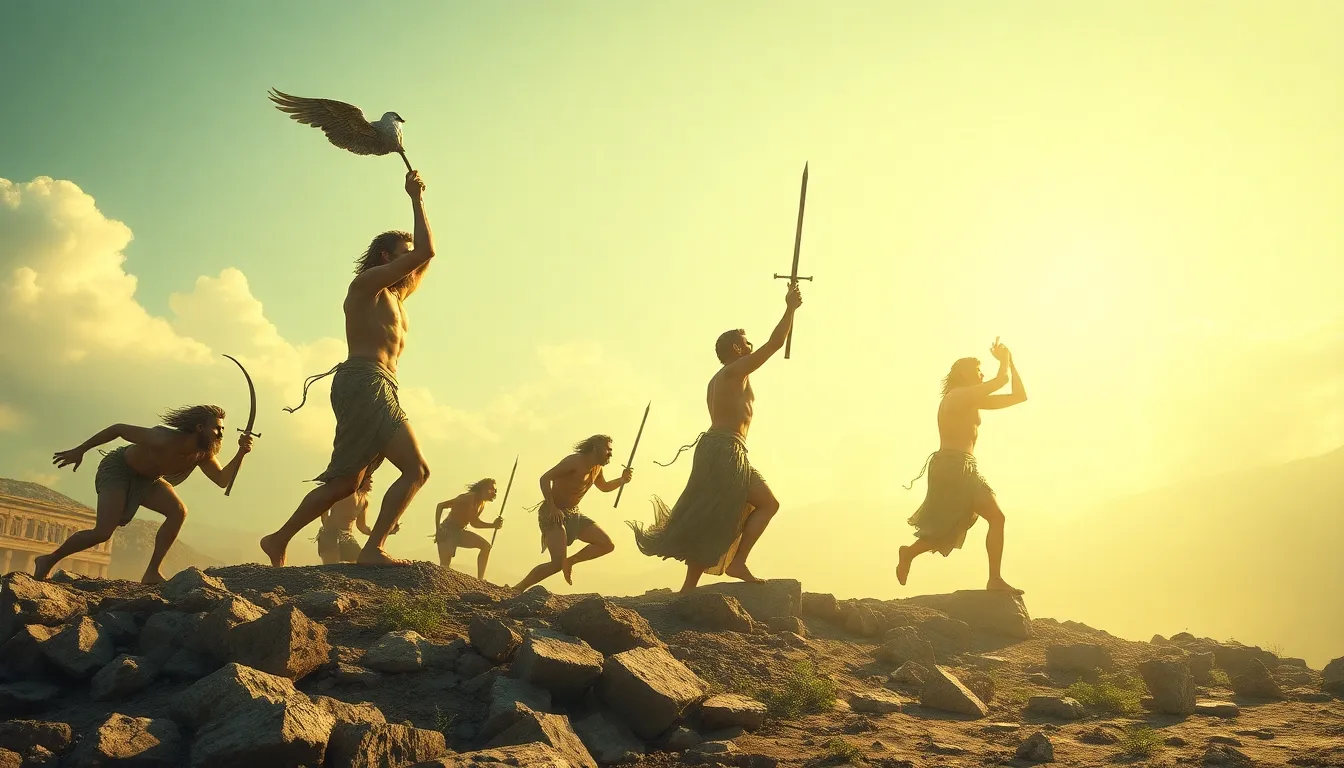
The Titanomachy: The War That Shaped Ancient Greek Beliefs
I. Introduction
The Titanomachy refers to the legendary war between the Titans, the former rulers of the cosmos, and the Olympian gods, who sought to usurp their power. This epic conflict is a cornerstone of ancient Greek mythology and serves as a crucial narrative that shaped the beliefs and values of Greek culture.
Understanding the Titanomachy is essential for grasping not only the mythology itself but also the broader implications it had on ancient Greek views of authority, rebellion, and the nature of divinity. This article will explore the origins, causes, course, and aftermath of the Titanomachy, as well as its impact on ancient Greek culture and its lasting legacy.
II. The Background of the Titanomachy
A. The origins of the Titans and Olympian gods
The Titans were the original divine beings born from Gaia (Earth) and Uranus (Sky). They were powerful entities who ruled during the Golden Age. Notable Titans include:
- Cronus – The leader of the Titans who overthrew his father, Uranus.
- Rhea – The mother of the first generation of Olympians.
- Oceanus – The Titan of the ocean.
- Themis – The Titaness of divine order and law.
In contrast, the Olympian gods, led by Zeus, were the offspring of Cronus and Rhea. After Cronus swallowed his children to prevent them from overthrowing him, Rhea saved Zeus, who later led the revolt against the Titans.
B. Key figures involved in the conflict
The primary figures in the Titanomachy include:
- Zeus – The chief deity and leader of the Olympians.
- Cronus – The Titan ruler and father of Zeus.
- Rhea – The mother of the Olympians, who aided Zeus.
- Prometheus – A Titan who sided with the Olympians.
- Atlas – A Titan who was punished by Zeus to hold up the sky.
C. The setting and context of the war
The Titanomachy took place in a mythological time when the universe was still in chaos. The battle was not just a physical confrontation but a cosmic struggle for order and governance of the universe. It unfolded across various locations, including Mount Olympus, where the Olympians gathered, and the plains of Thessaly, where the battles raged.
III. The Causes of the Titanomachy
A. The role of prophecy and fate
Prophecy played a significant role in the events leading to the Titanomachy. A prophecy foretold that Cronus would be overthrown by one of his children. This fear drove Cronus to take drastic measures, ultimately leading to the birth of Zeus and the subsequent rebellion.
B. Power struggles among the divine
The Titanomachy was fueled by a desire for power among the divine beings. As the Titans had ruled for ages, the emergence of the Olympians represented a new order that sought to challenge the established authority. This power struggle was emblematic of a larger theme in Greek mythology: the cyclical nature of power and the inevitability of change.
C. The significance of rebellion against authority
The war symbolizes the theme of rebellion against tyranny. Zeus, as the embodiment of the new generation, represented resistance against the oppressive rule of Cronus. This theme resonated with ancient Greek society, where the notion of challenging unjust rulers was a prevalent idea.
IV. The Course of the War
A. Major battles and strategies employed
The Titanomachy lasted for a decade and was marked by numerous battles. Zeus and his allies employed various strategies, including:
- Forming alliances with other deities, such as the Cyclopes and the Hecatoncheires, who provided powerful weapons.
- Using cunning and strategy to outmaneuver the Titans on the battlefield.
- Exploiting the Titans’ weaknesses, such as their overconfidence and lack of unity.
B. Key events and turning points in the conflict
Several pivotal moments defined the course of the Titanomachy:
- The release of the Cyclopes and Hecatoncheires from Tartarus, who aided Zeus with their formidable strength and weaponry.
- The battle at Mount Olympus, where the Olympians first clashed with the Titans.
- The final confrontation, where Zeus unleashed his thunderbolts, leading to the Titans’ defeat.
C. The role of allies and divine intervention
Throughout the Titanomachy, divine intervention played a critical role. The Olympians received assistance from:
- The Cyclopes, who forged Zeus’s iconic thunderbolt.
- The Hecatoncheires, colossal beings who hurled boulders at the Titans.
- Prometheus and Epimetheus, who sided with Zeus and provided counsel.
V. The Aftermath and Consequences
A. The defeat of the Titans and the rise of the Olympians
The Titanomachy culminated in the defeat of the Titans, who were cast into Tartarus, a deep abyss used as a dungeon of torment. This victory marked the ascension of the Olympian gods to power, establishing a new order in the cosmos.
B. Changes in the divine order and governance of the cosmos
With the Olympians in control, the governance of the universe shifted significantly. Zeus became the supreme ruler, and each Olympian was assigned a specific domain, such as:
- Poseidon – God of the sea.
- Hades – God of the underworld.
- Hera – Goddess of marriage and family.
- Athena – Goddess of wisdom and warfare.
C. Impact on the relationship between gods and mortals
The Titanomachy fundamentally altered the relationship between gods and mortals. The Olympians, having established their power through struggle, became more relatable figures. This shift fostered a belief in the power of individual agency and the possibility of change, influencing how mortals viewed their relationship with the divine.
VI. Titanomachy in Ancient Greek Culture
A. Depictions in art and literature
The Titanomachy inspired countless works of art and literature in ancient Greece. Notable representations include:
- Literary references in Hesiod’s “Theogony,” which provides a detailed account of the conflict.
- Vases and pottery depicting scenes from the Titanomachy, showcasing the dramatic battles and key figures.
- Statues and sculptures that celebrate the triumph of the Olympians over the Titans.
B. Influence on religious practices and rituals
The Titanomachy influenced various religious practices in ancient Greece. Festivals honoring the Olympian gods often referenced the themes of the Titanomachy, celebrating their victory and reinforcing their authority. Rituals included:
- Festivals such as the Panathenaea, dedicated to Athena.
- Sacrifices to Zeus and other Olympians, thanking them for their protection.
- Dramatic performances that reenacted the myths surrounding the Titanomachy.
C. The Titanomachy in the context of Greek identity
The Titanomachy contributed significantly to the Greek sense of identity. The conflict embodied the ideals of strength, resilience, and the triumph of order over chaos, which resonated with the values of Greek society. It provided a mythological framework through which Greeks understood their