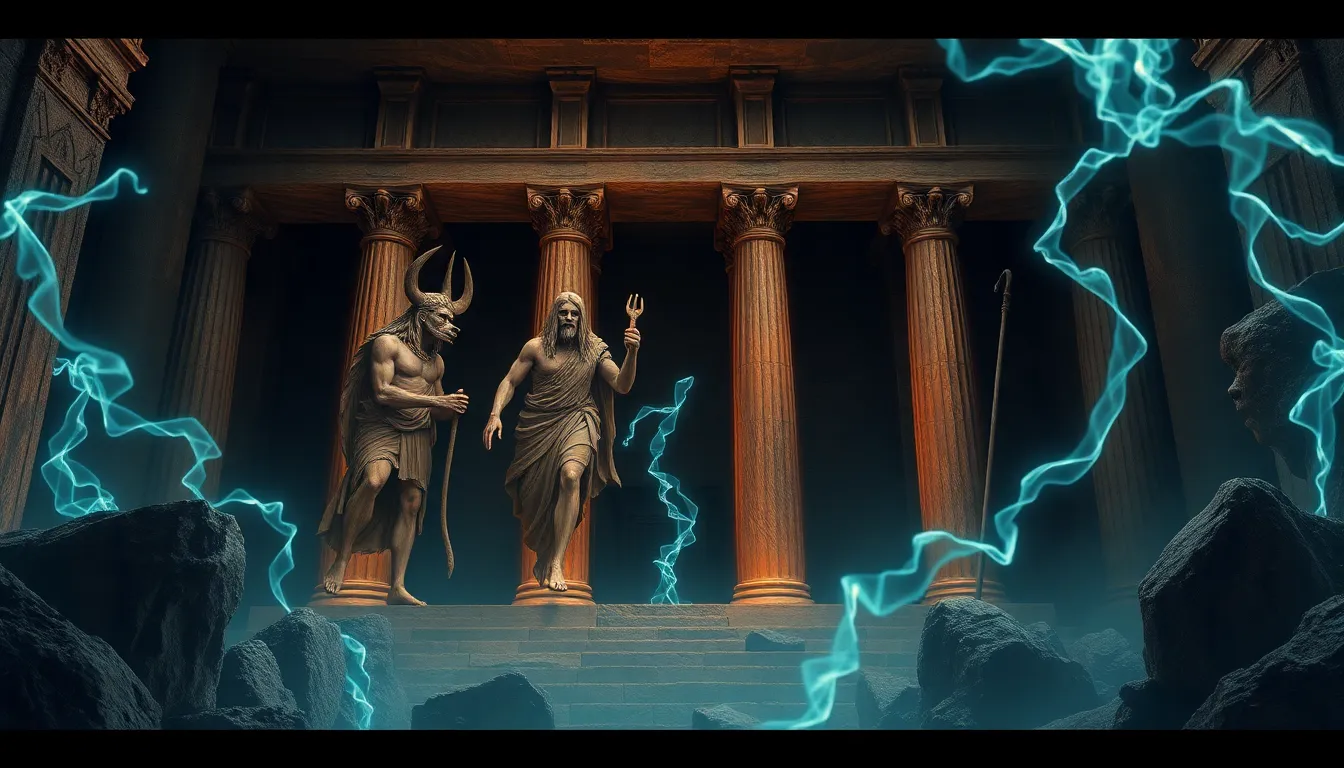
The Chthonic Deities of Tartarus: Who Ruled the Underworld?
I. Introduction to Chthonic Deities
In ancient Greek mythology, chthonic deities represent the spirits and gods associated with the underworld and the earth. The term “chthonic” derives from the Greek word “chthon,” meaning “earth” or “ground.” These deities were significant in understanding life, death, and the afterlife, as they governed the realms below the surface of the earth.
Tartarus, often depicted as a deep abyss used as a dungeon of torment for the wicked and a place of punishment, plays a crucial role within the Greek Underworld. It is distinct from Hades, the realm of the dead, and serves as a prison for the Titans and other malevolent beings. This article explores the nature of Tartarus and the prominent chthonic deities who ruled this dark and enigmatic realm.
II. The Nature of Tartarus
Tartarus is often portrayed in Greek mythology as a place far beneath the earth, even deeper than Hades. It is described as a primordial void, a dark pit where the worst offenders are punished. In contrast to Hades, which is more of a final resting place for souls, Tartarus serves as a place of eternal suffering.
The distinction between Tartarus and Hades is crucial for understanding the ancient Greek perception of the afterlife:
- Tartarus: A deep abyss primarily for punishment and containment of evil beings.
- Hades: A realm where the souls of the deceased reside, governed by Hades himself.
Culturally, the Greeks viewed Tartarus as a necessary balance to justice, where wrongdoers faced consequences for their actions in life. This belief underscored the importance of moral behavior and the consequences of sin, shaping their values and societal norms.
III. Key Chthonic Deities Associated with Tartarus
Hades: The God of the Underworld
Hades, the brother of Zeus and Poseidon, is the chief deity of the Underworld. He presides over the dead and is often depicted with a solemn demeanor, reflecting his role as the ruler of a realm that most mortals feared. Hades is responsible for ensuring that the dead do not escape and maintaining order within his domain.
His primary responsibilities include:
- Overseeing the souls of the deceased.
- Determining the fate of souls in the afterlife.
- Guarding the entrance to the Underworld, ensuring that no living being may enter without permission.
Persephone: The Queen of the Underworld
Persephone, the daughter of Demeter, is the queen of the Underworld and wife of Hades. Her dual nature embodies the seasonal cycle, as she spends part of the year with her mother on earth and part in the underworld with Hades. This duality symbolizes the connection between life and death, growth and decay.
Her significance includes:
- Representing the fertility of the earth and the changing seasons.
- Serving as a bridge between the living and the dead.
- Embodying the theme of sacrifice and rebirth.
Thanatos: The Personification of Death
Thanatos is the personification of death in Greek mythology. Often depicted as a winged youth, he represents the peaceful aspect of death, contrasting with more violent forms of demise. Thanatos is responsible for guiding souls to the afterlife, ensuring a smooth transition from the mortal realm.
His attributes and impact include:
- Symbolizing the inevitability of death.
- Playing a role in myths where heroes confront their mortality.
- Being a figure of compassion, as he delivers souls gently to their final resting place.
IV. Lesser-Known Chthonic Figures
Hecate: The Goddess of Magic and the Underworld
Hecate is a complex and multifaceted goddess associated with magic, witchcraft, and the night. She is often depicted holding torches, illuminating the darkness. Hecate’s role in the underworld is significant, as she is believed to guide lost souls and protect those who seek to communicate with the dead.
Her associations include:
- Being a guardian of the threshold between life and death.
- Her connection to ghosts and the supernatural.
- Symbolizing the power of transformation and knowledge.
Charon: The Ferryman of the Underworld
Charon is the grim ferryman who transports souls across the River Styx to the Underworld. He is often depicted as an old man with a stern demeanor, requiring payment for his services, typically in the form of an obol, a small coin placed in the mouth of the deceased.
Charon’s role includes:
- Ensuring that only those who have received proper burial rites can cross into the afterlife.
- Being a symbol of the transition from life to death.
- Representing the inevitability of facing one’s fate.
The Erinyes (Furies): Avenging Spirits
The Erinyes, also known as the Furies, are fierce avenging spirits who pursue wrongdoers, particularly those who have committed grave offenses such as murder or betrayal. They are often depicted as women with snakes for hair, embodying the wrath of the wronged.
Their duties include:
- Punishing the guilty in the afterlife.
- Serving as a reminder of the consequences of moral transgressions.
- Restoring balance and justice in the universe.
V. The Role of Titans in Tartarus
The Titans, the pre-Olympian gods, were overthrown by Zeus and his siblings in a great war known as the Titanomachy. As punishment for their rebellion, many Titans were imprisoned in Tartarus, where they faced eternal torment. This punishment reflects the mythological hierarchy and the consequences of defying the gods.
Key figures among the Titans include:
- Cronus: The leader of the Titans and father of Zeus, who was imprisoned for attempting to consume his children.
- Atlas: Condemned to hold up the sky, he symbolizes the burden of eternal punishment.
The presence of the Titans in Tartarus serves as a warning about the dangers of hubris and the importance of respecting the divine order.
VI. Myths and Legends Surrounding Tartarus
Numerous myths illustrate the functions and significance of chthonic deities associated with Tartarus. One of the most notable myths is that of Orpheus and Eurydice, where Orpheus descends into the underworld to retrieve his beloved. His encounter with Hades and Persephone highlights themes of love, loss, and the power of music.
Another prominent tale involves Heracles (Hercules), who descends into the Underworld to capture Cerberus, the three-headed dog guarding the gates of Hades. This myth emphasizes the hero’s bravery and the challenges faced when confronting death.
These stories illustrate the complex relationships between mortals and the chthonic deities, revealing the intricate beliefs surrounding death and the afterlife in ancient Greece.
VII. The Influence of Chthonic Deities in Modern Culture
The themes of chthonic deities and the underworld continue to resonate in modern culture, influencing literature, film, and art. Works such as:
- The Divine Comedy by Dante Alighieri, which explores the afterlife.
- Movies like “Hercules” and “What Dreams May Come,” which depict journeys through the underworld.
- Artworks inspired by Hades and Persephone, illustrating their mythological narratives.
These representations reflect the enduring fascination with themes of death, the afterlife, and the moral implications of human actions.
VIII. Conclusion
The chthonic deities of Tartarus play a vital role in understanding ancient Greek beliefs about death and the afterlife. They embody the complexities of human