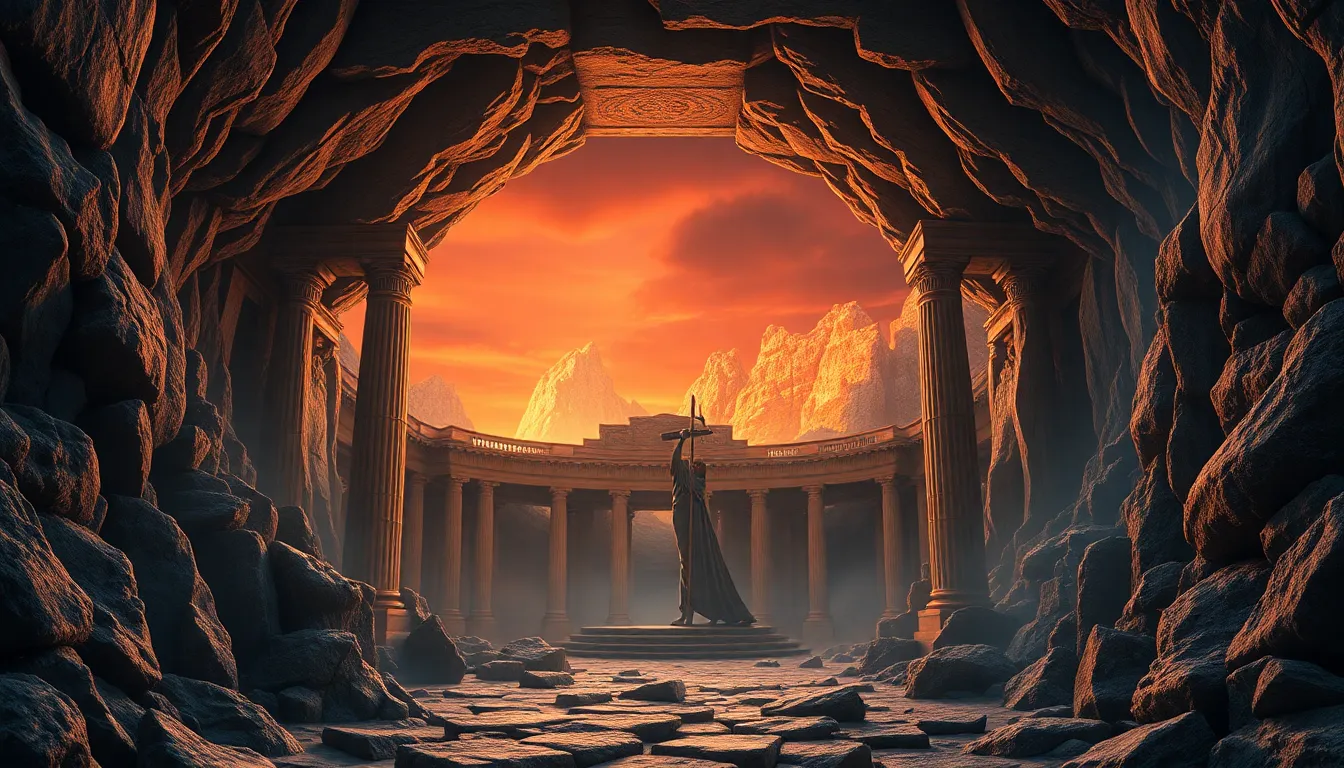
The Myths and Realities of Tartarus: An Ancient Perspective
I. Introduction
Tartarus, in Greek mythology, is often depicted as a deep abyss that serves as a dungeon of torment for the wicked and a prison for the Titans. While many may think of Tartarus simply as a place of punishment, its significance extends far beyond that simplistic view.
In ancient Greek culture, Tartarus held a critical role as both a physical location and a symbolic representation of justice, chaos, and the consequences of moral failings. This article aims to explore the myths surrounding Tartarus, examine its realities, and highlight its enduring influence on both ancient and modern interpretations.
II. Historical Context of Tartarus
The origins of Tartarus can be traced back to early Greek literature, where it is mentioned as a distinct part of the cosmos. Understanding its historical context allows us to appreciate the complexities of this mythological construct.
A. Origins of the concept in ancient texts
References to Tartarus appear in several ancient texts, indicating its long-standing presence in Greek mythology. The term itself is often associated with the primordial chaos that existed before the creation of the world.
B. Tartarus in Hesiod’s “Theogony”
Hesiod, in his work “Theogony,” describes Tartarus as a place located far beneath the earth, deeper than Hades. It is portrayed as a dark and gloomy region reserved for the punishment of the most heinous offenders, such as the Titans who rebelled against the Olympian gods.
C. Evolution of Tartarus in later Greek literature
As Greek literature evolved, so too did the concept of Tartarus. Later writers expanded its narrative, integrating it into various myths and legends. By the time of Plato and later philosophers, Tartarus began to take on more philosophical dimensions, often associated with the soul’s journey and moral consequences.
III. Tartarus vs. Hades: Understanding the Distinctions
One of the common misconceptions about Greek mythology is the equivalence of Tartarus and Hades. While both are part of the underworld, they serve distinct purposes and functions.
A. Overview of the Greek underworld
The Greek underworld is a complex realm encompassing various regions, each with its own characteristics. Hades is the more general term for the land of the dead, while Tartarus is a specific area within this realm.
B. Roles and functions of Tartarus and Hades
- Hades: Primarily serves as the abode of the deceased, where souls reside after death. It is overseen by Hades, the god of the underworld.
- Tartarus: Functions as a place of punishment for the wicked and a prison for those who have committed grave offenses against the gods.
C. Common misconceptions about their equivalence
Many people mistakenly conflate Tartarus with Hades, viewing them as interchangeable. However, while Hades encompasses all souls, Tartarus is specifically meant for the punishment of the irredeemable.
IV. The Nature of Punishment in Tartarus
The punishments inflicted upon those sent to Tartarus are some of the most vivid and haunting images in Greek mythology. Ancient sources provide detailed accounts of the fates that befell these individuals.
A. Descriptions of punishment in ancient sources
In Tartarus, the punishments are often eternal and serve as a reflection of the individual’s sins during their lifetime. The imagery used in these descriptions is both striking and thought-provoking, emphasizing the moral lessons intended by the myth.
B. Notable figures punished in Tartarus
- Tantalus: Condemned to stand in a pool of water beneath a fruit tree, forever reaching for food and drink that elude him.
- Sisyphus: Forced to roll a boulder up a hill, only for it to roll back down each time he reaches the top.
- Ixion: Bound to a fiery wheel for eternity as punishment for his transgressions against the gods.
C. The moral and philosophical implications of these punishments
The punishments in Tartarus serve as cautionary tales, illustrating the consequences of hubris, deceit, and betrayal. They reflect ancient Greek values regarding justice, morality, and the importance of honoring the gods.
V. Tartarus as a Place of Containment
Beyond its role as a punisher of the wicked, Tartarus also serves as a prison for the Titans and other entities that threatened the order of the cosmos.
A. The role of Tartarus as a prison for Titans
After their defeat in the Titanomachy, the Titans were cast into Tartarus, where they were contained and prevented from further rebellion against the Olympian gods. This aspect of Tartarus highlights its function as a place of containment and order within the universe.
B. The significance of containment in ancient mythology
Containment in mythology often symbolizes the imposition of order over chaos. By imprisoning the Titans, the gods established a clear hierarchy and maintained balance in the world.
C. Comparisons with other mythological prisons
Other mythologies also feature similar concepts of containment:
- Norse Hel: A realm for those who did not die a heroic death, ruled by the goddess Hel.
- Christian Hell: A place of eternal torment for the wicked, serving a similar function to Tartarus.
VI. Tartarus in Modern Interpretations and Popular Culture
In contemporary culture, Tartarus has been reimagined and adapted in various forms, from literature to film and video games, reflecting its enduring legacy.
A. Adaptations in literature, film, and video games
Tartarus appears in numerous modern works, often drawing on its themes of punishment and moral consequence:
- Books: Novels like “Percy Jackson & The Olympians” introduce Tartarus to a new generation, blending mythology with accessible storytelling.
- Films: Movies portraying the underworld often depict Tartarus as a dark and foreboding place.
- Video Games: Games such as “Hades” allow players to engage with the mythological landscape of Tartarus directly.
B. The shift in perception of Tartarus in contemporary culture
Modern interpretations often focus less on punishment and more on the psychological and existential implications of Tartarus. This reflects a broader cultural shift towards understanding suffering as part of the human experience.
C. How modern interpretations reflect ancient beliefs
Despite the changes in portrayal, the core themes of Tartarus—justice, consequence, and the struggle between order and chaos—remain relevant. These elements resonate with contemporary audiences, demonstrating the enduring nature of these ancient myths.
VII. Mythological Significance and Symbolism of Tartarus
Tartarus is rich in symbolism, representing not only punishment but also the chaotic forces that exist within the cosmos.
A. Tartarus as a symbol of chaos and disorder
In Greek mythology, Tartarus embodies the chaotic elements of existence that must be contained to maintain order. It serves as a reminder of the thin line between civilization and chaos.
B. Connections to ancient Greek views on justice and morality
Tartarus reflects the ancient Greeks’ understanding of justice, where wrongdoings must be met with appropriate consequences. The myths surrounding Tartarus highlight the importance of moral integrity and the repercussions of failing to uphold it.
C. The role of myth in understanding human nature and consequences
Myths like those of Tartarus provide valuable insights into human nature, illustrating how actions have consequences, both in life and in