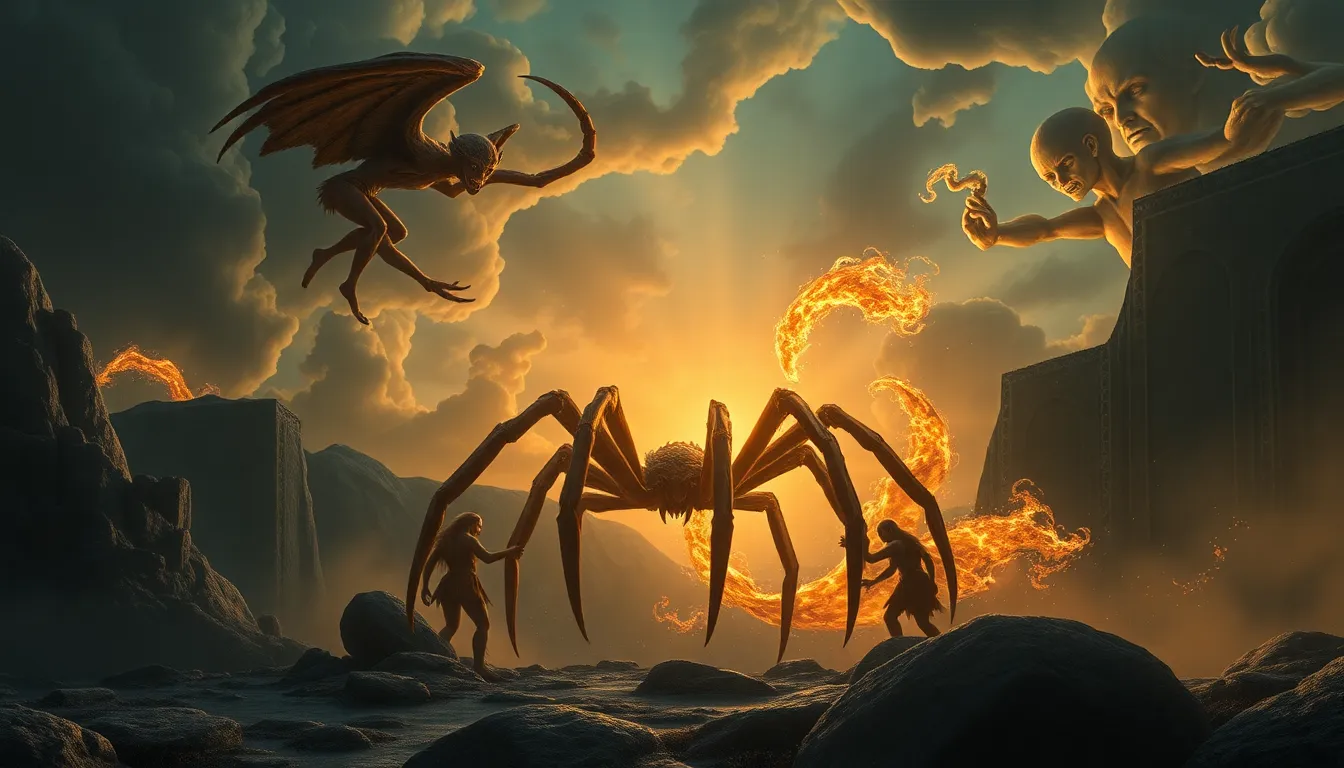
The Role of Tartarus in the Myths of Arachne
I. Introduction
Arachne, a character in Greek mythology, is best known for her extraordinary skills in weaving and her tragic tale that unfolds in the face of divine challenge. As a mortal, Arachne’s exceptional talent leads her to challenge the goddess Athena, resulting in a narrative rich with themes of hubris, consequence, and transformation.
Tartarus, on the other hand, is a crucial element of Greek mythological narratives, representing a deep abyss used as a dungeon of torment and suffering for the wicked. It also serves as a place of punishment for those who defy the gods. This article seeks to explore the intricate connection between Arachne and Tartarus, delving into how Arachne’s story reflects the moral and artistic consequences of hubris and defiance against divine authority.
II. Arachne: The Weaver and Her Hubris
Arachne was a talented mortal weaver, renowned for her unmatched skills. Her tapestries were so exquisite that they rivaled the very creations of the goddess Athena, the divinity of wisdom and craftsmanship. Arachne’s pride in her abilities led her to boast that she was superior to Athena herself.
The tale takes a pivotal turn when Arachne, intoxicated by her hubris, challenges Athena to a weaving contest. This act of defiance against a goddess is significant, as it reflects the ancient Greek belief in the dangers of excessive pride and self-confidence, known as ‘hubris.’
Upon accepting the challenge, the two engaged in a contest that showcased their remarkable abilities. Arachne’s tapestry depicted the flaws and failures of the gods, illustrating her boldness and defiance. However, Athena’s work portrayed the glory and power of the Olympians. The implications of this contest were profound, as Arachne’s hubris directly led to her downfall.
The consequences of defying the gods were severe. After witnessing Arachne’s audacity and the content of her tapestry, Athena became enraged. In her fury, Athena destroyed Arachne’s work and subsequently punished her severely, demonstrating the severe repercussions of hubris in Greek mythology.
III. The Nature of Tartarus
Tartarus is defined in Greek mythology as a primordial deity and a deep abyss that lies beneath the Underworld. It is often depicted as a place of punishment for the wicked and a prison for the Titans. The characteristics of Tartarus are stark; it is described as a shadowy, dark pit, far removed from the light, and a realm of suffering and retribution.
In comparison to other realms, such as the Underworld where souls are judged, Tartarus serves a more specific function as a place of torment. While the Underworld houses the souls of the deceased, Tartarus is reserved for those who have committed egregious acts against the gods, reflecting their hubris and arrogance.
The symbolism of Tartarus extends beyond mere punishment; it represents a fundamental aspect of justice in Greek mythology. It embodies the idea that the consequences of one’s actions will eventually catch up to them, serving as a deterrent against pride and disobedience.
IV. Arachne’s Transformation and Punishment
The outcome of Arachne’s contest with Athena was far from favorable. After losing the competition, Arachne, in despair and humiliation, took her own life. However, Athena, moved by Arachne’s tragic end, transformed her into a spider instead of condemning her to Tartarus. This transformation symbolizes the intertwining of creativity and the consequences of hubris.
Arachne’s metamorphosis into a spider is not merely a punishment but also a form of empowerment. In her new form, she embodies the essence of weaving, continuing her passion for artistry. However, it also reflects the consequences of her hubris, as she is forever bound to live in the shadows, spinning webs, yet never achieving the recognition she once sought.
Though Arachne was spared the torment of Tartarus, her story still echoes the implications of punishment. The transformation into a spider serves as a reminder of the thin line between artistry and consequence, with Tartarus lurking as a looming threat for those who dare to challenge the gods.
V. Thematic Connections Between Arachne and Tartarus
The themes of hubris and divine retribution are central to Arachne’s narrative. Arachne’s pride leads her to challenge the goddess, an act that ultimately results in her downfall. This reflects a recurring theme in Greek mythology: the consequences of defiance against the divine, where mortals must face the repercussions of their actions.
The relationship between artistry, creativity, and consequence is also pivotal. Arachne’s story illustrates the fine balance between ambition and humility. While her skills are admirable, her refusal to acknowledge the gods’ superiority brings about her tragic fate.
Moreover, Arachne’s story serves as a cautionary tale about the moral implications of challenging the gods. It emphasizes the idea that while creativity and ambition are commendable, they must be pursued with respect for divine order and acknowledgment of one’s place in the universe.
VI. Tartarus as a Symbol of Artistic Struggle
Arachne’s punishment can be interpreted as a critique of artistic ambition. The notion that great art comes at a cost is prevalent in many myths, and Arachne’s tale embodies this struggle. The suffering she endures, both as a mortal and as a transformed spider, reflects the sacrifices artists often make in the pursuit of their craft.
The cyclical nature of creation and destruction is another theme evident in Arachne’s transformation. The act of weaving is both creative and destructive; it requires the unmaking of threads to create something new. Similarly, Arachne’s journey illustrates how ambition can lead to both creation and ruin, mirroring the artistic process that often involves trials and tribulations.
VII. Modern Interpretations of Arachne and Tartarus
The myth of Arachne continues to influence contemporary art and literature. Many modern artists and writers draw upon her story as a source of inspiration, exploring themes of empowerment, creativity, and the consequences of ambition. Arachne is often seen as a symbol of resilience, representing the struggle against oppressive forces and the pursuit of artistic freedom.
Furthermore, Tartarus remains relevant in modern discussions of justice and consequence. The idea that actions have repercussions resonates in contemporary society, where accountability is increasingly emphasized. Tartarus serves as a metaphor for the moral and ethical dilemmas faced by individuals and societies alike.
Arachne’s narrative has also been embraced within feminist discourse, symbolizing the fight against patriarchal norms that stifle women’s voices in the arts. Her story encourages artists, especially women, to assert their creativity and challenge the status quo, reflecting the ongoing struggle for artistic and personal empowerment.
VIII. Conclusion
In conclusion, the significance of Tartarus in Arachne’s myth cannot be overstated. It serves as a powerful symbol of the consequences of hubris and the moral implications of challenging divine authority. Arachne’s story is a reminder of the delicate balance between creativity and accountability, urging us to reflect on our own ambitions and the potential repercussions of our actions.
The enduring legacy of Arachne and Tartarus in cultural narratives speaks to the timeless nature of these themes, resonating across generations. As we navigate our own lives, let us consider the relationship between creativity and accountability, striving to create with humility and respect for the forces that shape our existence.