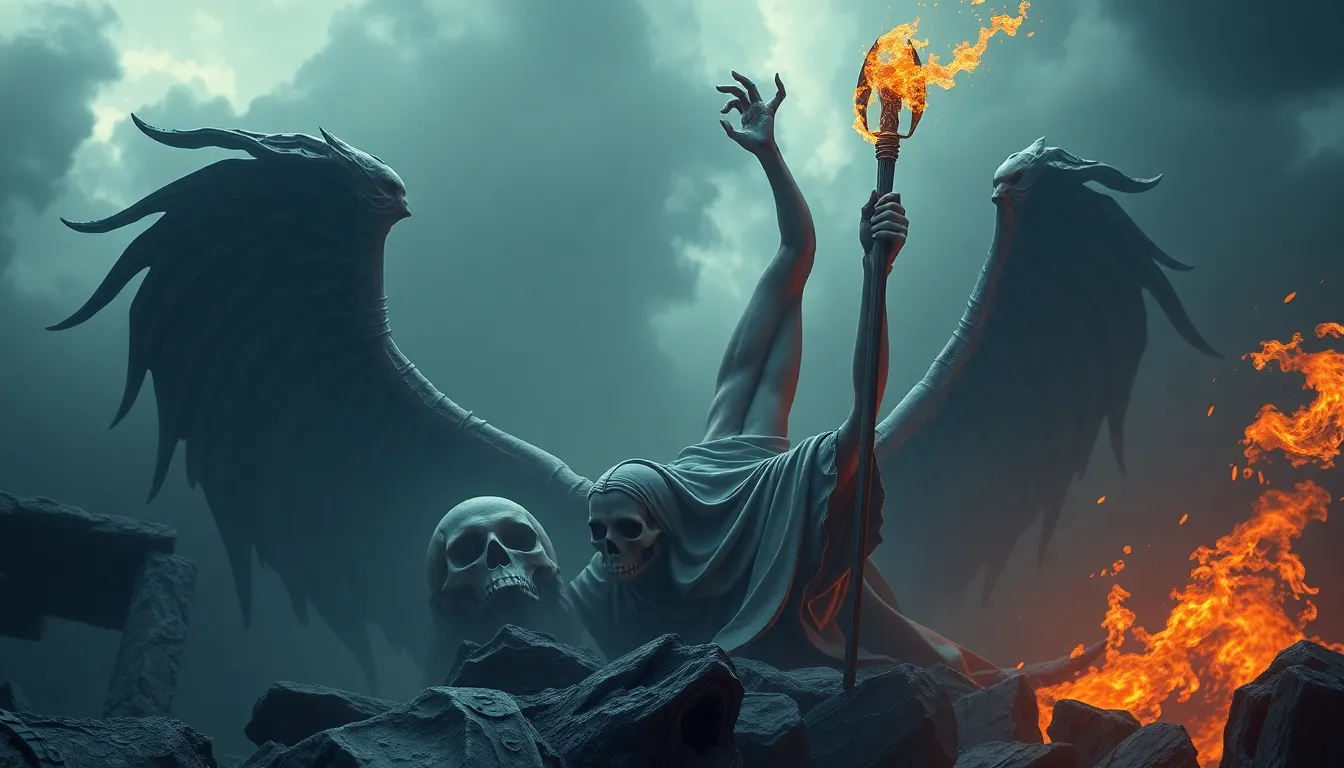
Hades: The God Who Rules the Dead Yet Desires Life
I. Introduction
Hades is one of the most enigmatic figures in Greek mythology. Often mischaracterized as merely the god of the dead, Hades embodies a rich and complex character that transcends the simple notion of death. He presides over the underworld, but he is also deeply intertwined with the themes of life, fertility, and transformation. This article aims to delve into the multifaceted nature of Hades, exploring his role as both ruler of the dead and as a deity who symbolizes life and renewal.
II. The Role of Hades in Greek Mythology
Hades, the son of Cronus and Rhea, is one of the three siblings who divided the cosmos after the defeat of their father. While Zeus took the sky and Poseidon claimed the sea, Hades became the ruler of the underworld, a domain that was as vital to the Greek understanding of existence as the realms of the living.
A. Origins and lineage of Hades
- Son of Cronus and Rhea
- Younger brother of Zeus and Poseidon
- Part of the original Twelve Olympian gods
B. Responsibilities as the god of the underworld
As the god of the underworld, Hades was responsible for overseeing the dead and ensuring that the souls of the departed were properly judged and assigned to their eternal resting places. His role was crucial in maintaining the balance between life and death.
C. Comparison with other Olympian gods
Unlike his brothers, Hades was not typically associated with the vibrant aspects of life and celebration. Instead, he often represented the somber realities of existence. While Zeus ruled with authority and Poseidon controlled the tempestuous seas, Hades maintained order in the shadowy depths of the underworld, often misunderstood by mortals.
III. Hades’ Domain: The Underworld
The underworld, known in Greek mythology as Hades, is a complex realm filled with various regions and inhabitants. It is not merely a place of torment; rather, it is a vital part of the cycle of life and death.
A. Description of the underworld: its regions and inhabitants
- Elysium: A paradise for the virtuous, where heroes and the righteous enjoy eternal bliss.
- Tartarus: A deep abyss used as a dungeon of torment for the wicked.
- The Asphodel Meadows: A neutral zone for those who lived average lives, where souls wander in a fog.
B. The significance of the River Styx and other features
The River Styx is one of the most iconic features of the underworld. It acts as a boundary between the world of the living and the dead. Souls are ferried across the Styx by Charon, the boatman, requiring the payment of an obol, a small coin placed in the mouth of the deceased. This practice underscores the importance of proper burial rites in ancient Greece.
C. Hades’ role in the judgment of souls
Hades is not merely a passive ruler but an active participant in the judgment of souls. Upon arrival in the underworld, souls are judged by three judges: Minos, Rhadamanthus, and Aeacus. Their decisions determine the fate of the souls, sending them either to Elysium, the Asphodel Meadows, or Tartarus.
IV. The Symbolism of Death and Life
In Greek mythology, death is often viewed as a natural part of the life cycle, and Hades embodies this duality. He represents both the end and the beginning, illustrating how death can lead to new life.
A. Death as a natural part of the cycle of life
Hades teaches us that death is not something to be feared but rather embraced as a necessary transition. This perspective encourages acceptance of mortality, highlighting that life and death are interconnected.
B. Hades’ association with fertility and agriculture
Interestingly, Hades is also associated with fertility and the growth of crops. This connection is often overlooked, yet it’s essential to understand his role in the life-giving aspects of nature. The earth’s fertility is tied to the cycle of life and death, with the dying of plants in winter leading to rebirth in spring.
C. Myths highlighting the life-giving aspects of Hades
Several myths illustrate this connection, notably the story of Persephone, who, upon eating the pomegranate seeds in the underworld, establishes the cycle of seasons. Her dual existence as both a queen of the underworld and a goddess of spring reinforces the theme of life arising from death.
V. The Myth of Persephone: Love and Transformation
The abduction of Persephone by Hades is one of the most significant myths in Greek mythology, revealing the complexities of Hades’ character and his relationship with life and death.
A. The abduction of Persephone and its implications
When Hades abducts Persephone to be his queen, it signifies not only a desire for companionship but also highlights the tension between life and death. This myth raises questions about consent, love, and the nature of transformation.
B. The seasonal cycle and its connection to Hades’ duality
The myth of Persephone provides a framework for understanding the seasons. Her descent into the underworld marks the onset of winter, while her return signifies the arrival of spring. This cycle illustrates Hades’ role not just as the god of the dead but also as a catalyst for life.
C. Exploration of love, desire, and compromise
The relationship between Hades and Persephone is a complex interplay of love and desire. It challenges the traditional notion of power dynamics in relationships, showcasing that even figures associated with darkness can embody love and compassion.
VI. Hades in Literature and Popular Culture
Throughout history, Hades has been represented in various forms of literature and culture, shaping our understanding of his character.
A. Representation in ancient texts: Homer, Hesiod, and others
Hades appears in various ancient texts, including the works of Homer and Hesiod. In these texts, he is often described as stern but fair, a necessary force in the balance of life and death.
B. Modern adaptations: films, books, and video games
- Films: Hades is often depicted as a villain in animated films like Disney’s “Hercules,” which simplifies his character.
- Books: Novels such as “Persephone” by Sally O. Lee explore his romantic side.
- Video Games: In games like “Hades,” he is portrayed with depth, showcasing his complexities and relationships.
C. The evolving perception of Hades in contemporary society
Today, Hades is often reinterpreted in modern culture, moving away from the traditional portrayal of a malevolent figure. Instead, he is increasingly seen as a complex deity who embodies the balance between life and death, highlighting the importance of understanding mortality.
VII. The Psychological Interpretation of Hades
Beyond mythology, Hades can be interpreted psychologically, representing aspects of the human psyche that confront our fears and desires.
A. Hades as a symbol of the subconscious and the unknown
Hades represents the subconscious mind, the parts of ourselves that we often fear or avoid. He invites us to explore the unknown aspects of our psyche, encouraging self-discovery and acceptance of our darker sides.
B. The balance between fear of death and the desire for life
The figure of Hades embodies the tension between the fear of death and the desire for life, teaching us that both are necessary for a complete understanding of existence. This duality invites reflection on how we approach our own mortality.
C. Lessons that Hades teaches about acceptance and transformation
Ultimately, Hades teaches us valuable lessons about acceptance and transformation. By embracing the inevitability of death, we can appreciate life more fully, understanding that endings often lead to new beginnings.
VIII. Conclusion
In conclusion, Hades is a complex and multifaceted deity whose character challenges our perceptions of death and life. His role as the ruler of the underworld