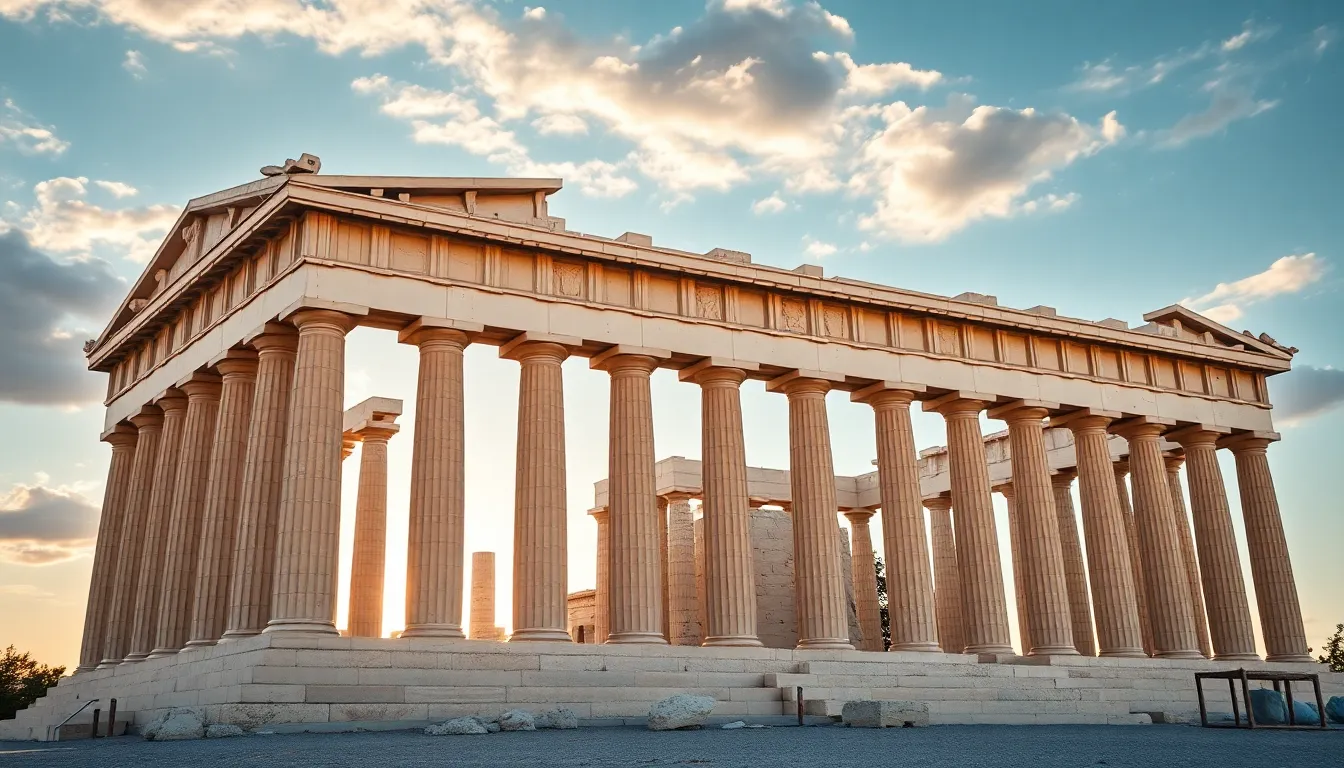
The Parthenon: A Symbol of Ancient Greek Power and Beauty
I. Introduction
The Parthenon, an iconic structure located on the Acropolis of Athens, stands as a testament to the power, artistry, and sophistication of ancient Greek civilization. Built in the 5th century BCE during the height of the Athenian Empire, the Parthenon was dedicated to Athena, the patron goddess of Athens. Its grandeur and beauty have made it a symbol of ancient Greece and a lasting representation of classical architecture and art.
This article aims to explore the historical context, architectural marvel, artistic features, religious significance, and cultural impact of the Parthenon, shedding light on why it continues to captivate the imagination of people around the world.
II. Historical Context of the Parthenon
A. The political landscape of Athens in the 5th century BCE
The 5th century BCE was a transformative period for Athens, marked by the emergence of democracy and the expansion of the Athenian Empire. Under the leadership of statesmen like Pericles, Athens became the cultural and political center of the Greek world. This era, often referred to as the Golden Age of Athens, saw significant advancements in art, philosophy, and architecture.
The political landscape was characterized by a strong sense of civic pride and a collective identity among Athenians, which was reflected in their monumental building projects, including the Parthenon.
B. The role of the Parthenon in the Athenian Empire
The Parthenon served not only as a temple but also as a symbol of Athenian power and wealth. It was constructed using funds from the Delian League, a coalition of Greek city-states led by Athens, which had been established to fend off Persian threats. The Parthenon’s grandeur communicated Athens’ dominance and its role as a leader among Greek city-states.
C. Key figures involved in its construction
- Pericles: The influential statesman who oversaw the construction of the Parthenon as part of a larger project to beautify Athens.
- Phidias: The chief sculptor and artist responsible for the statue of Athena Parthenos and the decorative sculptures of the Parthenon.
- Ictinus and Callicrates: The architects who designed the Parthenon, ensuring that it adhered to the principles of the Doric order.
III. Architectural Marvel of the Parthenon
A. Design and planning: Doric order and proportions
The Parthenon is an exemplary model of the Doric order of classical architecture, characterized by its sturdy columns and simple elegance. The temple is constructed on a rectangular plan, measuring approximately 69.5 meters long and 30.9 meters wide.
The proportions of the Parthenon are particularly noteworthy. The height of the columns and the spacing between them were meticulously calculated to create a sense of harmony and balance.
B. Innovations in construction techniques
The construction of the Parthenon involved several innovative techniques that were advanced for its time. The use of entasis, a slight curvature in the columns, corrected optical illusions that would make straight columns appear to sag. This subtle detail contributes to the temple’s overall aesthetic appeal.
Moreover, the Parthenon was built using a combination of marble from Mount Pentelicus and local limestone, showcasing the Athenians’ skill in utilizing available resources effectively.
C. Use of optical illusions in its design
The architects of the Parthenon employed several optical refinements to enhance its visual impact. For instance, the stylobate—the upper step of the temple—curves slightly upward in the center, and the columns are spaced closer together at the corners. These adjustments create an illusion of straight lines and symmetry, making the structure appear more perfect than it actually is.
IV. Artistic Features and Decorations
A. Sculptural elements: The frieze, metopes, and pediments
The Parthenon is adorned with intricate sculptural decorations that narrate various mythological themes. The frieze that encircles the temple depicts the Panathenaic procession, celebrating the festival in honor of Athena. The metopes, located above the columns, feature reliefs depicting battles between Greeks and mythical creatures, symbolizing the struggle between civilization and chaos.
The pediments at each end of the temple showcase grand scenes, such as the birth of Athena from the head of Zeus and the contest between Athena and Poseidon for the patronage of Athens. These artistic choices reflect the values and beliefs of Athenian society.
B. The statue of Athena Parthenos
At the heart of the Parthenon stood the colossal statue of Athena Parthenos, crafted by Phidias. This statue, made of gold and ivory (chryselephantine), depicted Athena in full armor, standing proudly with a shield and a Nike (Victory) in her hand. The statue was not only a religious symbol but also a representation of Athenian ideals, embodying wisdom, strength, and victory.
C. Symbolism behind the artistic choices
The artistic elements of the Parthenon were laden with symbolism. The choice of Athena as the central figure represented the city’s identity and values, while the scenes depicted on the frieze and metopes conveyed themes of heroism, honor, and the divine protection of the city. Together, these elements reinforced the connection between the Athenians and their patron goddess.
V. The Parthenon’s Role in Religion and Rituals
A. The Parthenon as a temple to Athena
The Parthenon was primarily built as a temple dedicated to Athena Parthenos, the virgin goddess of wisdom and warfare. It served as a focal point for religious worship and a place where Athenians could come to pay tribute to their goddess.
B. Festivals and religious ceremonies held at the site
The Parthenon was integral to many religious festivals, the most notable being the Panathenaic Festival. This grand celebration included athletic competitions, musical contests, and a procession that culminated at the Acropolis, where offerings were made to Athena.
C. The significance of the Panathenaic Festival
The Panathenaic Festival was not merely a religious observance but also a demonstration of Athenian unity and pride. It reinforced civic identity and showcased the cultural achievements of Athens. The festival featured a grand procession with citizens, athletes, and priests, emphasizing the importance of collective participation in worship and civic life.
VI. The Parthenon Through the Ages
A. Changes and adaptations over time
Throughout its history, the Parthenon has undergone numerous changes and adaptations. After the fall of Athens, it was converted into a Christian church in the 6th century CE, dedicated to the Virgin Mary. Later, during the Ottoman period, it was transformed into a mosque.
B. The impact of wars and natural disasters
The Parthenon has faced significant challenges over the centuries, including damage from wars, the 1687 explosion during a Venetian bombardment, and the effects of pollution and neglect. Each event has left its mark on this ancient structure, causing loss of sculptures and structural integrity.
C. Restoration efforts and modern challenges
In recent years, extensive restoration efforts have been undertaken to preserve the Parthenon and its sculptures. These efforts aim to stabilize the structure, restore its aesthetic qualities, and protect it from environmental damage. However, challenges remain, including funding, pollution control, and tourism pressures.
VII. The Parthenon as a Cultural Icon
A. Influence on Western architecture and art
The Parthenon has significantly influenced Western architecture and art, inspiring countless structures and movements throughout history. Its Doric columns and proportional design have served as models for neoclassical architecture, seen in buildings such as the United States Capitol and numerous museums and institutions worldwide.
B. Symbol of democracy and civic pride
Beyond its architectural significance, the Parthenon has become a symbol of democracy and civic pride. As the site where Athenian democracy flourished, it embodies the ideals of freedom, public participation, and civic responsibility, making it a powerful emblem for democratic movements around the globe.
C. The Parthenon in contemporary culture and media
The Parthenon continues to capture the imagination of contemporary culture and media. It appears in literature, films, and art, often representing ideas of beauty, strength, and