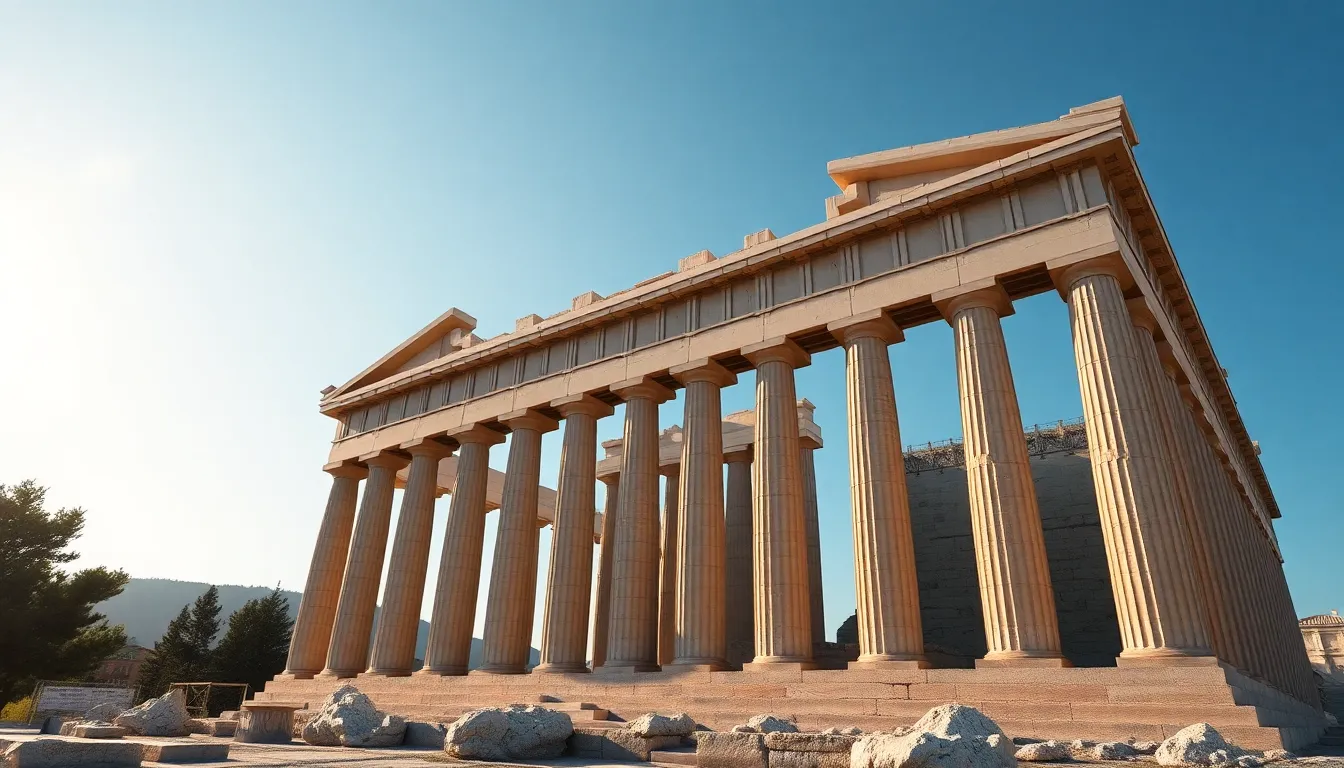
The Parthenon: A Testament to Ancient Greek Engineering Genius
I. Introduction
The Parthenon stands as one of the most iconic monuments of ancient Greece, showcasing the remarkable engineering prowess and artistic vision of its creators. Erected in the 5th century BCE, during the Golden Age of Athens, this temple has not only served as a religious center but also as a symbol of Athenian democracy and cultural achievement.
In ancient Greek culture, the Parthenon was dedicated to Athena Parthenos, the patron goddess of Athens, embodying the city’s values of wisdom, courage, and civic pride. This article aims to explore the historical context, architectural brilliance, engineering techniques, artistic masterpieces, and the enduring legacy of the Parthenon.
II. Historical Context
A. The political and cultural landscape of Athens during the 5th century BCE
The 5th century BCE was a remarkable period in Athenian history, marked by political power, cultural flourishing, and military prowess. Following the Persian Wars, Athens emerged as a dominant power in the Greek world, leading to the establishment of the Delian League. The city became a center for arts, philosophy, and democracy, promoting ideals that would influence Western civilization for centuries.
B. The role of the Parthenon in honoring Athena, the city’s patron goddess
The Parthenon was constructed to honor Athena Parthenos, the virgin goddess of wisdom and warfare. As Athens’ protector, she symbolized the city’s strength and intellectual superiority. The temple was not only a place of worship but also a statement of Athenian identity, reflecting their devotion to their patron goddess.
C. Key figures involved in its construction (e.g., Pericles, Phidias)
Several key figures played crucial roles in the construction of the Parthenon:
- Pericles: The influential statesman who initiated the project and oversaw its construction, promoting the idea that the Parthenon embodied Athenian democracy.
- Phidias: The chief sculptor and architect responsible for the artistic direction of the Parthenon, including the statue of Athena and the decorative sculptures.
- Ictinus and Callicrates: The architects credited with the overall design of the Parthenon, ensuring that it adhered to the ideals of classical architecture.
III. Architectural Design and Features
A. The Doric order and its influence on the Parthenon’s design
The Parthenon is an exemplary representation of the Doric order, one of the three classical orders of ancient Greek architecture. Characterized by its simplicity and strength, the Doric columns of the Parthenon are fluted and lack a base, resting directly on the stylobate. This choice emphasizes the temple’s grandeur and stability.
B. Key architectural features (columns, friezes, and pediments)
The architectural design of the Parthenon incorporates several key features:
- Columns: The temple features 46 outer columns and 23 inner columns, each standing 10.4 meters tall.
- Friezes: The Parthenon’s friezes depict significant historical events, including the Panathenaic procession, showcasing the celebration of Athena.
- Pediments: The east and west pediments are adorned with sculptural groups, illustrating myths related to Athena and Poseidon.
C. Innovations in design, such as entasis and optical corrections
The Parthenon is renowned for its architectural innovations that enhance its aesthetic appeal. One notable feature is entasis, the slight curvature of columns that corrects the optical illusion of concavity. Additionally, the temple incorporates subtle optical corrections, such as:
- The columns lean inward slightly to create a sense of stability.
- The stylobate, or the upper step, is slightly curved, preventing the illusion of a sagging structure.
IV. Engineering Techniques
A. Construction methods and materials used
The construction of the Parthenon involved sophisticated engineering techniques and high-quality materials. The primary material used was Pentelic marble, known for its pure white appearance and durability. The use of precise measurements and careful planning ensured the temple’s structural integrity.
B. The role of skilled labor and artisans in the building process
The construction of the Parthenon required a skilled workforce, including:
- Master builders and architects who designed the temple.
- Stonemasons and artisans who quarried, shaped, and assembled the marble blocks.
- Laborers who transported materials and contributed to the construction efforts.
C. Examination of the tools and technology of the time
The tools available during the 5th century BCE included simple yet effective implements such as chisels, hammers, and levers. The use of cranes and scaffolding facilitated the construction of the temple, allowing workers to reach higher elevations safely.
V. Artistic Masterpieces within the Parthenon
A. The sculptural works by Phidias and their significance
Phidias’s artistic genius is evident in the Parthenon’s sculptural decorations, which include the famous statue of Athena Parthenos and the intricate reliefs on the friezes and metopes. These works reflect the cultural and religious values of the time, emphasizing the importance of Athena in Athenian society.
B. Description of the friezes, metopes, and the statue of Athena Parthenos
The Parthenon’s artistic features include:
- Friezes: The continuous frieze on the exterior depicts the Panathenaic procession, highlighting the civic pride of the Athenians.
- Metope reliefs: The metopes illustrate battles between gods and giants, symbolizing the triumph of civilization over chaos.
- Athena Parthenos: The monumental statue of Athena, crafted from gold and ivory, stood within the temple, representing the goddess’s power and protection over Athens.
C. The Parthenon as a canvas for artistic expression
The Parthenon served as a canvas for artistic expression, blending architecture and sculpture to create a harmonious whole. The interplay between the structural elements and the decorative artworks exemplifies the heights of classical Greek art and architecture.
VI. Symbolism and Cultural Legacy
A. The Parthenon as a symbol of democracy and civic pride
The Parthenon transcends its role as a mere temple; it symbolizes the ideals of democracy, civic pride, and cultural achievement that defined ancient Athens. As a focal point for civic life, the temple represented the collective identity of the Athenian people.
B. Its influence on subsequent architectural styles and structures
The architectural innovations of the Parthenon influenced countless structures throughout history, including:
- The British Museum in London, which houses the Elgin Marbles from the Parthenon.
- The United States Capitol building, reflecting neoclassical architectural principles.
- Modern museums and cultural institutions that draw inspiration from its design.
C. The Parthenon in modern culture and its representation in art and literature
In contemporary culture, the Parthenon remains a powerful symbol of classical ideals. It is frequently referenced in literature, art, and popular media, representing the enduring legacy of ancient Greece. Its image is often used to evoke themes of democracy, beauty, and the pursuit of knowledge.
VII. Preservation and Restoration Efforts
A. The challenges faced in preserving the Parthenon over time
Throughout its history, the Parthenon has faced numerous challenges, including:
- Natural disasters, such as earthquakes and erosion caused by weather.
- Human-induced damage, including the conversion of the temple into a church and later a mosque.
- Destruction during wars, particularly during the Venetian siege of 1687.
B. Major restoration projects and their significance
Significant restoration projects have aimed to preserve and restore the Parthenon, including: