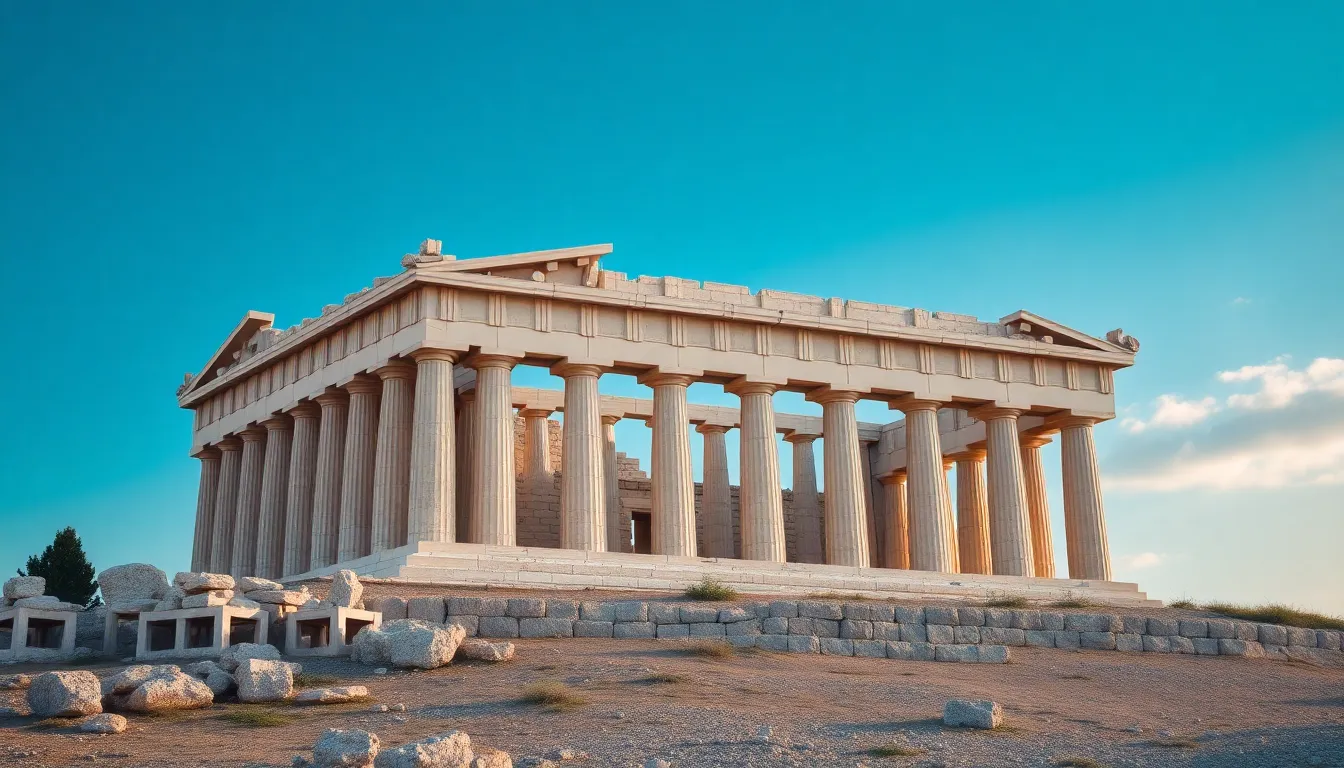
The Parthenon: More Than Just a Temple to Athena
I. Introduction
The Parthenon, an iconic symbol of Ancient Greece, stands majestically on the Acropolis of Athens. Completed in 432 BCE, this classical temple dedicated to the goddess Athena, whom the people of Athens considered their patroness, is often viewed solely as a place of worship. However, its significance extends far beyond religious purposes, encompassing various aspects of Athenian society, culture, and democracy.
II. Historical Context
The construction of the Parthenon took place during the Golden Age of Athens, a period marked by extraordinary political, cultural, and artistic achievements. Under the leadership of Pericles, the Athenian empire flourished, leading to a surge in public works and artistic endeavors.
Political and social factors played a pivotal role in the design and purpose of the Parthenon. In the aftermath of the Persian Wars, the Athenians sought to demonstrate their strength and resilience. The Parthenon was not only a temple; it was a statement of power and a symbol of Athenian identity.
III. Architectural Marvel
The Parthenon is celebrated for its architectural brilliance and innovative design. It exemplifies the Doric order of classical architecture while incorporating elements of the Ionic order, showcasing a blend of styles that reflects a sophisticated understanding of aesthetics and engineering.
Key design elements include:
- Columns: The Parthenon features 46 outer columns, each standing 10.4 meters high.
- Optical Corrections: Subtle curves in the columns and stylobate create an optical illusion that makes the structure appear perfectly straight.
- Friezes and Pediments: Elaborate sculptures adorned the friezes and pediments, depicting mythological scenes and historical events.
The architects of the Parthenon, Ictinus and Callicrates, were instrumental in bringing this vision to life, combining artistry with engineering prowess. Their collaborative efforts resulted in a structure that has influenced architecture for centuries.
IV. Symbol of Athenian Democracy
The Parthenon stands as a powerful representation of Athenian ideals and values, encapsulating the principles of democracy, civic responsibility, and cultural pride. It was constructed during a time when Athens was at the forefront of democratic governance, and the temple served as a physical manifestation of these ideals.
Its role in the development of civic identity and unity cannot be overstated. The Parthenon was a place where citizens gathered to celebrate their shared identity, reinforcing the bonds between individuals and the state. It symbolized the collective achievements of the Athenian people and their commitment to democratic ideals.
V. Artistic Achievements
The artistic achievements of the Parthenon are among the most significant contributions to the cultural heritage of humanity. The temple’s sculptures and friezes are a testament to the extraordinary talent of ancient artisans and their ability to convey complex narratives through art.
Notable artistic features include:
- The Parthenon Marbles: These sculptures, originally part of the temple, depict historical battles and mythological scenes, showcasing the skill of Athenian sculptors.
- The Athena Parthenos: A massive statue of the goddess Athena made of gold and ivory, crafted by the renowned sculptor Phidias, was housed within the Parthenon. This statue was not only a religious icon but also a representation of Athenian wealth and artistry.
The artistic elements of the Parthenon have inspired countless artists and architects throughout history, symbolizing the pinnacle of ancient Greek art.
VI. Cultural and Political Center
Beyond its religious significance, the Parthenon served as a cultural and political center for Athens. It was a venue for civic ceremonies, religious festivals, and public gatherings, playing a crucial role in the social life of the city.
Its use in civic ceremonies included:
- The Panathenaic Festival, a celebration of Athena, which involved processions and athletic competitions.
- Religious sacrifices and rituals that reinforced the connection between the city’s people and their patron goddess.
Additionally, the Parthenon functioned as a treasury, housing the wealth of the Delian League and serving as a symbol of Athenian power and influence in the ancient world. This dual role as a religious temple and a political treasury highlights its multifaceted significance in Athenian society.
VII. Influence on Later Architecture
The Parthenon’s architectural and artistic legacy extends far beyond ancient Greece, influencing various styles of architecture throughout history. Its design principles and aesthetic ideals have left a lasting impact on Renaissance and neoclassical architecture.
Key influences include:
- Renaissance Architecture: Architects such as Andrea Palladio drew inspiration from the Parthenon, incorporating classical elements into their designs.
- Neoclassical Movement: The Parthenon became a model for neoclassical buildings in the 18th and 19th centuries, reflecting the ideals of democracy and civic virtue that it embodied.
Modern interpretations and adaptations of the Parthenon can be seen in various global contexts, from government buildings to museums, demonstrating its enduring significance as a symbol of democracy and artistic achievement.
VIII. Conclusion
In summary, the Parthenon is much more than a temple dedicated to Athena; it is a multifaceted symbol of Athenian society, culture, and democracy. From its architectural brilliance to its role in civic life, the Parthenon encapsulates the values and achievements of ancient Athens.
Its enduring legacy continues to inspire artists, architects, and scholars, serving as a reminder of the rich cultural heritage of ancient Greece and the principles of democracy that resonate to this day. The Parthenon stands not only as a testament to the past but also as a beacon of hope for future generations, embodying the ideals of art, culture, and democratic governance.