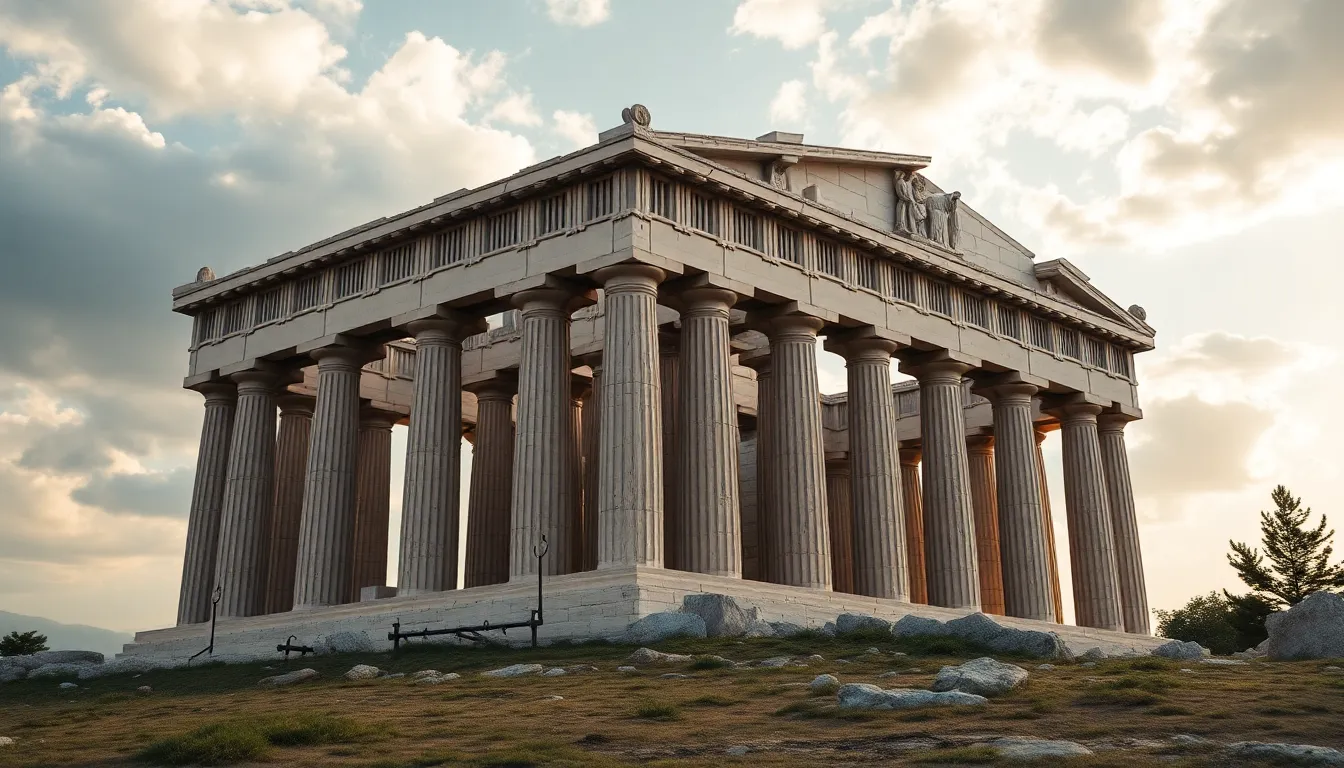
Exploring the Parthenon’s Influence on Western Civilization
I. Introduction
The Parthenon, a magnificent temple located on the Acropolis of Athens, stands as one of the most significant monuments of ancient Greece and a symbol of Western civilization. Constructed in the 5th century BCE, the Parthenon not only exemplifies the architectural brilliance of its time but also embodies the cultural, political, and religious ideals of the Athenian society. Its historical significance extends far beyond its physical structure; it has profoundly influenced various aspects of Western culture, politics, and philosophy.
This article aims to examine the Parthenon’s impact on Western civilization, exploring its historical context, architectural innovations, representation in art and literature, role in national identity, preservation efforts, and influence on education and scholarship. Through this exploration, we will uncover how the Parthenon has shaped contemporary values and ideals.
II. Historical Context of the Parthenon
The Parthenon was constructed between 447 and 432 BCE during the golden age of Athens, primarily under the leadership of the statesman Pericles. Its architectural features and historical context provide insight into its significance.
A. Construction and architectural features of the Parthenon
The Parthenon was designed by the architects Ictinus and Callicrates, and it was built as a temple dedicated to the goddess Athena, the patroness of the city. The temple is primarily constructed of Pentelic marble and features the Doric order, which is characterized by its simplicity and strength. Key architectural features include:
- The grand scale: The Parthenon measures 69.5 meters in length and 30.9 meters in width.
- The use of the entasis technique: Columns are slightly curved to appear straight from a distance.
- The frieze and pediments adorned with intricate sculptures depicting mythological scenes.
B. The Parthenon as a symbol of Athenian democracy and power
The Parthenon was not merely a religious site; it embodied the ideals of Athenian democracy. Built during a time of great political and military power, it served as a symbol of the city-state’s achievements and the democratic values held dear by its citizens. The temple represented the idea that the state and its citizens were united in their devotion to the goddess Athena.
C. The role of the Parthenon in ancient Greek religion and culture
The Parthenon was the focal point of religious life in Athens, housing a monumental statue of Athena Parthenos created by the sculptor Phidias. This statue stood approximately 12 meters tall and was made of gold and ivory, symbolizing the wealth and artistic prowess of Athens. The Parthenon also hosted various religious festivals, most notably the Panathenaic Festival, which celebrated Athena and included athletic and artistic competitions.
III. Architectural Innovations and Aesthetic Principles
The Parthenon is celebrated for its architectural innovations and aesthetic principles that have left a lasting mark on Western architecture.
A. The Doric order and its influence on classical architecture
The Parthenon exemplifies the Doric order, characterized by its sturdy columns and unadorned simplicity. This architectural style influenced various subsequent architectural movements, including the Roman and Renaissance periods. Its principles of proportion and harmony became foundational in the study of architecture.
B. Use of optical illusions and symmetry in the Parthenon’s design
The architects of the Parthenon employed several optical refinements to enhance its appearance. These included:
- Curvature of the stylobate (the upper step of the temple) to create a sense of visual harmony.
- Inclination of the columns, which slightly lean inward to counteract the illusion of sagging.
- Variations in column spacing to maintain symmetry and balance.
C. The Parthenon as a prototype for future Western architectural styles
The design and aesthetics of the Parthenon have served as a prototype for countless buildings throughout Western history. Its influence can be seen in various structures, from neoclassical government buildings to modern museums. Architects such as Thomas Jefferson, who designed the Virginia State Capitol, drew inspiration from the Parthenon’s timeless beauty and harmonious proportions.
IV. The Parthenon in Art and Literature
The Parthenon has inspired countless works of art and literature throughout history, shaping the cultural landscape of the West.
A. The representation of the Parthenon in classical literature
In classical literature, the Parthenon is often referenced as a symbol of beauty, power, and cultural achievement. Notable works, such as those by Plato and Plutarch, reflect on the significance of the Parthenon in relation to Athenian society and its values.
B. Influence on Renaissance artists and architects
The Renaissance marked a revival of classical ideas, and the Parthenon played a crucial role in this movement. Artists and architects studied its proportions and aesthetics, leading to the creation of iconic structures such as:
- The Pantheon in Rome, which reflects the grandeur of the Parthenon.
- The United States Capitol, which incorporates neoclassical elements inspired by the Parthenon.
C. The Parthenon as a subject in modern art and media
In modern times, the Parthenon continues to captivate artists and filmmakers. Its image is utilized in various media, from paintings to films, often symbolizing ideals of democracy, beauty, and civilization. Noteworthy examples include:
- The works of artists like John Singer Sargent and Edward Hopper.
- Films such as “The Parthenon” (2009), which explores its historical and cultural significance.
V. The Parthenon and National Identity
The Parthenon holds a significant place in the national identity of Greece and has influenced the identities of many Western nations.
A. The Parthenon as a symbol of Greek national pride
For Greeks, the Parthenon represents their cultural heritage and national pride. It is a symbol of resistance, democracy, and artistic achievement, often used in political and cultural discourse to evoke a sense of unity and heritage.
B. Its role in shaping the identity of Western nations
The Parthenon has also contributed to the identity of Western nations, particularly in the context of democracy and civic responsibility. Its legacy informs contemporary ideals, influencing how nations perceive their own democratic values.
C. The impact of the Parthenon on modern democratic ideals
The principles embodied by the Parthenon continue to resonate in modern democratic ideals, emphasizing the importance of civic engagement, public service, and collective identity. The temple serves as a reminder of the democratic aspirations that shaped Western civilization.
VI. Preservation and Restoration Efforts
Preserving the Parthenon poses numerous challenges due to its age and the impact of pollution and tourism.
A. Historical challenges to the preservation of the Parthenon
Throughout history, the Parthenon has faced various threats, including:
- Destruction during the Persian invasion in 480 BCE.
- Conversion into a Christian church and later a mosque, leading to structural alterations.
- Severe damage from an explosion in 1687 when the building was used as a gunpowder store.
B. Modern restoration projects and their significance
In recent decades, extensive restoration efforts have been undertaken to stabilize and preserve the Parthenon. These projects emphasize the importance of preserving cultural heritage for future generations. Key restoration efforts include:
- Repairing the damaged columns and sculptures.
- Implementing protective measures against environmental damage.
- Using modern technology to analyze structural integrity and guide restoration practices.
C. The role of the Parthenon in contemporary cultural heritage discussions
The Parthenon serves as a focal point in discussions about cultural heritage preservation. Its status as a UNESCO World Heritage Site highlights the need for international cooperation to protect and maintain such invaluable cultural landmarks.
VII. The Parthenon’s Influence on Education and Scholarship
The Parthenon has played a significant role in the education and scholarship of Western civilization.
A. Incorporation of the Parthenon in Western education systems
The study of the Parthenon is integral to curricula in history, art