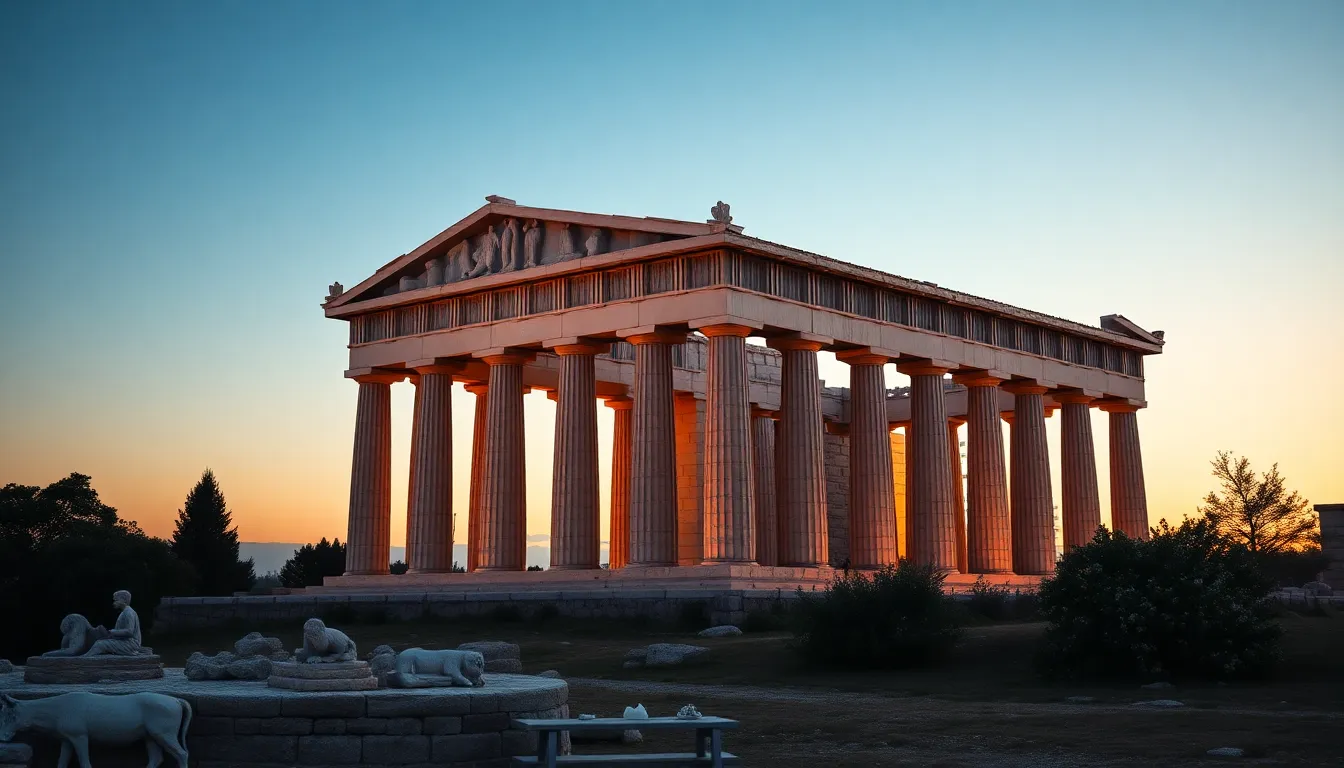
The Parthenon: A Testament to Ancient Greek Innovation
I. Introduction
The Parthenon stands as one of the most iconic structures of ancient Greece, embodying the architectural and artistic innovations of its time. Located on the Acropolis of Athens, this temple dedicated to the goddess Athena is not just a symbol of Athenian democracy but also a masterpiece of classical architecture. Its significance extends beyond its religious function; it represents the cultural and political zenith of Athens during the 5th century BCE.
This article aims to explore the various innovations that contributed to the Parthenon’s design and construction, highlighting its historical context, architectural features, artistic elements, and the challenges of preservation.
II. Historical Context
A. The political and cultural landscape of Ancient Greece
In the 5th century BCE, Athens was at the height of its power, following its victory in the Persian Wars. This period, known as the Golden Age of Athens, saw the development of democracy, philosophy, and the arts. The political landscape was characterized by the leadership of statesmen like Pericles, who promoted the construction of monumental structures like the Parthenon to celebrate Athenian strength and cultural identity.
B. The role of the Parthenon in Athenian society
The Parthenon served not only as a temple but also as a treasury, reflecting the wealth and power of Athens. It was a place of worship, housing the colossal statue of Athena Parthenos, and symbolized the unity and pride of the Athenian people. The temple was a central point for civic life and religious festivals, reinforcing Athens’ identity as a cultural and political leader in the Greek world.
III. Architectural Design and Innovations
A. The Doric order and its architectural principles
The Parthenon is primarily designed in the Doric order, the simplest of the classical orders. This architectural style is characterized by sturdy columns, plain capitals, and a lack of elaborate decoration. The Doric columns of the Parthenon exhibit:
- Height and proportion: The columns are slightly tapered and rise to a height of about 10.4 meters.
- Entasis: A slight curvature in the columns, which corrects optical illusions and gives the structure a sense of vitality.
- Simplicity: A minimalistic approach that emphasizes strength and elegance.
B. Innovations in symmetry and proportions
Beyond the Doric style, the Parthenon showcases remarkable innovations in symmetry and proportions. The architects Ictinus and Callicrates employed mathematical ratios to create a harmonious structure. Key features include:
- The “Golden Ratio”: The proportions of the Parthenon reflect the mathematical principle that is aesthetically pleasing, with the relationship between its width and height embodying this ideal.
- Optical refinements: Subtle adjustments in the design, such as the curvature of the stylobate and the entablature, counteract visual distortions that can occur from certain viewing angles.
IV. The Use of Materials and Construction Techniques
A. Sourcing of materials: Marble and its significance
The primary material used in the construction of the Parthenon was Pentelic marble, renowned for its pure white color and fine grain. This high-quality marble was sourced from Mount Pentelicus, approximately 16 kilometers from Athens. Its significance includes:
- Durability: The use of marble ensured the temple’s longevity and resistance to weathering.
- Aesthetic appeal: The marble’s ability to reflect light contributed to the temple’s visual impact, especially when it was originally adorned with painted details.
B. Advanced construction techniques of the time
The construction of the Parthenon involved advanced techniques and skilled craftsmanship. Notable methods included:
- Precision cutting: Stones were cut with remarkable accuracy, allowing for tight joints and a seamless appearance.
- Use of cranes: Although primitive by modern standards, cranes were employed to lift heavy stones into place, showcasing the ingenuity of ancient engineering.
- Collaborative workforce: A large team of artisans, laborers, and architects worked together, reflecting the collective effort of Athenian society in this monumental project.
V. Artistic Elements and Sculptural Mastery
A. The role of sculptor Phidias in the Parthenon’s decoration
Phidias was the chief sculptor responsible for the artistic decoration of the Parthenon. His influence is evident in the overall design and specific sculptures that adorned the temple. His contributions include:
- The statue of Athena Parthenos: A monumental chryselephantine statue made of gold and ivory, standing approximately 12 meters tall, which served as the temple’s centerpiece.
- The friezes and metopes: Phidias oversaw the creation of intricate relief sculptures depicting mythological battles and religious processions, emphasizing Athenian values and culture.
B. Analysis of the friezes, metopes, and the statue of Athena
The artistic elements of the Parthenon are not only visually stunning but also rich in symbolism. Key components include:
- The Panathenaic Frieze: This continuous relief runs along the outer walls of the temple, illustrating the Panathenaic Festival, a celebration of Athena.
- The Metopes: The 92 metopes depict various mythological themes, such as the Centauromachy and the Gigantomachy, symbolizing the struggle between civilization and chaos.
- The Statue of Athena: The statue represented the goddess as a warrior and protector, embodying the ideals of wisdom and strength associated with Athens.
VI. The Parthenon’s Influence on Later Architecture
A. The Neoclassical movement and its inspiration from the Parthenon
The Parthenon’s architectural style and grandeur had a profound influence on the Neoclassical movement of the 18th and 19th centuries. Key points of inspiration include:
- Revival of classical forms: Architects sought to emulate the Doric order and the symmetry of the Parthenon in their designs.
- Public buildings: Many governmental and civic structures, such as the U.S. Capitol and the British Museum, incorporated elements reminiscent of the Parthenon.
B. Modern interpretations and adaptations of Parthenon design
In contemporary architecture, the Parthenon continues to inspire new designs and adaptations. Examples include:
- Modern museums and cultural institutions that draw on neoclassical principles.
- Innovative uses of the Parthenon’s aesthetic in public spaces, reinforcing its status as a timeless symbol of democracy and culture.
VII. Preservation and Restoration Efforts
A. Challenges faced in preserving the Parthenon
Despite its historical significance, the Parthenon has faced numerous challenges over the centuries, including:
- Environmental damage: Pollution and weathering have eroded the marble and weakened the structure.
- Human intervention: The temple has suffered from various wars, looting, and misguided restoration attempts that have altered its original form.
B. Current restoration projects and their importance
Today, extensive restoration projects are underway to preserve the Parthenon for future generations. Key efforts include:
- Cleaning and repairing damaged marble: Utilizing advanced technologies to restore the integrity of the original materials.
- Structural stabilization: Ensuring the temple remains safe and secure while maintaining its historical authenticity.
VIII. Conclusion
The Parthenon remains a testament to the innovation and artistry of ancient Greek civilization. Its architectural brilliance, artistic mastery, and cultural significance continue to inspire awe and admiration worldwide. As we reflect on its legacy, it becomes imperative to preserve this iconic structure, not only as a monument to the past but as a beacon of our shared cultural heritage.
Through ongoing restoration efforts and a commitment to safeguarding historical sites, we ensure that the Parthenon will endure as a symbol of democracy, beauty, and human achievement for generations to come.