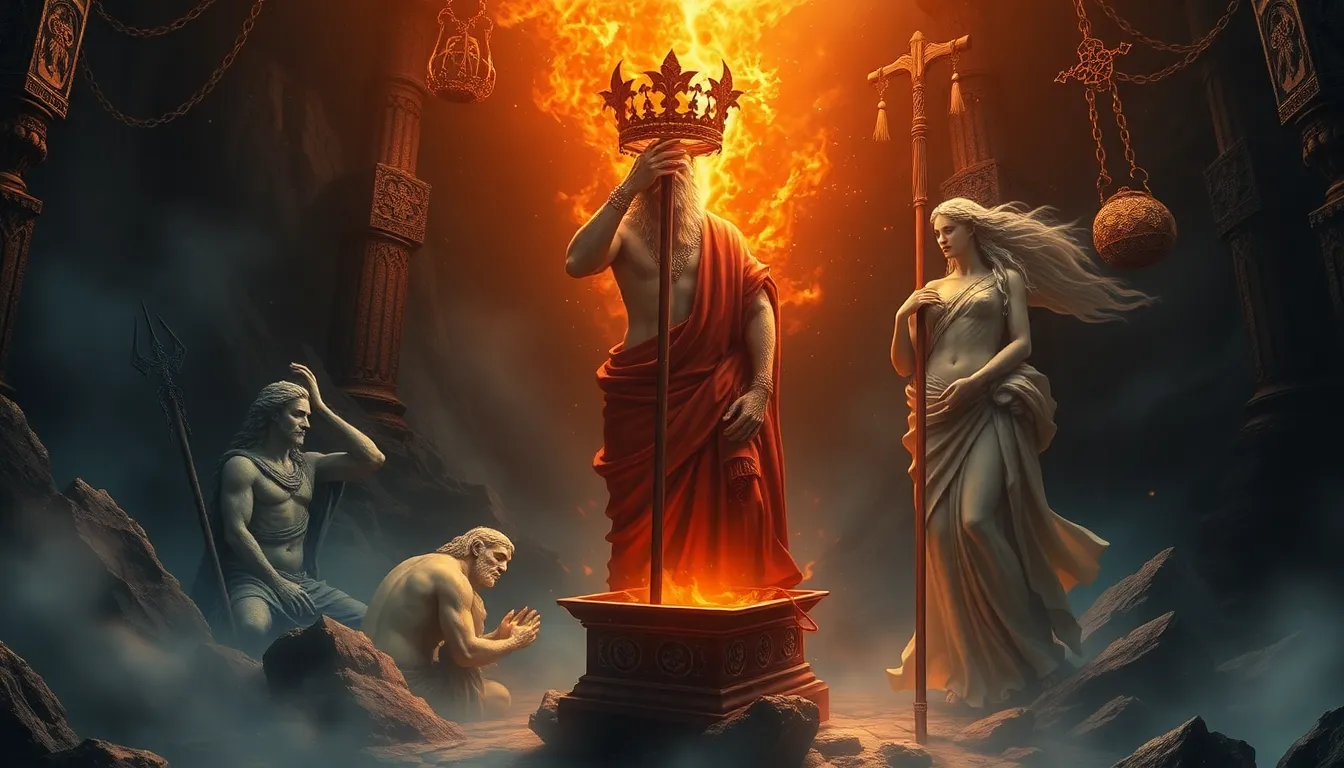
The Sacrifices of the Underworld: Myths of Hades and Persephone
I. Introduction
In the rich tapestry of Greek mythology, the story of Hades and Persephone stands out as a profound exploration of themes such as sacrifice, loss, and the duality of existence. Hades, the god of the Underworld, and Persephone, the daughter of Demeter, the goddess of the harvest, embody the intricate relationships between life and death, spring and winter. Their myth not only explains the changing seasons but also unveils deeper philosophical questions about the nature of sacrifice and renewal.
II. The Origins of Hades and Persephone
A. Background of Hades as the god of the Underworld
Hades is one of the three sons of Cronus and Rhea, alongside Zeus and Poseidon. After the defeat of the Titans, the brothers divided the universe among themselves, with Hades receiving dominion over the Underworld. Unlike the common perception of him as a villain, Hades is a complex figure. He is neither evil nor benevolent but rather a necessary part of the cosmic order. The Underworld, ruled by Hades, is where souls go after death, and it is often depicted as a place of gloom and shadow, yet it is also a realm of justice and balance.
B. The birth and significance of Persephone as the daughter of Demeter
Persephone, known for her beauty and grace, is the daughter of Demeter, the goddess of agriculture and fertility. Her birth was celebrated as a symbol of life and growth. Demeter, who is often associated with the nurturing aspects of nature, raised Persephone to be a strong and independent goddess. As the goddess of springtime and the harvest, Persephone represents the cycle of life, making her eventual abduction by Hades particularly poignant, as it signifies a transition from innocence to a deeper understanding of existence.
III. The Abduction of Persephone
A. The myth of Persephone’s kidnapping by Hades
The myth of Persephone’s abduction is one of the most famous stories in Greek mythology. One day, while picking flowers in a meadow, she was lured into a hidden chasm by Hades, who had fallen in love with her beauty. Unable to resist his desire, Hades took Persephone to the Underworld to be his queen. This act of abduction initiated a series of events that would forever alter the relationship between the mortal world and the divine.
B. The role of the pomegranate and its symbolism in the myth
A crucial element of the abduction myth is the pomegranate. According to the story, while in the Underworld, Persephone ate six seeds of a pomegranate, which bound her to Hades. This act has deep symbolism, representing the connection between life and death, as well as the cycle of renewal. The pomegranate, often seen as a symbol of fertility and rebirth, serves as a reminder of the choices we make and their lasting consequences.
IV. The Sacrifice of Demeter
A. Demeter’s response to Persephone’s abduction
When Demeter discovered that her daughter had been taken, she fell into a deep despair. Her grief was so profound that she neglected her duties as the goddess of the harvest. Crops withered, and the earth became barren. This act of mourning not only highlights the bond between mother and daughter but also serves as a metaphor for the sacrifices made in the face of loss.
B. The impact of her grief on the earth and the seasons
Demeter’s sorrow resulted in a catastrophic impact on the earth. Without her nurturing presence, the earth experienced its first winter, leading to a time of hardship and famine. This seasonal change is symbolic of the sacrifices that must be made in the cycle of life. Eventually, her grief prompted the gods to intervene, leading to Persephone’s return, but not without a price.
V. Persephone’s Dual Role: Queen of the Underworld and Goddess of Spring
A. Exploration of Persephone’s transformation
Persephone’s journey from the innocent maiden of spring to the queen of the Underworld reflects her complex character and transformation. She embodies both life and death, light and darkness. This duality allows her to play a significant role in the balance of nature and the human experience. As the seasons change, so does her persona, bridging the gap between the living and the dead.
B. The duality of life and death represented in her character
Persephone’s existence is a constant reminder of the cycle of life and death. In the spring, she brings life to the earth, nurturing crops and flowers, while in the fall and winter, she descends into the Underworld, representing the death and dormancy of nature. This duality is crucial in understanding the interdependence of life and death, as one cannot exist without the other.
VI. The Cycle of Seasons: A Mythological Explanation
A. The relationship between Persephone’s time in the Underworld and the changing seasons
The myth of Hades and Persephone provides a mythological explanation for the changing seasons. When Persephone is in the Underworld, Demeter mourns, resulting in winter. Conversely, when she returns to the surface, spring emerges, and the earth flourishes. This cyclical pattern illustrates the themes of sacrifice and renewal, emphasizing that life continues despite loss.
B. How this cycle reflects themes of sacrifice and renewal
The seasonal cycle, as explained by the myth, demonstrates how sacrifice is inherent in the process of renewal. Persephone’s dual existence signifies that in order to experience growth and life, one must also endure periods of darkness and sacrifice. This cycle resonates with the human experience, where moments of despair often lead to personal growth and rebirth.
VII. Interpretations and Cultural Impact
A. Different interpretations of the Hades and Persephone myth across cultures
The myth of Hades and Persephone has been interpreted in various ways across different cultures and time periods. For some, it represents the inevitability of death and the acceptance of loss. For others, it symbolizes the relationship between mothers and daughters, showcasing the sacrifices made for love and the bonds that transcend even death.
- Feminist interpretations: Some scholars argue that the myth reflects the patriarchal structures of ancient societies, where women were often subject to the desires of men.
- Psychological interpretations: Carl Jung viewed the myth as a representation of the archetypal journey into the unconscious, where Persephone’s descent symbolizes personal transformation.
- Seasonal cycles: Many cultures have drawn parallels between this myth and agricultural practices, viewing Persephone’s return as the vital force of fertility in farming communities.
B. Influence on art, literature, and modern media
The story of Hades and Persephone has had a lasting impact on art, literature, and modern media. Countless works have been inspired by their myth, from ancient pottery and paintings to contemporary novels and films.
- Art: Artists like Sandro Botticelli and Edward Burne-Jones have depicted their story, often emphasizing the themes of beauty and despair.
- Literature: Poets like John Keats and modern authors have drawn upon their myth to explore themes of love, loss, and rebirth.
- Modern media: Television shows and films, such as “Percy Jackson” and “Lore Olympus,” have reimagined their story for new audiences, keeping the myth alive and relevant.
VIII. Conclusion
The story of Hades and Persephone is a timeless tale of sacrifice and the intricate dance between life and death. Their myth encapsulates the essence of human experience—love intertwined with loss, beauty shadowed by despair. As we reflect upon their narrative, we find that the themes of sacrifice and renewal resonate deeply in our own lives. The enduring relevance of Hades and Persephone reminds us that through our struggles and sacrifices, we can emerge transformed, much like the changing seasons that mark the passage of time.