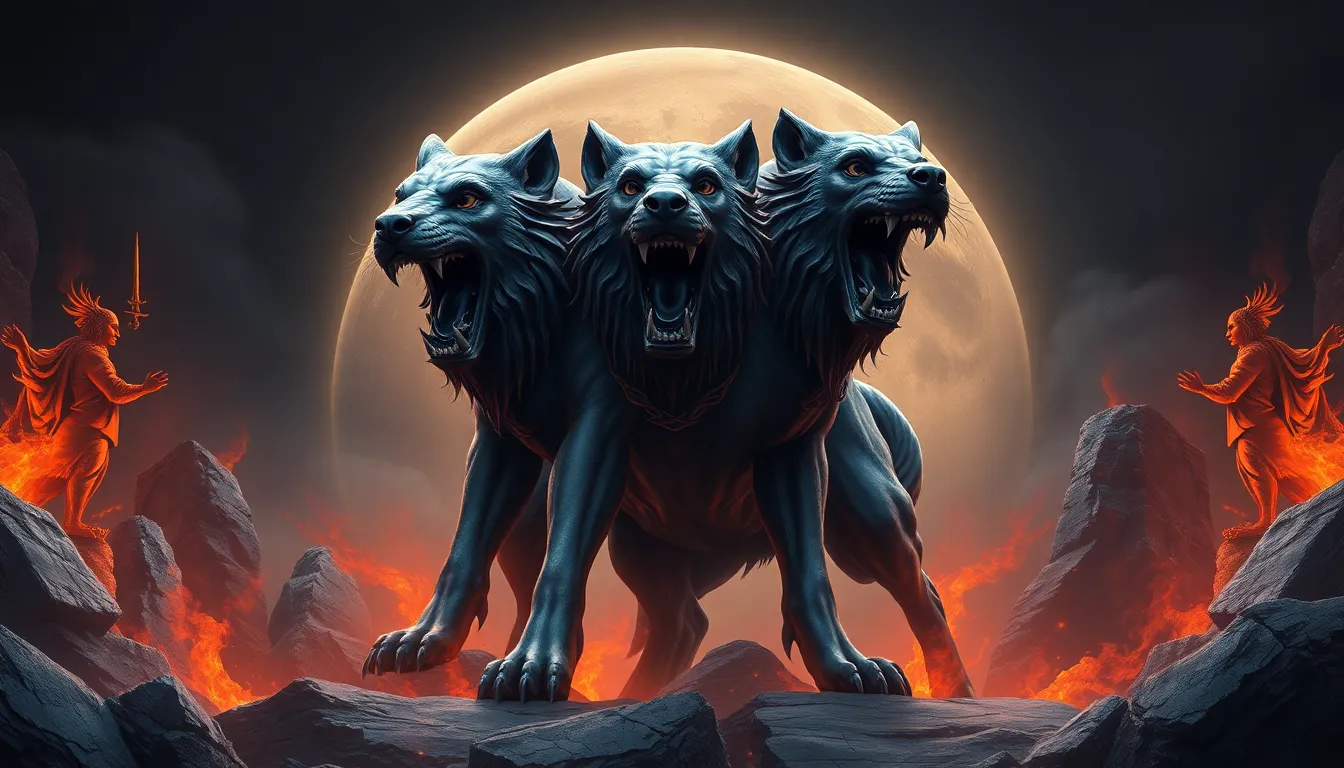
Cerberus: The Three-Headed Guardian of the Underworld
I. Introduction
Cerberus, the fearsome three-headed dog of Greek mythology, serves as one of the most iconic figures associated with the Underworld. Known for his formidable presence and terrifying bark, Cerberus is often depicted as a symbol of the boundary between the living and the dead. His role as the guardian of Hades not only emphasizes the significance of death and the afterlife in Greek culture but also reflects the intricate nature of mythology itself.
This article aims to delve into the origins, characteristics, and cultural significance of Cerberus, exploring how this mythological creature has impacted stories throughout history and its representation in modern culture.
II. Origins of Cerberus
A. Birth and lineage of Cerberus
Cerberus was born from two of the most feared creatures in Greek mythology, Echidna and Typhon. Echidna, often referred to as the “Mother of Monsters,” was a half-woman, half-snake being, while Typhon was a monstrous giant and father of many legendary creatures.

1. Parentage: Echidna and Typhon
The lineage of Cerberus is significant, as it underscores his monstrous nature. He is one of the many offspring of Typhon, who challenged Zeus for supremacy and was ultimately defeated, imprisoned under Mount Etna. This heritage positions Cerberus not only as a guardian but as a creature born from chaos, embodying both fear and power.
2. Role in the mythology of the Titans
In the context of Titan mythology, Cerberus represents the transition from Titans to Olympians. His role as a guardian signifies the establishment of order in the Underworld, which was once a chaotic realm under the influence of the Titans.
B. Cerberus in early Greek texts
References to Cerberus can be found in early Greek literature, including Hesiod’s “Theogony,” where he is mentioned as part of the lineage of monsters. Later, Homer’s “Iliad” and “Odyssey” also illustrate his role in the Underworld, emphasizing his fearsome reputation and the importance of his guardianship.
III. Physical Description
A. The three heads and their symbolism
Cerberus is most famously depicted with three distinct heads, each representing different aspects of his character and role. The three heads symbolize:
- Past: One head represents the memories of the souls he guards.
- Present: The second head embodies the current state of the Underworld.
- Future: The third head signifies the inevitable fate that awaits all living beings.
B. Other characteristics: serpent tail, dragon-like features
In addition to his three heads, Cerberus is often depicted with a serpent-like tail, which adds to his fearsome appearance. He may also have dragon-like features, including claws and a fierce, intimidating stance, showcasing his role as a protector of the Underworld.
C. Artistic representations throughout history
Throughout history, Cerberus has been a popular subject in art, from ancient pottery to modern sculptures. Artists have portrayed him in various styles, emphasizing his monstrous attributes and his role as a guardian. Notable representations include:
- Ancient Greek vases depicting Cerberus in battle with heroes.
- Renaissance paintings that explore his duality as both a fearsome beast and a protector.
- Modern interpretations in films and literature that continue to evolve his image.
IV. Cerberus’s Role in the Underworld
A. Guardian of the gates of Hades
Cerberus’s primary function is to guard the gates of Hades, preventing the escape of souls and ensuring that the living do not enter the realm of the dead without permission. His presence is a reminder of the finality of death and the importance of respecting the boundaries between life and death.
B. Duties and responsibilities in the afterlife
In the Underworld, Cerberus has several key responsibilities, including:
- Monitoring the souls of the deceased to ensure they do not escape.
- Welcoming new arrivals to Hades and guiding them to their respective places in the afterlife.
- Maintaining order within the realm, deterring any disruptions from the living or the dead.
C. Interaction with souls and the living
Cerberus’s interactions with both souls and living beings often highlight his dual nature. While he can be terrifying, there are instances where he shows a degree of loyalty and affection, particularly in myths involving heroes who manage to befriend him. This complexity adds depth to his character, illustrating the nuanced nature of mythological creatures.
V. Cerberus in Myths and Legends
A. Famous myths involving Cerberus
Cerberus appears prominently in numerous myths, the most notable being:
1. Heracles and the Twelve Labors
One of the most famous stories involving Cerberus is his encounter with Heracles (Hercules) during the hero’s Twelve Labors. Heracles was tasked with capturing Cerberus and bringing him to the surface without using weapons. This labor served as a test of Heracles’s strength and ingenuity, showcasing both his heroic qualities and Cerberus’s formidable nature.
2. Orpheus and Eurydice
Another significant myth is that of Orpheus, who journeyed to the Underworld to retrieve his beloved Eurydice. Orpheus’s enchanting music lulled Cerberus to sleep, allowing him to pass through the gates of Hades. This story emphasizes the power of art and love, while also portraying Cerberus as a creature that, despite his fearsome image, can be subdued.
B. Cerberus’s impact on heroism and trials
Cerberus’s role in these myths illustrates the broader themes of heroism, trials, and the confrontation of fears. Heroes must face Cerberus to prove their worth, symbolizing the challenges individuals must overcome in their own lives. This narrative arc resonates throughout various cultures, linking the concept of guardianship with personal growth and transformation.
VI. Cultural Significance
A. Cerberus in ancient literature and art
In ancient Greece, Cerberus was not only a significant figure in mythology but also a subject of fascination in literature and art. Writers and poets often referenced him to symbolize the fear of death and the unknown. His depiction in art served as a reminder of the importance of respecting the boundaries of life and death.
B. Modern interpretations and adaptations in popular culture
In contemporary culture, Cerberus continues to capture the imagination of audiences. He appears in various forms of media, including:
- Literature: Books like “The Lightning Thief” by Rick Riordan feature Cerberus as a key character.
- Film: Movies such as “Hercules” and “Harry Potter and the Deathly Hallows” include modern adaptations of Cerberus.
- Video games: Titles like “Hades” and “God of War” incorporate Cerberus as a formidable opponent or ally.
C. Symbol of fear and protection
Cerberus embodies both fear and protection, serving as a guardian of the Underworld while simultaneously representing the fears associated with death. His duality makes him a rich symbol in both ancient and modern contexts, illustrating humanity’s complex relationship with mortality.
VII. Cerberus in Comparative Mythology
A. Similar mythological figures in other cultures
Cerberus is not alone in his role as a guardian of the afterlife. Many cultures have similar figures, including:
- Fenrir: In Norse mythology, Fenrir is a monstrous wolf prophesied to play a crucial role during Ragnarok.
- Anubis: The Egyptian god associated with mummification and the afterlife, often depicted as having a canine head.
- Yama: In Hindu mythology, Yama is the god of death and the guardian of the afterlife.
</