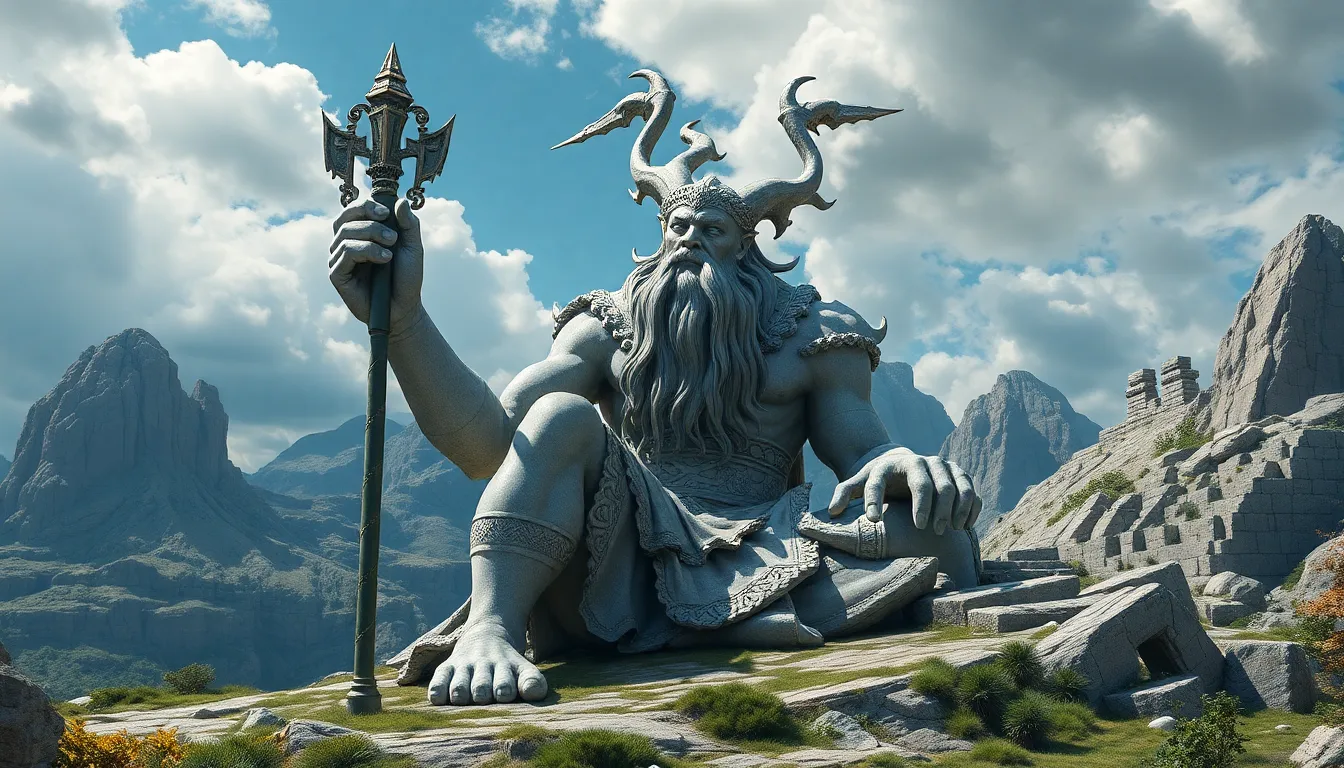
Exploring the Myths of Cronus: A Multifaceted Titan
I. Introduction to Cronus
Cronus is one of the most significant figures in Greek mythology, often depicted as the leader of the Titans and a complex character representing power, fear, and fate. As a titan, he embodies the transition from chaos to order, playing a pivotal role in the mythological narrative that shaped ancient Greek belief systems. The Titans, including Cronus, were primordial beings who preceded the gods of Olympus and are crucial to understanding the ancient lore of Greece.
This article aims to debunk myths surrounding Cronus, exploring his character through various lenses, including his origins, rise to power, his relationships, and ultimately, his downfall.
II. The Origin of Cronus: Birth and Background
Cronus was born into a lineage of titanic proportions, being the son of Ouranos (the sky) and Gaia (the earth). This genealogy is significant as it sets the stage for the conflicts and themes that characterize his life.
According to mythology:
- Ouranos: The personification of the sky, who represents the heavens.
- Gaia: The earth goddess, who symbolizes fertility and the nurturing aspects of nature.
Cronus’s emergence as a prominent figure among the Titans is marked by his overthrow of Ouranos, a decisive move that illustrates his ambition and the complex dynamics of power within the primordial families of Greek mythology.
III. Cronus’s Rise to Power
Cronus’s rise to power is one of the most dramatic narratives in Greek mythology. His rebellion against Ouranos is often portrayed through the myth of castration, where Cronus, armed with a sickle given to him by Gaia, castrates his father, thereby usurping his position.
This act of violence signifies the overthrow of an old order:
- The castration myth is symbolic of the birth of a new generation, as it leads to the emergence of the Olympian gods.
- Cronus’s establishment as the ruler of the Titans comes with both power and the burden of prophecy, foreshadowing his eventual downfall.
IV. The Prophecy and Its Implications
A central theme in Cronus’s story is the prophecy concerning his children. It foretold that one of his offspring would eventually overthrow him, mirroring his own actions against Ouranos. This fear drives Cronus to commit heinous acts, including the swallowing of his children shortly after their birth.
Significantly, this narrative explores the tension between fate and free will:
- Cronus attempts to defy fate through his actions, yet his very efforts lead to the fulfillment of the prophecy.
- This highlights a recurring theme in Greek mythology: the inescapability of destiny and the limitations of human (or titan) agency.
V. The Role of Rhea: Cronus’s Partner and Counterpoint
Rhea, the sister and wife of Cronus, plays a crucial role in the myths as both a partner and a counterpoint to Cronus’s tyrannical nature. While Cronus embodies fear and destruction, Rhea represents nurturing and resilience.
The dynamics of their relationship are complex:
- Initially, Rhea is complicit in Cronus’s actions but later becomes a symbol of rebellion against his oppressive rule.
- Her decision to save Zeus, the youngest of their children, marks a turning point in the mythological narrative.
Rhea’s actions not only challenge Cronus but also set the stage for the eventual rise of the Olympian gods and the downfall of the Titans.
VI. The Titanomachy: Cronus’s Downfall
The Titanomachy, a ten-year war between the Titans and the Olympians, represents the climax of Cronus’s story. As Zeus leads the charge against Cronus and the Titans, the conflict symbolizes the struggle between old and new orders.
Key events leading to Cronus’s defeat include:
- The alliance of Zeus with the Cyclopes and Hecatoncheires, who provide him with powerful weapons.
- The strategic and fierce battles that ultimately lead to the Titans’ defeat.
The consequences of the Titanomachy are profound, resulting in Cronus being imprisoned in Tartarus and the ascendancy of the Olympian gods, who would reshape the landscape of Greek mythology.
VII. Symbolism and Cultural Interpretations
Cronus is often viewed as a symbol of time and the harvest, embodying the cyclical nature of life and the inevitability of change. In agricultural contexts, he is associated with the harvest and the passage of seasons.
Artistic representations of Cronus vary, showcasing him as both a nurturing father and a vengeful tyrant:
- Ancient sculptures often depict him with a sickle, emphasizing his role in the castration of Ouranos.
- Modern interpretations frequently explore the duality of his character, reflecting themes of creation and destruction.
This duality enhances Cronus’s complexity as a mythological figure, allowing for diverse interpretations across cultures and eras.
VIII. Conclusion: The Legacy of Cronus in Mythology
In conclusion, Cronus’s multifaceted nature reveals much about the ancient Greek worldview, emphasizing themes of power, fear, and the inescapability of fate. His actions and their consequences resonate through later myths and literature, shaping the narrative structures that followed.
Understanding figures like Cronus is crucial in appreciating the rich tapestry of cultural history and mythology, as these narratives continue to influence modern storytelling and interpretations of power dynamics in human society.