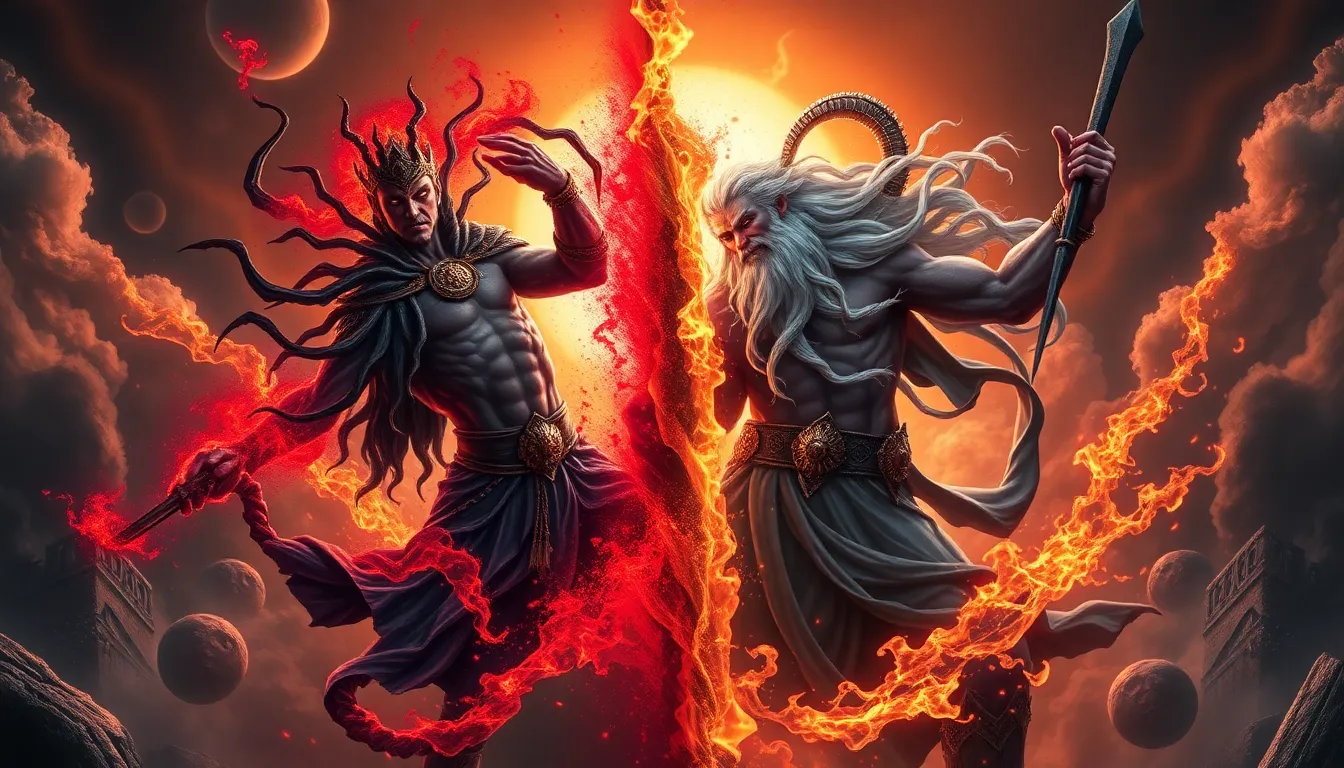
Hades vs. Zeus: The Ultimate Power Struggle in Greek Mythology
I. Introduction
Greek mythology is a rich tapestry of stories, characters, and themes that have captivated audiences for millennia. It provides insight into ancient Greek culture, religious beliefs, and the human condition through its complex narratives. Central to this mythology are two of the most powerful gods: Hades, the ruler of the Underworld, and Zeus, the king of the Olympian gods. Their rivalry and the dynamics of their power struggle illustrate key themes of authority, control, and the nature of existence itself.
This article aims to explore the origins, realms, nature of their rivalry, their allies and adversaries, and their legacy in art and literature, providing a comprehensive overview of the conflict between Hades and Zeus.
II. The Origins of Hades and Zeus
A. Birth and lineage: The Titans and the Olympians
Hades and Zeus are sons of the Titans Cronus and Rhea, making them part of a lineage that includes some of the most significant figures in Greek mythology. Cronus, fearing a prophecy that one of his children would overthrow him, swallowed each of his offspring upon their birth. However, Rhea managed to save Zeus by hiding him in a cave on Crete and giving Cronus a stone wrapped in swaddling clothes instead.
When Zeus grew up, he returned to free his siblings, including Hades, who was swallowed along with his other brothers and sisters. This act of rebellion against Cronus led to the Titanomachy, a brutal war between the Titans and the Olympians.
B. The prophecy that shaped their destinies
The prophecy that dictated the fates of Hades and Zeus was not just about the overthrow of Cronus; it also hinted at the distribution of power among the brothers. After their victory, they drew lots to divide the realms of the universe. Zeus claimed the sky, Poseidon took the sea, and Hades received the Underworld. This division set the stage for the ongoing power struggle between the brothers.
C. The division of realms after the Titanomachy
Following the Titanomachy, the realms were distinctly defined:
- Zeus: King of the Gods, ruler of Mount Olympus and the heavens.
- Hades: God of the Underworld, presiding over the dead and the afterlife.
This division was not merely geographical; it symbolized their respective powers and responsibilities, with Zeus often seen as the more dynamic and influential of the two, while Hades ruled over a realm that was often misunderstood and feared.
III. The Realms of Power
A. Hades: The Underworld and its significance
The Underworld, ruled by Hades, was a complex place in Greek mythology. It was not merely a realm of punishment, but rather a place where all souls went after death. It was divided into various sections, including:
- Elysium: A paradise for the virtuous.
- Tartarus: A deep abyss used as a dungeon of torment.
- The Asphodel Meadows: A neutral zone for ordinary souls.
Hades was often depicted as a somber figure, not inherently evil but rather a necessary part of the cosmic order. His realm was crucial for the balance of life and death, and he was respected, albeit feared, by both mortals and gods.
B. Zeus: The Heavens and his role as king of the gods
In contrast, Zeus ruled the skies and was the embodiment of law, order, and justice. As the king of the gods, his role extended beyond mere governance; he was a protector of hospitality and oaths, a bringer of storms, and a wielder of thunderbolts. His domain included:
- Mount Olympus: The home of the gods.
- The Sky: Control over weather and celestial phenomena.
- Justice: Enforcer of moral order among mortals.
Zeus was often portrayed as a powerful and capricious deity, wielding significant influence over both gods and humans alike.
C. The cultural perceptions of both realms
The cultural perceptions surrounding Hades and Zeus reflect the duality of life and death in ancient Greek thought. The Underworld was viewed with a mix of fear and respect, representing the inevitable fate of all mortals. In contrast, Zeus and the heavens represented hope, power, and the ideals of governance and civilization. This dichotomy laid the groundwork for their enduring rivalry.
IV. The Nature of Their Rivalry
A. Thematic elements of power and control
The rivalry between Hades and Zeus can be understood through various thematic elements, including power, control, and the struggle for dominance. While Zeus often sought to expand his influence over the mortal realm, Hades maintained a more reserved and stoic approach, focusing on his dominion over the dead.
B. Instances of conflict between Hades and Zeus
Several key instances highlight the tension between Hades and Zeus:
- The Abduction of Persephone: Hades’ abduction of Zeus’ daughter, Persephone, created strife between the brothers, leading to a compromise that allowed Persephone to spend half the year with Hades and half with Zeus.
- The Titanomachy: The initial conflict between the Titans and the Olympians was a precursor to their rivalry, showcasing their differing approaches to power and rule.
- Mortal Affairs: Their interactions with heroes and mortals often resulted in friction, particularly when their interests overlapped.
C. The role of mortal affairs in their rivalry
The affairs of mortals frequently became battlegrounds for the influence of both gods. Heroes such as Heracles and Orpheus found themselves caught in the crossfire of Hades and Zeus’s rivalry. Decisions made by mortals often had repercussions that echoed in the divine realm, further complicating their relationship.
V. The Allies and Adversaries
A. Key figures supporting Hades and Zeus
Both Hades and Zeus had their own sets of allies and adversaries that played crucial roles in their narratives:
- Allies of Hades:
- Persephone: His queen and a vital part of his story.
- Thanatos: The personification of death.
- Charon: The ferryman of the dead.
- Allies of Zeus:
- Hera: His wife and queen, often embroiled in the dynamics of power.
- Poseidon: His brother, whose domain of the sea complements Zeus’s sky.
- Athena: The goddess of wisdom, often aligned with Zeus in matters of governance.
B. The role of other gods, goddesses, and mythical beings
Numerous gods and mythical beings influenced the balance of power between Hades and Zeus. For instance, the Furies, who avenged moral crimes, often acted on behalf of Hades, while Hermes served as a messenger for Zeus, connecting the divine with the mortal realm.
C. Influence of human characters and heroes in the struggle
Human characters and heroes often found themselves at the mercy of the rivalry between Hades and Zeus. Their choices could tip the balance, leading to divine favor or wrath. Notable heroes like Odysseus and Theseus navigated this complex landscape, often seeking the favor of Zeus while avoiding Hades’ domain.