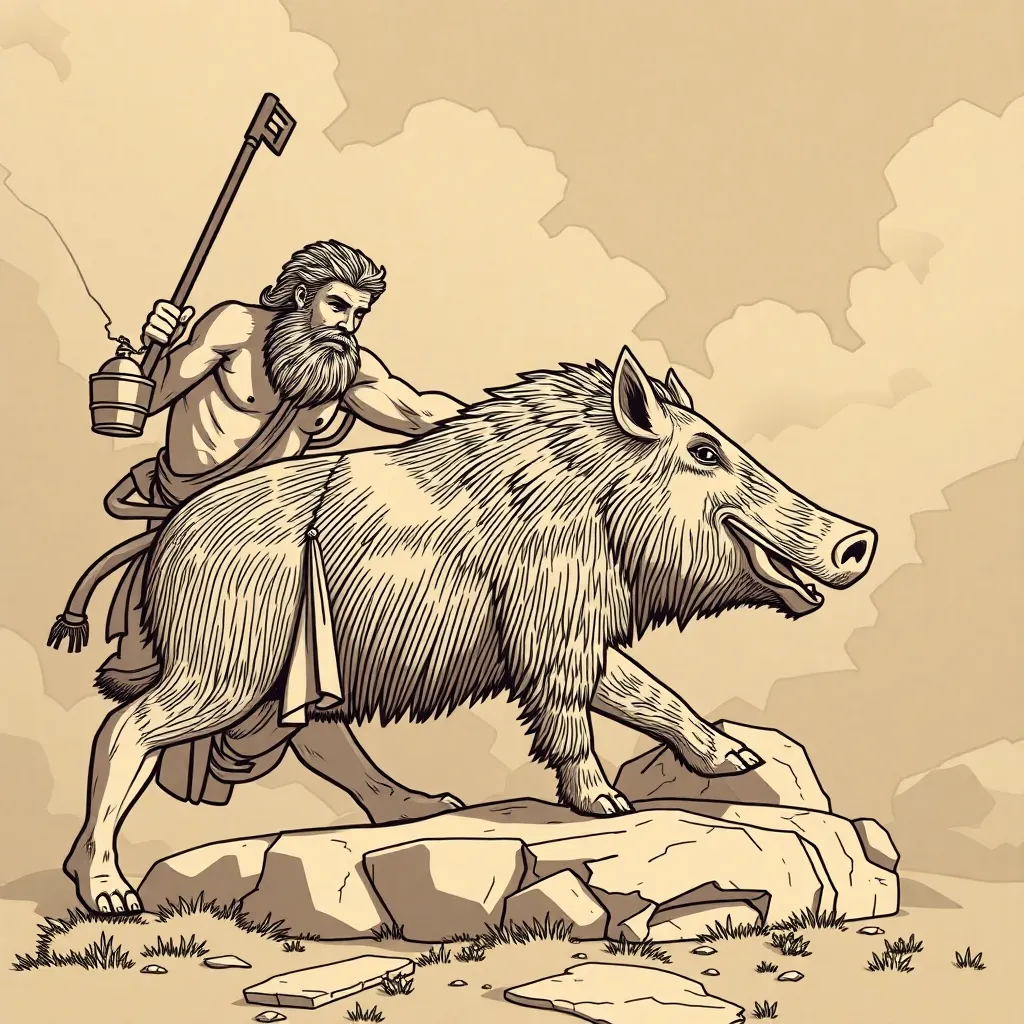
Heracles and the Erymanthian Boar: Exploring the Fourth Labor
I. Introduction
In the rich tapestry of Greek mythology, few heroes shine as brightly as Heracles (Hercules in Roman mythology). Renowned for his extraordinary strength and bravery, Heracles is best known for his Twelve Labors, a series of quests that were meant to atone for a grave sin and showcase his heroic qualities. Among these labors, the Fourth Labor, which involves the capture of the fearsome Erymanthian Boar, stands out for its complexity and the lessons it imparts.
This article aims to delve into the myth surrounding the Erymanthian Boar, exploring its significance in the context of Heracles’ journey and its broader implications in Greek mythology.
II. Background on Heracles
A. Birth and origins
Heracles was born to Zeus, the king of the gods, and Alcmene, a mortal woman. His birth was marked by divine intervention and jealousy from Hera, Zeus’ wife. Hera’s animosity towards Heracles manifested in various challenges throughout his life, setting the stage for his legendary status.
B. The context of the Twelve Labors
After a series of tragic events, including the madness inflicted upon him by Hera, Heracles was driven to kill his own family. In a quest for redemption, he sought guidance from the Oracle of Delphi, who advised him to serve King Eurystheus of Tiryns. Thus began the Twelve Labors, a set of nearly impossible tasks designed to test his strength, resilience, and ingenuity.
C. Heracles’ character and attributes
Heracles is characterized by his immense physical strength, bravery, and determination. However, he is also depicted as possessing a complex personality, often facing internal struggles and moral dilemmas. His journey reflects themes of redemption, heroism, and the human condition.
III. The Erymanthian Boar: Mythological Context
A. Description of the Erymanthian Boar
The Erymanthian Boar was a monstrous creature that roamed the slopes of Mount Erymanthos in Arcadia. It was known for its size, ferocity, and insatiable appetite, causing destruction to the crops and lands of the region. Its presence instilled fear in the hearts of local inhabitants.
B. The boar’s role in Greek mythology
In Greek mythology, the Erymanthian Boar served as a symbol of chaos and untamed nature. The creature’s capture signified the hero’s ability to conquer primal forces and bring order to the world. Additionally, the boar’s story intertwines with other myths, such as the tale of the centaurs and the hero’s encounters with them.
C. Symbolism of the boar in ancient culture
The Erymanthian Boar symbolizes various themes, including:
- Fear and Chaos: The boar represents the chaotic aspects of nature that threaten human existence.
- Heroism: Capturing the boar showcases Heracles’ bravery and strength, reinforcing the archetype of the hero overcoming formidable obstacles.
- Transformation: The labor signifies a journey from chaos to order, mirroring Heracles’ personal growth.
IV. The Fourth Labor: The Task Defined
A. Details of the labor assigned by King Eurystheus
King Eurystheus ordered Heracles to capture the Erymanthian Boar and bring it back alive. This task was daunting, as the boar was not only massive but also known for its speed and ferocity. Eurystheus hoped this labor would prove fatal for Heracles, thus eliminating the threat he posed.
B. Challenges outlined in capturing the boar
The challenges Heracles faced included:
- Locating the boar in the dense forests of Erymanthos.
- Devising a strategy to capture the swift and aggressive creature.
- Navigating the treacherous terrain while avoiding other dangers, including hostile centaurs.
C. The significance of the labor within the Twelve Labors
The Fourth Labor is crucial within the Twelve Labors as it represents a turning point in Heracles’ journey. It not only tests his physical abilities but also his capacity for strategic thinking and leadership. This labor highlights the duality of his character—both brute strength and cleverness.
V. Heracles’ Journey to Erymanthos
A. The route taken by Heracles
Heracles embarked on his journey to Mount Erymanthos, traversing various terrains that included dense forests, rugged mountains, and dangerous valleys. His route was fraught with challenges that would prepare him for the confrontation with the boar.
B. Encounters along the way (e.g., Pholus and the centaurs)
During his journey, Heracles encountered several significant figures:
- Pholus: A kind centaur who offered Heracles hospitality. Their encounter resulted in an unintentional conflict that led to the death of several centaurs.
- The Centaurs: A tribe of half-human, half-horse beings known for their wildness. Heracles’ interactions with them foreshadowed the challenges he would face in capturing the boar and represented the clash between civilization and chaos.
C. The significance of these interactions
These encounters served to illustrate Heracles’ character development and foreshadow the trials he would face. They also emphasized the themes of friendship, conflict, and the consequences of one’s actions, reinforcing the moral complexities that define Heracles’ journey.
VI. The Capture of the Erymanthian Boar
A. Strategies employed by Heracles
Upon reaching Erymanthos, Heracles devised a plan to capture the boar. He implemented strategies that showcased his intelligence and physical prowess:
- Using traps to contain the boar’s movement.
- Employing his strength to corner the creature in a confined space.
- Utilizing his knowledge of the terrain to outmaneuver the boar.
B. The confrontation with the boar
When Heracles finally confronted the Erymanthian Boar, it charged at him in a fury. The battle was intense, with Heracles using his agility to evade the boar’s attacks while waiting for the opportune moment to strike.
C. The methods of capturing the creature
Ultimately, Heracles succeeded in capturing the boar by employing a combination of brute force and strategy. He was able to ensnare the creature and bind it, demonstrating not only his physical strength but also his ability to think critically under pressure. After securing the boar, he transported it back to Eurystheus.
VII. Aftermath and Consequences
A. Return to Eurystheus and presentation of the boar
Upon returning to Tiryns, Heracles presented the captured Erymanthian Boar to King Eurystheus. The sight of the fearsome creature struck fear into the king, fulfilling the labor’s intention to showcase Heracles’ prowess.
B. Reactions from Eurystheus and the people
Eurystheus was both amazed and terrified by the boar. In some versions of the myth, he is said to have hidden in a large jar, unable to face the creature. The people of Tiryns regarded Heracles with renewed respect, acknowledging his strength and determination.
C. The implications of this labor for Heracles’ journey
The successful capture of the Erymanthian Boar marked a significant milestone in Heracles’ journey. It reinforced his identity as a hero and set the stage for the subsequent labors. Each task he completed not only served as a means of redemption but also contributed to his growth as a character.
VIII. Conclusion
A. Reflection on the themes of the Fourth Labor
The Fourth Labor encapsulates themes of bravery, strategy, and the struggle against chaos. It illustrates how Heracles confronted not only external challenges but also his internal demons, symbolizing the universal human experience of striving for redemption.
B. Heracles’ growth and development through the labor
Through the labor, Heracles evolves from a figure of raw strength to a nuanced hero capable of strategic thinking and moral reflection. Each labor contributes to his identity, shaping him into a legendary