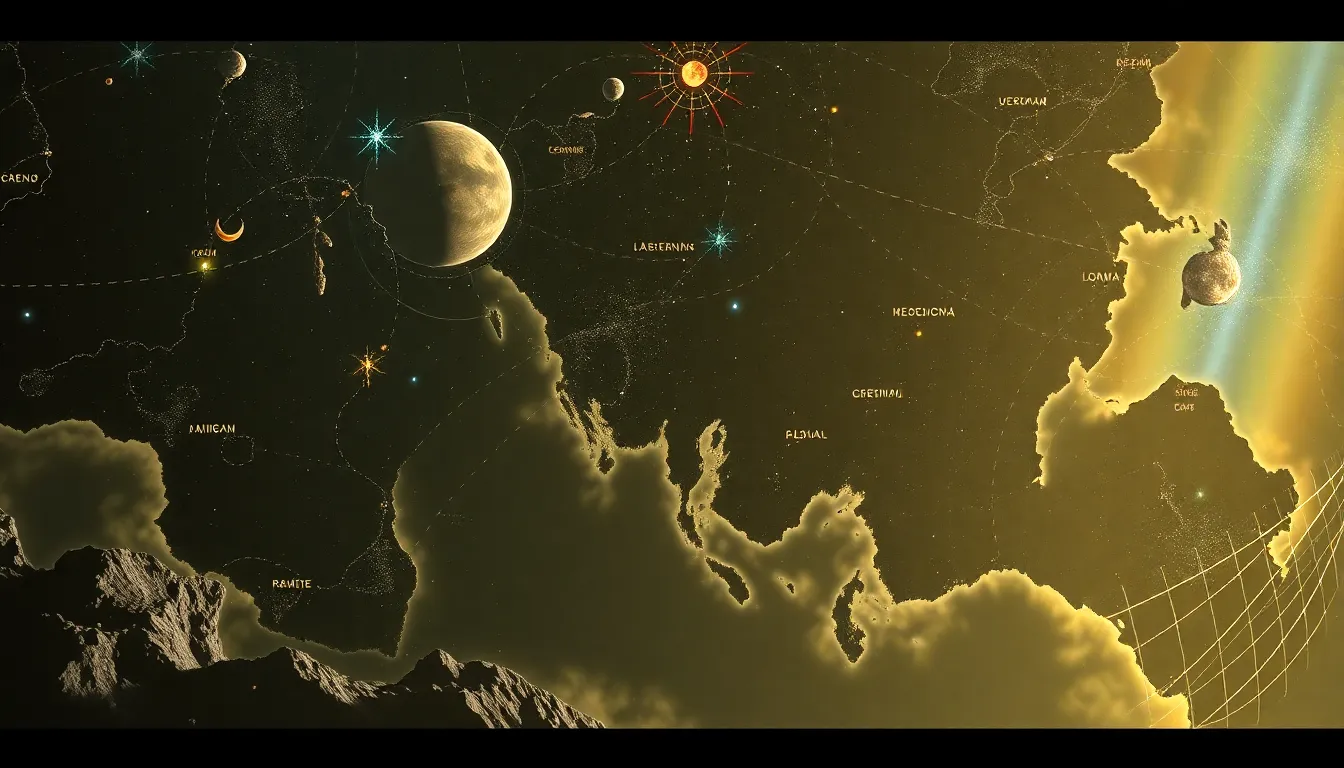
The Celestial Legacy of Uranus: How He Influenced Ancient Thought
I. Introduction
Uranus, the primordial sky god in Greek mythology, stands as a significant figure in the ancient pantheon. He is often depicted as the personification of the heavens, embodying the vastness of the sky and its mysteries. In ancient cultures, celestial bodies were not merely astronomical phenomena; they were imbued with profound meaning and played a pivotal role in shaping the worldview of societies. This article aims to explore the influence of Uranus on ancient thought, examining his mythological origins, cosmological significance, and lasting legacy in art, literature, and science.
II. The Mythological Origins of Uranus
In Greek mythology, Uranus is one of the primordial beings, born from Chaos, the void that existed before creation. He represents the sky and is often depicted as a dome arching over the Earth, personified by Gaia, the Earth goddess. Their relationship is one of union and conflict, laying the foundation for the birth of many deities.
Uranus and Gaia produced several offspring, most notably:
- The Titans, who were powerful deities that ruled during the Golden Age
- The Cyclopes, known for their single eye and craftsmanship
- The Hecatoncheires, giants with a hundred arms
However, Uranus’s fear of his children led him to imprison them, prompting Gaia to conspire with her son Cronus to overthrow him. This myth not only illustrates the dynamics of power and fear but also marks the transition from primordial chaos to structured order in the universe.
III. Uranus in Ancient Cosmology
The sky held immense significance in ancient worldviews, serving both practical and spiritual purposes. For the Greeks, Uranus represented the heavens, a vast and mysterious realm that governed earthly life. His celestial nature was intertwined with the cycles of nature, influencing agriculture, navigation, and timekeeping.
In Greek cosmology, Uranus was not just a distant entity; he was an active participant in the cosmos. The Greeks perceived a harmonious relationship between Earth and sky, a theme echoed in various ancient cultures:
- Mesopotamian Mythology: The sky god Anu was similar to Uranus, representing authority over the heavens.
- Egyptian Mythology: Nut, the goddess of the sky, arched over the earth, much like Uranus.
- Hindu Cosmology: The concept of Svarga, the celestial abode, mirrors the significance of the sky in the human experience.
These comparative perspectives highlight the universal reverence for the sky across different civilizations, with Uranus at the center of Greek thought.
IV. Uranus and the Concept of Order in the Universe
Uranus’s role in establishing celestial order cannot be overstated. In myth, his overthrow by Cronus symbolizes the transition from chaos to a structured universe, reflecting the ancient Greeks’ understanding of cosmic order. This idea influenced philosophical thought, particularly in the works of early philosophers like Plato and Aristotle, who sought to understand the nature of the universe and humanity’s place within it.
Furthermore, Uranus is closely linked to the concept of fate. The Greeks believed that the heavens influenced human destiny, where celestial alignments could dictate the course of events on Earth. This belief system established a framework for understanding the interconnectedness of the universe and individual lives.
V. The Astrological Significance of Uranus
Astrology, an integral part of ancient cultures, relied heavily on the positions and movements of celestial bodies for interpretations and predictions. Ancient astrologers viewed Uranus as a significant influence, associating it with changes, innovation, and upheaval.
Key aspects of Uranus in ancient astrology included:
- Transitional Energy: Uranus was linked to sudden changes and events that disrupted the status quo.
- Intuition and Insight: Its influence was believed to enhance intuitive understanding and visionary thinking.
- Rebellion and Freedom: Uranus represented the drive for individual freedom and the breaking of societal norms.
These astrological beliefs have evolved over the centuries, influencing contemporary astrology and retaining their significance in the interpretation of personal and collective experiences.
VI. Uranus’s Influence on Art and Literature
Uranus has been a rich source of inspiration in ancient art and literature. His depictions in sculptures and pottery often emphasized his celestial nature and connection to other divine beings.
Some notable representations include:
- Sculptures: Statues depicting Uranus often show him as a majestic figure, embodying the sky with flowing robes and a grand demeanor.
- Pottery: Vases and bowls featured scenes of Uranus interacting with Gaia and their offspring, illustrating their mythological narratives.
Literary references to Uranus are also found in classical texts, such as Hesiod’s “Theogony,” where the story of his birth and relationship with Gaia is recounted. These representations have left a lasting legacy, influencing later artistic movements and literary works that draw upon mythological themes.
VII. The Impact of Uranus on Scientific Thought
The transition from mythology to astronomy marks a significant evolution in human understanding. The ancient interpretations of Uranus laid the groundwork for future scientific discoveries, particularly in the field of astronomy.
Key developments include:
- Identification of Uranus: In 1781, the planet Uranus was discovered by Sir William Herschel, expanding the known solar system and linking mythological figures to astronomical bodies.
- Influence on Scientific Inquiry: The study of celestial bodies prompted a shift towards empirical observation and mathematical modeling of the universe.
- Modern Astronomy: The legacy of ancient thought continues to inform contemporary astrophysics and cosmology, where the interplay of myth and science remains relevant.
VIII. Conclusion
Uranus’s multifaceted influence on ancient thought is undeniably profound. From his mythological origins as the primordial sky god to his role in establishing cosmic order and inspiring artistic expression, Uranus has shaped the way humanity understands the universe. The relevance of these ancient ideas persists in contemporary thought, reminding us of the enduring legacy of celestial figures in shaping our worldview.
As we reflect on the influence of Uranus, we recognize the persistent human desire to comprehend the cosmos and our place within it, bridging the gap between mythology and modern science.