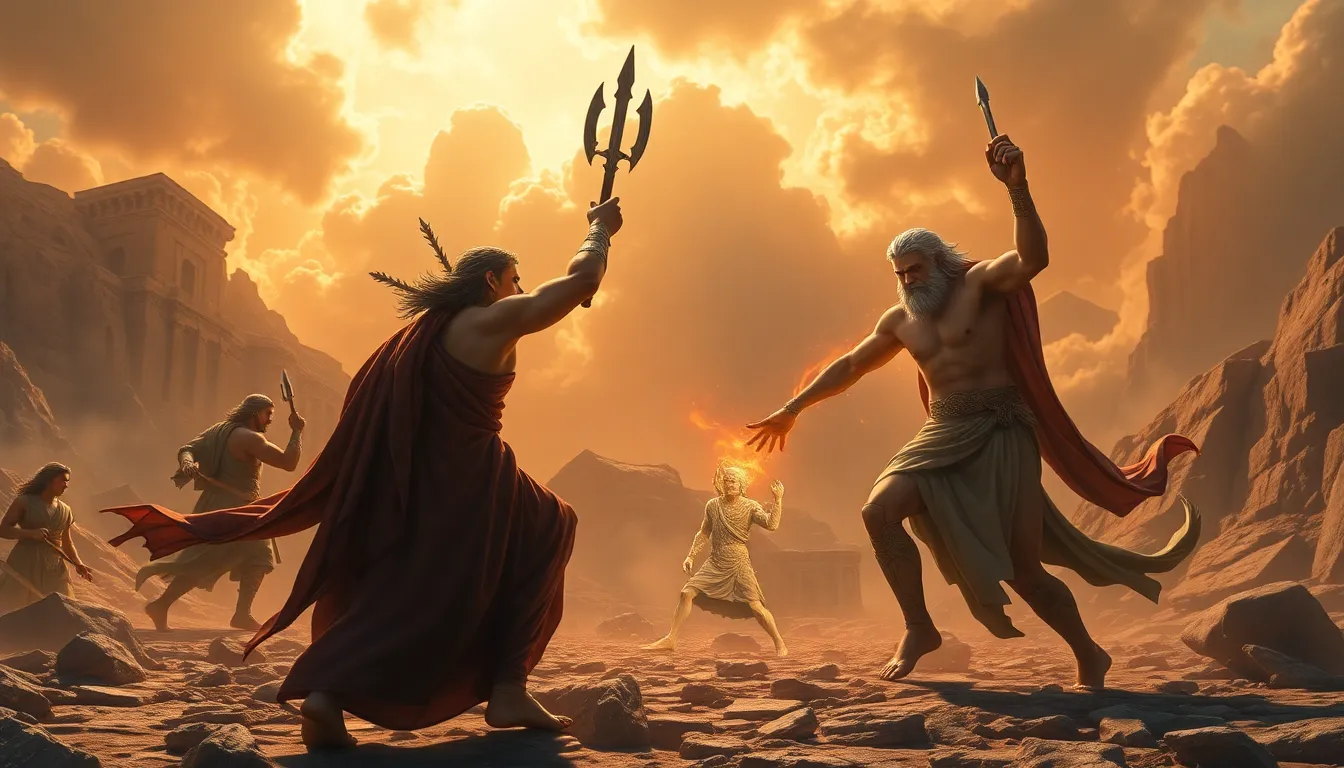
The Clash of Titans: Legendary Encounters with the Gods
I. Introduction
Throughout history, the theme of divine encounters has captivated the human imagination, offering tales of immense power, conflict, and resolution. In various mythologies, these encounters often manifest as titanic battles between gods and titans, reflecting the fundamental struggle between order and chaos, light and darkness, creation and destruction.
Such legendary confrontations not only entertain but also serve as vital cultural narratives, shaping the beliefs, values, and identities of civilizations. This article embarks on a journey through mythological tales, exploring some of the most significant battles between gods and titans, examining their origins, implications, and lasting legacies.
II. Understanding Titans and Gods in Mythology
A. Definition and characteristics of Titans
In Greek mythology, Titans are primordial beings, descendants of Gaia (Earth) and Uranus (Sky). They embody vast natural forces and represent the old order of the universe before the rise of the Olympian gods. Titans are often depicted as colossal figures, possessing immense strength and power, yet they are also characterized by their flaws, such as pride and ambition.
B. The role of gods in various mythologies
Gods, on the other hand, are often seen as more anthropomorphic, dealing directly with human affairs, emotions, and moralities. They govern various aspects of life and nature, from love and war to agriculture and the sea. In many cultures, gods are revered and worshipped, embodying ideals and virtues that societies aspire to.
C. Historical context: Greek, Norse, and other mythological frameworks
While Greek mythology is rich with tales of Titans and gods, similar structures exist in other cultures. The Norse pantheon includes the Aesir and the Jotnar (giants), while Hindu mythology features divine beings and asuras (demons). Each mythology provides a unique perspective on the dynamics of power and the cosmic balance between opposing forces.
III. The Titanomachy: The Epic Battle in Greek Mythology
A. Origins of the Titanomachy
The Titanomachy is one of the most significant events in Greek mythology, representing the struggle between the Olympian gods, led by Zeus, and the Titans, led by Cronus. This epic conflict arose from Cronus’s fear of being overthrown by his children, leading him to swallow them at birth. However, Zeus, the youngest child, escaped and later rallied his siblings to challenge Cronus and the Titan regime.
B. Key figures: Zeus, Cronus, and the Olympian gods
- Zeus: The king of the Olympian gods, associated with lightning and thunder.
- Cronus: The leader of the Titans, known for his ruthless rule and fear of being overthrown.
- Rhea: The mother of Zeus and sister-wife to Cronus, who played a crucial role in saving her children.
- Poseidon and Hades: Brothers of Zeus who joined him in the battle against their father and the Titans.
C. Outcomes and implications of the battle
The Titanomachy lasted for ten years, culminating in the defeat of the Titans. Zeus and his siblings imprisoned the Titans in Tartarus, establishing a new order of gods known as the Olympians. This victory not only solidified Zeus’s position as the supreme deity but also marked a significant shift in the balance of power in the cosmos, symbolizing the triumph of order over chaos.
IV. Norse Encounters: The Aesir vs. the Jotnar
A. Introduction to the Aesir gods and the Jotnar (giants)
In Norse mythology, the Aesir are the principal group of deities, including figures such as Odin, Thor, and Frigg. They are often in conflict with the Jotnar, the giants who embody chaos and primal forces. This conflict reflects the ongoing struggle between civilization and the untamed wild.
B. Notable conflicts: Ragnarok and its significance
One of the most pivotal moments in Norse mythology is Ragnarok, the prophesied end of the world. This cataclysmic event involves a final battle between the Aesir and the Jotnar, leading to the death of many gods and the destruction of the world. It signifies not only physical destruction but also the cyclical nature of existence, where death gives rise to rebirth.
C. The impact of these encounters on Norse cosmology
The conflicts between the Aesir and the Jotnar shape the Norse understanding of fate and the inevitability of change. The myths surrounding Ragnarok also emphasize themes of heroism, sacrifice, and the importance of facing one’s destiny, making them central to Norse cultural identity.
V. Hindu Mythology: The Churning of the Ocean
A. Overview of the Samudra Manthan (Churning of the Ocean)
The Samudra Manthan, or the Churning of the Ocean, is a significant event in Hindu mythology that involves both divine beings (the Devas) and titans (the Asuras). This cosmic event was initiated to obtain the nectar of immortality (amrita) from the ocean of milk.
B. Role of divine beings and titans (asuras) in the event
In this myth, the Devas and Asuras worked together to churn the ocean using Mount Mandara as a churning rod and the serpent Vasuki as the rope. Their collaboration highlights the complex relationships between good and evil in Hindu cosmology.
C. Symbolism and lessons derived from the story
The Churning of the Ocean symbolizes the struggle for knowledge and enlightenment, illustrating that both good and evil must participate in the quest for higher truths. The eventual acquisition of amrita represents spiritual awakening and immortality, emphasizing the importance of cooperation and balance in the universe.
VI. Ancient Egyptian Myths: Ra and Set
A. The conflict between Ra (the sun god) and Set (the god of chaos)
In ancient Egyptian mythology, Ra, the sun god, represents order, light, and life, while Set embodies chaos, darkness, and destruction. The ongoing struggle between these two deities is a fundamental theme in Egyptian cosmology.
B. Significance of their struggle in Egyptian mythology
The conflict between Ra and Set is most notably depicted in the myth of Osiris, where Set murders his brother Osiris and battles Horus, Osiris’s son. This struggle not only represents the cyclical battle between light and dark but also symbolizes the struggle for kingship and legitimacy in ancient Egyptian society.
C. Cultural interpretations of order versus chaos
The narrative of Ra versus Set reflects the Egyptian worldview, where maintaining balance and order (ma’at) was essential for societal harmony. Their conflict serves as a reminder of the perpetual tension between stability and disruption, a theme that resonates across various cultures.
VII. The Legacy of Titan and God Encounters in Modern Culture
A. Influence of mythological battles in literature and film
The epic battles between gods and titans continue to inspire modern storytelling, influencing literature, film, and art. Works such as Rick Riordan’s “Percy Jackson” series and films like “Clash of the Titans” draw upon these ancient myths, reimagining them for contemporary audiences.
B. Analysis of modern adaptations and reinterpretations
Modern adaptations often explore themes of power, identity, and morality, reflecting contemporary societal issues. The reimagining of mythological figures allows for new interpretations, demonstrating the timeless nature of these stories and their relevance to modern life.
C. The enduring fascination with divine conflict in popular culture
The fascination with divine conflict speaks to the human experience, as these myths encapsulate the struggles, aspirations, and fears of humanity. The clash of titans offers a framework for exploring fundamental questions about existence, morality, and the nature of power.
VIII. Conclusion
In conclusion, the legendary encounters between gods and titans across various mythologies provide profound insights into the human condition. From the Titanomachy in Greek mythology to the battles of the Aesir and Jotnar in Norse tales, these narratives reveal the complexities of power, morality, and the eternal struggle between order and chaos.
Understanding these myths not only enriches our knowledge of ancient cultures but also invites us to reflect on our own lives,