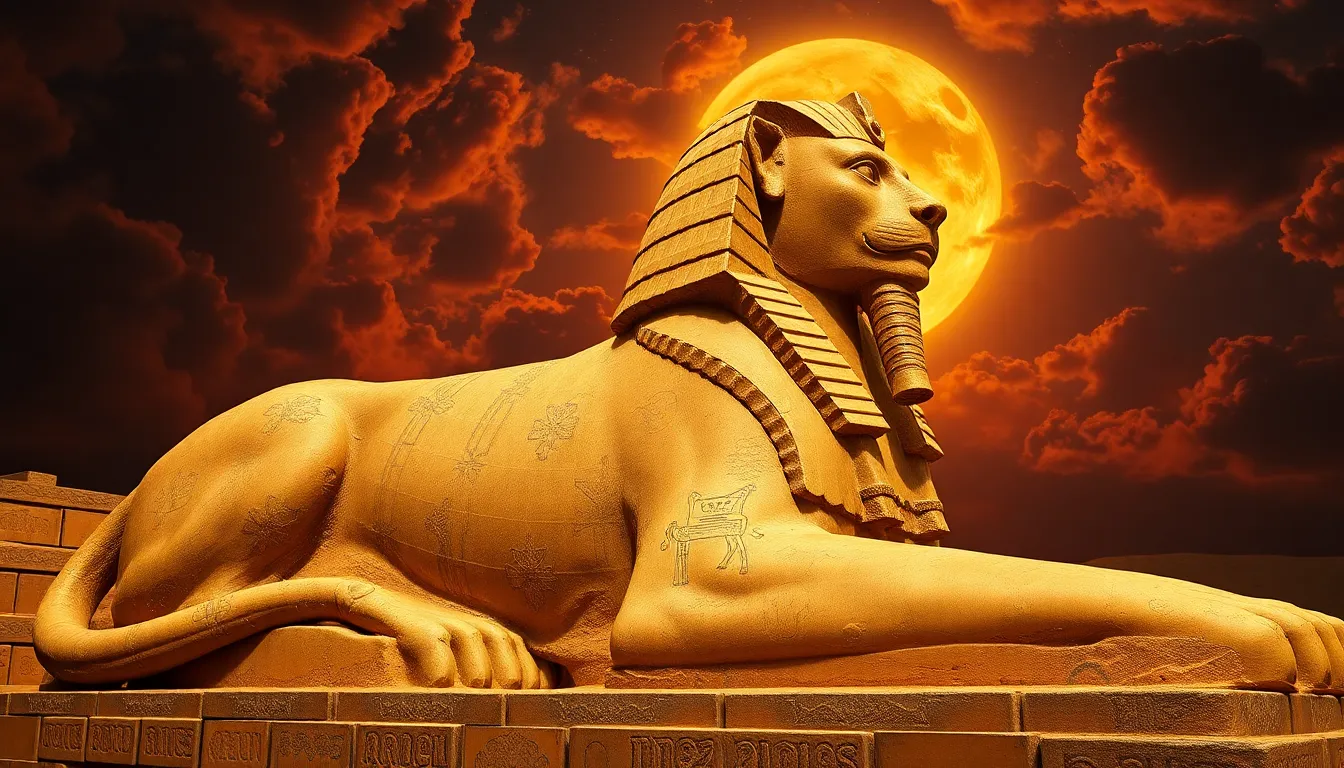
The Enigma of the Sphinx: Riddles and Realms of Mystery
I. Introduction
The Sphinx, an iconic figure of ancient mythology, captivates the imagination of people around the world. With its lion’s body and human head, this enigmatic creature has stood the test of time, symbolizing mystery, strength, and wisdom. The Sphinx holds a significant place in the annals of history, weaving together tales of riddle and revelation, power and peril. Its allure lies not only in its physical grandeur but also in the riddles and myths that surround it.
Throughout centuries, the Sphinx has been a subject of fascination for scholars, archaeologists, and enthusiasts alike. The mysteries that envelop this ancient figure continue to inspire curiosity, prompting exploration into its historical, cultural, and architectural significance.
II. Historical Context
A. The origins of the Sphinx in ancient Egypt
The Sphinx is believed to have originated in ancient Egypt, where it served both religious and symbolic purposes. The most famous Sphinx, known as the Great Sphinx of Giza, dates back to around 2500 BCE during the reign of Pharaoh Khafre. It is carved from limestone and stands on the Giza Plateau, facing the rising sun.
Historically, the Sphinx represents the pharaoh’s power and divine authority, acting as a guardian of the tombs and temples. Its image can be found throughout ancient Egyptian art, signifying not only strength but also protection against evil forces.

B. The Sphinx in relation to the Great Pyramids of Giza
The Great Sphinx of Giza is strategically located near the Great Pyramids, creating a unique trio of monumental architecture that has intrigued historians for centuries. The alignment of the Sphinx, Khufu’s Great Pyramid, and the other pyramids suggests a carefully planned architectural scheme intended to demonstrate the pharaoh’s connection to the divine.
Moreover, the Sphinx’s proximity to these monumental structures reinforces its role as a sentinel, watching over the tombs of the pharaohs and ensuring their safe passage to the afterlife.
III. The Riddle of the Sphinx
A. The famous riddle posed to Oedipus
In Greek mythology, the Sphinx is perhaps best known for its riddle posed to travelers who dared approach its lair. The riddle goes as follows:
- “What walks on four legs in the morning, two legs at noon, and three legs in the evening?”
This riddle was famously answered by Oedipus, who correctly deduced that the answer was “man.” As a baby, a man crawls on all fours; as an adult, he walks on two legs; and in old age, he uses a cane for support.
B. Interpretations and symbolism of the riddle
The riddle of the Sphinx holds deep symbolic meanings. It represents the stages of human life, illustrating the journey from innocence to wisdom. Oedipus’s ability to solve the riddle not only signifies his intelligence but also foreshadows his tragic fate, as he unwittingly fulfills the prophecy of killing his father and marrying his mother.
Furthermore, the Sphinx’s riddle has been interpreted as a metaphor for the quest for knowledge and understanding. The challenge posed by the Sphinx serves as a reminder of the mysteries of existence and the importance of seeking answers to life’s profound questions.
IV. Architectural and Artistic Significance
A. The design and construction of the Sphinx
The Great Sphinx is an architectural marvel, standing at 66 feet tall and 240 feet long, making it the largest monolithic statue in the world. Its construction involved the meticulous carving of the limestone bedrock, showcasing the advanced engineering skills of the ancient Egyptians.
The Sphinx’s face is believed to represent Pharaoh Khafre, and its features have been sculpted with remarkable precision. The statue’s body and head are proportioned in a way that showcases both power and grace, embodying the idealized image of the pharaoh as both a ruler and a deity.
B. Artistic representations of the Sphinx throughout history
The Sphinx has inspired countless artistic representations throughout history. In ancient times, it was depicted in various forms of art, including sculptures, paintings, and reliefs. The image of the Sphinx has also influenced artists in different cultures, serving as a symbol of mystery and enigma.
In modern art and literature, the Sphinx continues to be a source of inspiration. Its presence can be felt in works ranging from poetry to film, where it often represents the allure of the unknown and the quest for truth.
V. Cultural Impact and Legacy
A. The Sphinx in ancient mythology and literature
The Sphinx occupies a prominent place in both ancient Egyptian mythology and Greek literature. In Egyptian mythology, it serves as a protector of sacred spaces, embodying the duality of strength and wisdom. Greek literature, particularly the tragic tale of Oedipus, further solidified the Sphinx’s role as a harbinger of fate and destiny.
From ancient texts to modern interpretations, the Sphinx has been a powerful symbol of the intersection between knowledge and ignorance, inviting exploration of the human condition.
B. Influence on modern culture, art, and popular media
In contemporary culture, the Sphinx continues to captivate audiences. It appears in various forms of media, from movies and television shows to video games and literature. Its enigmatic nature often serves as a plot device, representing challenges that characters must overcome to achieve enlightenment.
- Films such as “The Mummy” and “Transformers: The Last Knight” feature the Sphinx prominently.
- Literary works, including fantasy novels, often draw on the Sphinx’s symbolism to explore themes of knowledge and mystery.
- Video games like “Assassin’s Creed” incorporate the Sphinx as part of their narrative, inviting players to engage with its mythology.
VI. Theories and Speculations
A. Various theories about the purpose of the Sphinx
Scholars and researchers have proposed numerous theories regarding the purpose of the Sphinx. Some of the most prominent theories include:
- Guardian of the Tombs: The Sphinx is thought to have been constructed as a protector of the pyramids, symbolizing the pharaoh’s divine authority.
- Astrological Significance: Some theories suggest that the Sphinx was aligned with celestial bodies, serving as a marker for astronomical events.
- Religious Symbolism: The Sphinx may have represented the pharaoh as a divine being, connecting the mortal world with the gods.
B. Speculations regarding hidden chambers and undiscovered secrets
The Sphinx has long been the subject of speculation regarding hidden chambers and undiscovered secrets. Various archaeological studies have suggested the possibility of tunnels and chambers beneath the Sphinx, potentially leading to treasures or ancient texts.
Some researchers believe that the Sphinx may hold clues to lost knowledge about ancient Egyptian civilization, prompting ongoing investigations and explorations.
VII. The Sphinx in Modern Research
A. Archaeological discoveries related to the Sphinx
Modern archaeological efforts have revealed fascinating insights into the Sphinx’s history and construction. Excavations around the Sphinx have uncovered artifacts, including tools and inscriptions that shed light on the techniques used by ancient builders.
Additionally, discoveries of ceremonial structures and temples near the Sphinx have indicated its importance in ancient religious practices, further enhancing our understanding of its role in Egyptian society.
B. Contemporary studies and technological advancements in Sphinx research
With advancements in technology, researchers are employing new methods to study the Sphinx more thoroughly. Techniques such as ground-penetrating radar and 3D scanning have allowed for non-invasive exploration of the site, revealing potential hidden structures without damaging the monument.
These technological innovations have opened new avenues for understanding the Sphinx’s construction, purpose, and significance in ancient Egypt.
VIII. Conclusion
A. Reflection on the Sphinx as a symbol of mystery and human curiosity
The Great Sphinx of Giza stands as a testament to human creativity, curiosity, and the quest for knowledge. Its enigmatic presence invites exploration and reflection, reminding us of the mysteries that lie at the heart of our existence.
B. The Sphinx’s place in