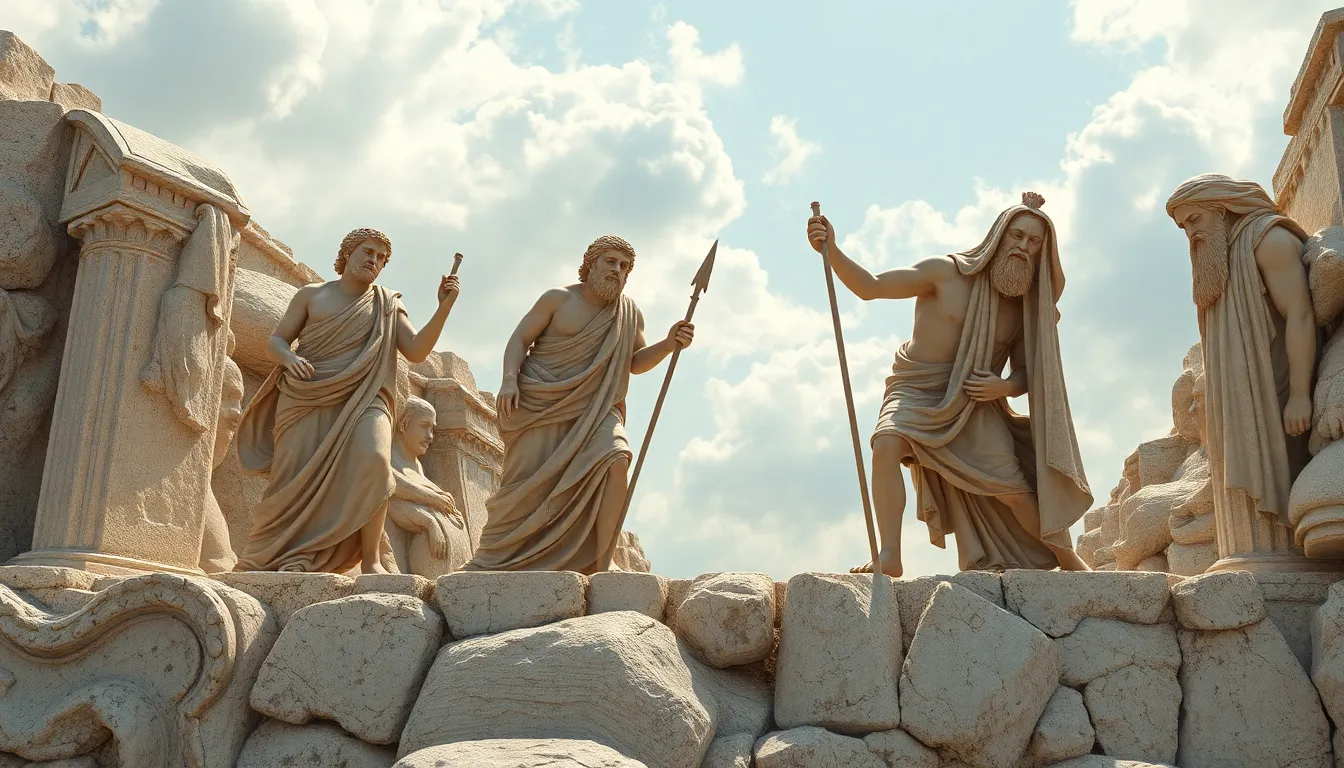
The Fates and Their Connection to the Myth of Sisyphus
I. Introduction
Greek mythology is a rich tapestry of stories, characters, and themes that have captivated human imagination for centuries. It serves not only as a historical record of ancient beliefs but also as a source of moral lessons and philosophical inquiries. Among the many figures in Greek mythology, the Fates stand out as crucial arbiters of destiny, weaving the threads of life and death for every mortal and god alike.
In stark contrast to the Fates is the myth of Sisyphus, a figure doomed to an eternal punishment that reflects profound themes of struggle and futility. Sisyphus, a cunning king, is condemned to roll a boulder up a hill, only for it to roll back down each time he reaches the summit. This article aims to explore the intricate connection between the Fates and the saga of Sisyphus, shedding light on their implications for our understanding of fate, free will, and the human condition.
II. Understanding the Fates
A. Definition and roles of the Fates in Greek mythology
The Fates, known as the Moirai in Greek, are three primordial goddesses who personify destiny. Their very presence in mythology underscores the belief that fate governs the lives of both mortals and deities. The Fates are often depicted as stern, unwavering figures who determine the length and quality of life.
B. The three Fates: Clotho, Lachesis, and Atropos
- Clotho: The spinner of the thread of life, Clotho is responsible for bringing individuals into existence.
- Lachesis: The measure of the thread, Lachesis determines the length of each person’s life and the events that will occur during it.
- Atropos: The inevitable, Atropos is the cutter of the thread, signifying the end of life and the inescapable fate that awaits everyone.
C. Their influence over human destiny and life cycles
The Fates have a profound influence over human destiny, weaving together the narratives of countless lives. Their decisions are final, leaving mortals to navigate the complexities of existence within the boundaries they set. This theme of predestination is pivotal to understanding the myth of Sisyphus.
III. The Myth of Sisyphus
A. Summary of the myth of Sisyphus
Sisyphus, the king of Corinth, was known for his cleverness and deceit. He famously outwitted Death, twice! As a result, he was punished by the gods, who condemned him to roll an immense boulder up a hill in the underworld, only for it to roll back down each time he reached the top. This cycle continues eternally, symbolizing the futility of his struggle.
B. Sisyphus’s defiance of the gods and punishment
Sisyphus’s punishment is rooted in his defiance of divine authority. His attempts to cheat death and manipulate fate angered the gods, leading to a fittingly ironic punishment: a task that is both endless and devoid of purpose, illustrating the limits of human cunning against the will of the divine.
C. Themes of struggle, perseverance, and futility in the myth
The myth of Sisyphus is rich with themes that resonate deeply with the human experience. It embodies:
- The struggle against insurmountable odds.
- The perseverance required to confront hopeless situations.
- The inherent futility of certain endeavors, raising questions about the meaning of existence.
IV. The Concept of Fate in Sisyphus’s Punishment
A. How the Fates determine Sisyphus’s eternal punishment
The Fates play a pivotal role in determining Sisyphus’s punishment. His fate was sealed by their relentless decree, showcasing their omnipotent control over life and death. Sisyphus’s defiance did not alter the course set for him; instead, it reinforced the inevitability of his fate.
B. The inevitability of fate in Sisyphus’s story
Sisyphus’s tale serves as a stark reminder of the inevitability of fate. No matter how clever or resourceful one may be, the threads spun by the Fates cannot be altered. His eternal struggle is emblematic of the human condition, where attempts to escape fate often lead to deeper entanglement within it.
C. The philosophical implications of fate within the myth
The philosophical implications of Sisyphus’s story extend beyond mere punishment. It invites us to ponder questions about the nature of existence, the role of free will, and the quest for meaning in a world governed by forces beyond our control.
V. The Philosophical Interpretations of Sisyphus
A. Overview of existentialist interpretations, particularly by Albert Camus
Albert Camus, in his essay “The Myth of Sisyphus,” presents an existentialist interpretation of the myth. He suggests that Sisyphus embodies the human struggle against the absurdity of life. Camus posits that one must imagine Sisyphus as happy, finding contentment in the struggle itself rather than the end goal.
B. The notion of finding meaning in absurdity
Camus argues that life is inherently devoid of meaning, yet it is through our struggles and choices that we create our own significance. Sisyphus’s ceaseless toil, while seemingly pointless, becomes a source of empowerment as he embraces his fate.
C. The relationship between the struggle of Sisyphus and the concept of fate
The struggle of Sisyphus highlights the tension between fate and personal agency. While the Fates dictate his punishment, Sisyphus’s awareness of his plight allows him to confront and accept his reality, thus finding a modicum of freedom within the confines of his fate.
VI. The Symbolism of the Boulder
A. The boulder as a metaphor for human challenges and fate
The boulder in Sisyphus’s myth serves as a powerful symbol of the challenges that individuals face throughout life. It represents the burdens, responsibilities, and struggles that are often inescapable.
B. The repetitive nature of Sisyphus’s task and its existential significance
The repetitive nature of Sisyphus’s task mirrors the cycles of life, where individuals often find themselves trapped in routines and patterns. This reflects existential themes of monotony and the search for purpose amidst the repetitive nature of existence.
C. The boulder’s connection to the Fates’ control over life and death
The boulder can also be seen as a manifestation of the Fates’ control over Sisyphus’s life. Its weight symbolizes the inescapable fate that hangs over all mortals, emphasizing the inevitability of death and the limits of human agency.
VII. The Intersection of Choice and Destiny
A. Examining the tension between free will and predetermined fate
The myth of Sisyphus raises critical questions about free will and destiny. Are our choices truly our own, or are they merely the threads woven by the Fates? This tension is central to understanding the human experience.
B. Sisyphus’s choices and their implications in the context of the Fates
Although Sisyphus is bound by his punishment, his choices—such as how he approaches his task—reflect the complexities of human agency. His decision to confront his fate with defiance is a testament to the human spirit, even within the confines of predetermined destiny.
C. How this dynamic reflects broader themes in human experience
This dynamic of choice versus fate resonates with broader themes in human experience, where individuals navigate the interplay of autonomy and external forces. Sisyphus’s struggle exemplifies the resilience of the human spirit in the face of insurmountable challenges.
VIII. Conclusion
The myth of Sisyphus, intertwined with the influence of the Fates, provides profound insights into the nature of existence, struggle, and destiny. The Fates’ control over Sisyphus’s eternal punishment underscores the inevitability of fate, while his defiance and perseverance illuminate the complexities of human agency.
As we reflect on Sisyphus’s story, we find enduring relevance in our own lives. The struggle against our challenges, the search for meaning, and the acceptance of our limitations are themes that resonate across time. Ultimately, the myth of Sisyphus invites us to embrace our struggles, finding purpose and resilience even in the face of an indifferent universe.