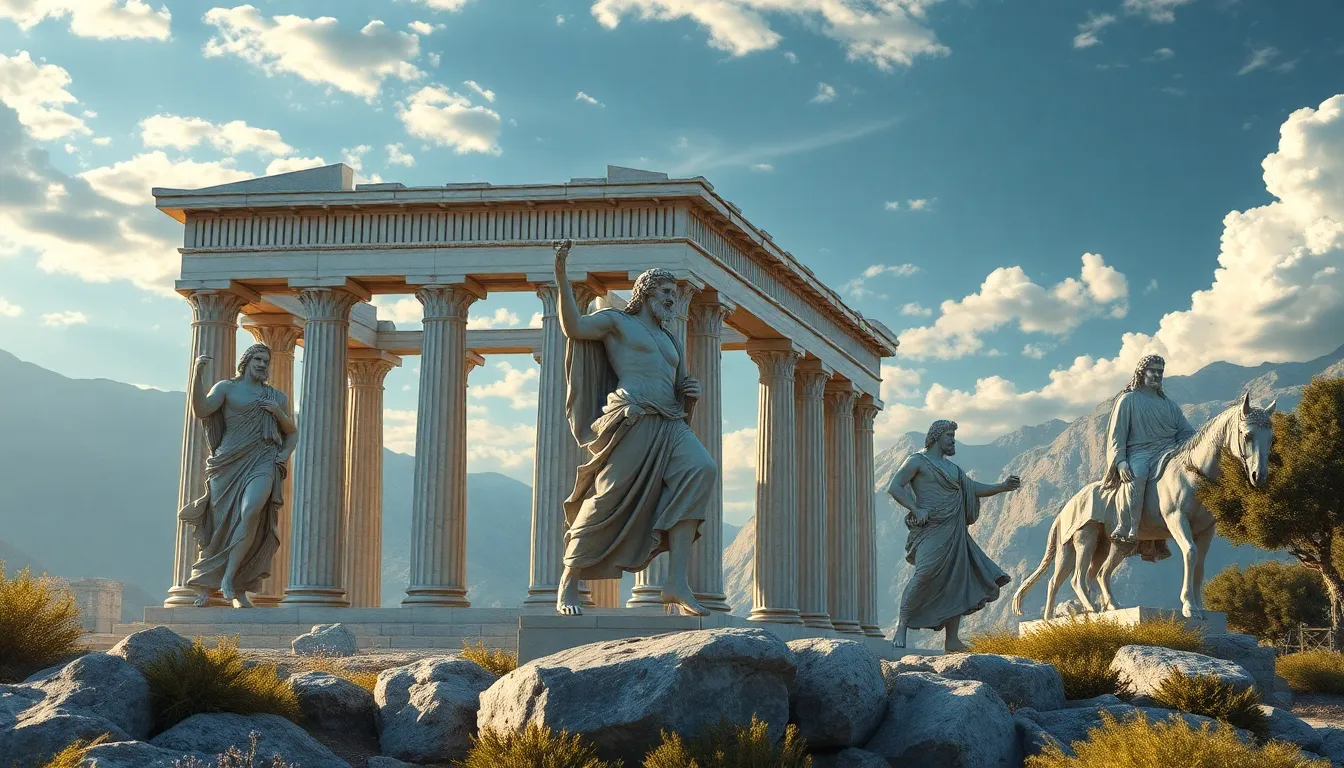
The Influence of Greek Myths on the Development of Western Philosophy
I. Introduction
Greek mythology, a rich tapestry of tales featuring gods, heroes, and mythical creatures, has played a significant role in shaping the cultural and intellectual landscape of Western civilization. These ancient stories not only provided entertainment but also served as vehicles for exploring profound questions about existence, morality, and the human condition.
Western philosophy, which emerged in the context of ancient Greek thought, owes much of its foundational ideas to these myths. The interplay between myth and reason set the stage for philosophical inquiry that would evolve over centuries. This article argues that Greek myths profoundly influenced the development of Western philosophical thought, shaping ideas about ethics, metaphysics, and human nature.
II. The Role of Myth in Ancient Greek Culture
In ancient Greece, myths served various functions within society, deeply embedded in the cultural and religious practices of the time. They were more than mere stories; they were essential in explaining the natural world and human experiences.
- Explanatory Function: Myths provided explanations for natural phenomena, such as the changing seasons, storms, and celestial events, attributing them to the actions of gods and supernatural beings.
- Moral Lessons: Many myths carried moral lessons, teaching values such as bravery, loyalty, and the consequences of hubris. These stories acted as cautionary tales that shaped societal norms.
- Philosophical Inquiry: Myths also spurred early philosophical inquiries. Thinkers began to question the truths embedded in these narratives, leading to a search for rational explanations behind the myths.
III. Early Philosophers and Mythological Influences
As philosophy began to take shape in ancient Greece, early thinkers such as Heraclitus and Pythagoras engaged with mythology in various ways. Their works illustrate the transition from mythos (myth-based understanding) to logos (rational explanation).

A. Pre-Socratic Thinkers
Pre-Socratic philosophers laid the groundwork for later philosophical thought, often grappling with mythological concepts:
- Heraclitus: His notion of the “Logos,” or rational principle, contrasted with the mythological explanations of the cosmos. Yet, his use of metaphor and imagery reflected the influence of myth.
- Pythagoras: Known for his mathematical insights, Pythagoras also integrated religious and mythological elements into his philosophy, viewing numbers as having mystical significance.
B. Mythos vs. Logos
The contrast between mythos and logos became a fundamental theme in the evolution of philosophical thought. While mythos relied on traditional narratives, logos emphasized rationality and empirical observation. This shift marked a significant development in the way humans sought to understand their world.
C. Case Studies
Specific myths influenced the ideas of early philosophers in distinct ways:
- Prometheus: The myth of Prometheus, who stole fire from the gods to give to humanity, was interpreted by many philosophers as a symbol of human progress and the quest for knowledge.
- Orpheus: The story of Orpheus navigating the underworld to retrieve his beloved Eurydice illustrated themes of love, loss, and the human condition, prompting reflections on mortality and the afterlife.
IV. Socrates and the Mythological Foundation of Ethics
Socrates, one of the most significant figures in Western philosophy, utilized mythological narratives to explore complex moral concepts. His dialogues often featured myths that served as allegories for ethical dilemmas.
A. Socratic Dialogues
In his discussions, Socrates employed myths to provoke thought and reflection on ethical issues. For example, the myth of Gyges, which raises questions about morality and the nature of justice, is a pivotal moment in Plato’s writings.
B. Allegorical Significance
The use of myth allowed Socrates to convey deeper philosophical truths. Myths functioned as allegories, illustrating abstract concepts in a more relatable manner, thus making ethical discussions more accessible.
C. Impact on Ethical Frameworks
The narratives Socrates engaged with influenced the development of ethical frameworks that emphasized virtue and the pursuit of the good life. His ideas paved the way for later philosophical explorations of morality, shaping Western ethical thought.
V. Plato’s Use of Myth in Philosophical Discourse
Plato, a student of Socrates, further integrated myth into his philosophical works, using it as a tool to elucidate complex ideas. His dialogues often featured narratives that illustrated his philosophical concepts.
A. The Republic
In “The Republic,” Plato presents the Allegory of the Cave, a powerful myth that serves as a metaphor for enlightenment and the journey toward knowledge. The cave represents the world of appearances, while the journey outside symbolizes the philosopher’s quest for truth.
B. Myths as Illustrative Tools
Plato believed that myths could effectively communicate philosophical ideas that might be difficult to grasp through rational discourse alone. They served to engage the imagination and provoke deeper contemplation.
C. Duality of Myth and Rational Thought
Plato acknowledged the tension between myth and rational thought, often critiquing the reliability of myths while simultaneously employing them to convey his philosophical messages. This duality reflects the complexities of human understanding.
VI. Aristotle’s Critique of Myth and Its Philosophical Implications
Aristotle, a student of Plato, took a more critical stance toward mythology. His approach marked a significant shift in philosophical inquiry, moving away from mythological explanations toward empirical observation and rational analysis.
A. Perspective on Mythology
Aristotle viewed myths as products of imagination that lacked empirical foundation. He believed that while myths could contain moral truths, they were not reliable sources of knowledge.
B. Shift to Empirical Observation
Aristotle’s emphasis on observation and experience laid the groundwork for the scientific method. He advocated for a systematic approach to understanding the world, prioritizing evidence over mythological narratives.
C. Groundwork for Modern Scientific Thought
Aristotle’s critiques of mythology contributed to the development of rational thought and scientific inquiry, influencing later philosophers and scientists who sought to understand the natural world through observation and experimentation.
VII. The Legacy of Greek Myths in Later Philosophical Traditions
The influence of Greek mythology continued to resonate in various philosophical traditions long after the classical period. Roman philosophy, the Renaissance, and the Enlightenment all drew on mythological themes.
A. Influence on Roman Philosophy and the Stoics
Roman philosophers, such as Seneca and Cicero, engaged with Greek myths, incorporating them into their own ethical frameworks. The Stoics, in particular, used myth to illustrate their ideas about virtue and the rational order of the universe.
B. Resurgence in Renaissance and Enlightenment Thought
During the Renaissance, there was a revival of interest in classical texts, including Greek myths. Thinkers like Erasmus and Machiavelli referenced mythological themes to explore human nature and governance.
C. Contemporary Philosophical Discussions
In contemporary philosophy, Greek mythology continues to inspire discussions about identity, morality, and the human experience. Scholars draw upon these ancient narratives to examine modern existential questions, highlighting the enduring relevance of myth.
VIII. Conclusion
The profound influence of Greek myths on Western philosophy cannot be overstated. From the ethical inquiries of Socrates to the metaphysical explorations of Plato and the empirical critiques of Aristotle, these ancient narratives shaped the trajectory of philosophical thought.
As contemporary philosophers continue to engage with mythological themes, it becomes clear that the interplay between myth and reason remains a vital aspect of human understanding. Greek mythology, with its rich symbolism and moral depth, continues to offer insights into the complexities of human nature and ethical dilemmas.
In reflecting on the legacy of Greek myths, we recognize their power not only as stories but as essential components of the philosophical discourse that has shaped Western civilization.