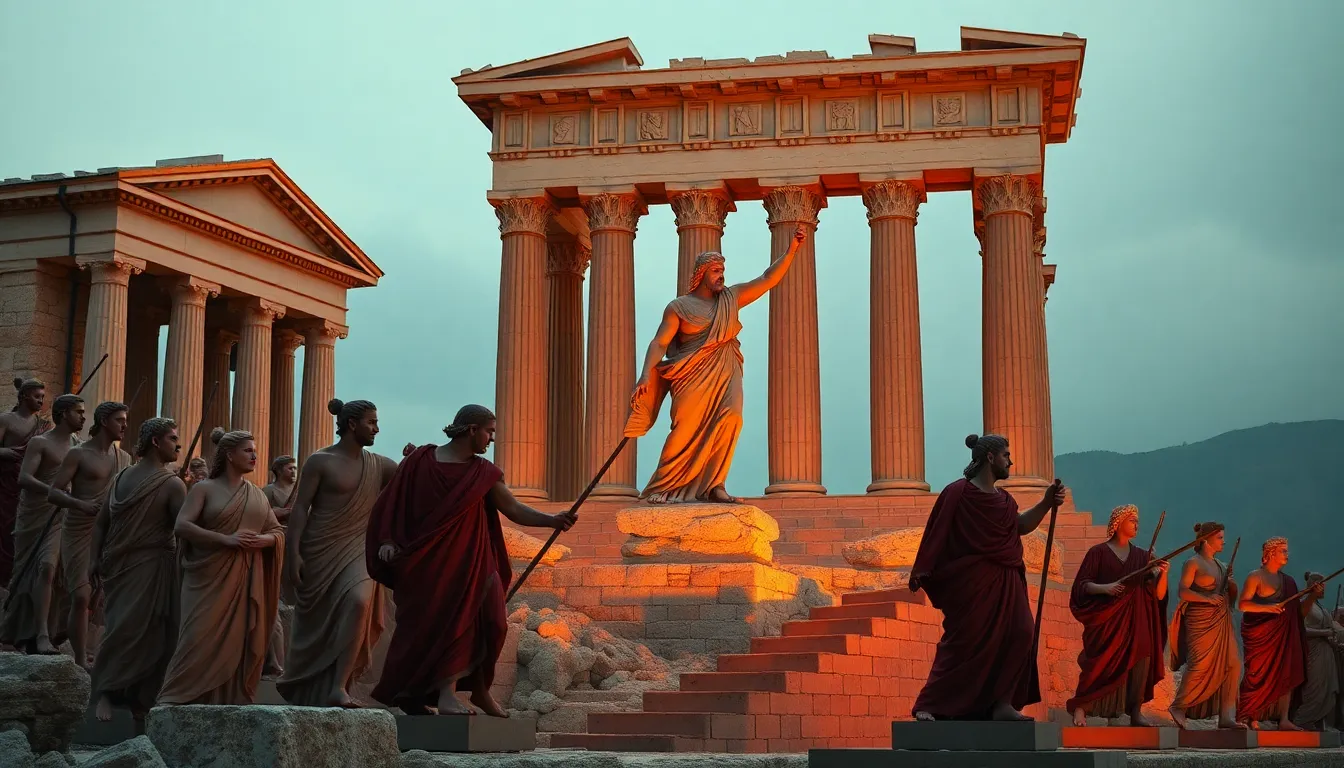
The Legacy of Greek Myths in Today’s Political Discourse
I. Introduction
Greek mythology, a collection of stories and teachings from ancient Greece, has shaped cultural narratives and moral frameworks for centuries. The pantheon of gods, heroes, and mythical creatures served as a foundation for understanding human nature, morality, and the cosmos. As society evolves, the significance of these myths continues to resonate, particularly in the realm of politics.
The intersection of mythology and politics is a rich field for exploration. Myths not only inform cultural identities but also provide powerful allegories for political discourse. By examining how these ancient stories influence contemporary political conversations, we can better understand the enduring impact of Greek myths in shaping societal values and governance.
This article will explore the legacy of Greek myths in modern political discourse, illustrating how these ancient narratives continue to inform political ideologies, rhetoric, and leadership archetypes today.
II. Historical Context of Greek Myths
A. Origins and key narratives of Greek myths
Greek myths originated in the oral traditions of ancient Greece, conveying stories of gods, heroes, and mythical beings. These narratives often explained natural phenomena, human behavior, and life’s complexities. Prominent figures include:
- Zeus: King of the gods, symbolizing authority and justice.
- Athena: Goddess of wisdom and warfare, representing strategic thinking.
- Hercules: A hero known for his strength, embodying perseverance and valor.
These myths were not merely entertainment; they were integral to the cultural and political fabric of ancient Greek society.

B. Role of myths in ancient Greek society and politics
In ancient Greece, myths played a crucial role in shaping civic identity and communal values. They provided moral lessons and served as a means to legitimize political authority. Rulers often invoked myths to substantiate their governance, drawing parallels between their leadership and the heroic qualities of mythological figures. Festivals and rituals dedicated to gods fostered unity and reinforced social hierarchies, linking religion with political power.
C. Influence of mythology on philosophical and political thought
The influence of Greek mythology extends beyond mere storytelling; it has profoundly impacted philosophical and political thought. Philosophers like Plato and Aristotle referenced myths to illustrate complex ideas about human nature, ethics, and governance. For instance, Plato’s “Allegory of the Cave” draws on mythical imagery to discuss enlightenment and the ideal state, using myth as a tool for philosophical exploration.
III. Greek Myths as Political Allegories
A. Examination of specific myths that reflect political themes
Many Greek myths serve as allegories for political themes, reflecting societal values and governance structures. For example:
- The story of Prometheus: His defiance of Zeus and subsequent punishment symbolizes the struggle between authority and individual freedom.
- The tale of Pandora: Represents the unforeseen consequences of human curiosity and the complexities of human nature in governance.
B. Analysis of characters and their symbolic representation in governance
Characters in Greek mythology often embody traits that can be analyzed within a political context. For example:
- Oedipus: A tragic figure whose pursuit of truth leads to downfall, reflecting the dangers of hubris in leadership.
- Theseus: A hero who unites Athens, symbolizing the importance of unity and vision in governance.
C. Case studies of ancient political figures and their use of myths
Political figures in ancient Greece often utilized mythological narratives to establish their legitimacy. For instance, Alexander the Great positioned himself as a descendant of Achilles, drawing on heroic imagery to bolster his authority and inspire his troops. This strategic use of mythology helped solidify his status as a legendary leader.
IV. Modern Political Rhetoric and Mythology
A. How contemporary politicians reference Greek myths
In modern politics, references to Greek myths are prevalent in speeches, campaigns, and public discourse. Politicians often evoke these myths to convey messages of heroism, justice, and moral authority. For example, invoking the story of Hercules can symbolize the struggle against adversity and the pursuit of noble goals.
B. The use of mythological narratives to frame political ideologies
Political ideologies are frequently framed through mythological narratives. For instance, the rise of populism can be likened to the myth of the hero’s journey, where leaders position themselves as champions of the people against oppressive forces. This narrative strategy resonates with voters’ desires for change and empowerment.
C. Examples of political speeches and campaigns invoking Greek themes
Several political figures have drawn on Greek mythology in their rhetoric. Notable examples include:
- Barack Obama: In his speeches, he referenced the “American Prometheus,” drawing parallels between American ideals and the myth of Prometheus.
- Donald Trump: His campaign often invoked themes of strength and heroism, likening himself to mythological figures who confront giants.
V. The Role of Archetypes in Political Leadership
A. Discussion of mythological archetypes in leadership (e.g., hero, tyrant)
Mythological archetypes play a significant role in shaping perceptions of political leadership. The hero archetype, for instance, resonates with voters seeking strong leadership in times of crisis. Conversely, the tyrant archetype reflects fears of authoritarianism and abuses of power.
B. Impact of these archetypes on public perception and political identity
Public perception of leaders can be heavily influenced by these archetypes. For example, a leader embodying heroic traits may garner admiration and support, while one perceived as tyrannical may face backlash and opposition. This dynamic shapes political identities and party affiliations.
C. Analysis of modern leaders who embody mythological traits
Several modern leaders have been analyzed through the lens of mythological archetypes:
- Angela Merkel: Often seen as a pragmatic leader, her approach mirrors the wisdom of Athena.
- Vladimir Putin: His strongman image aligns with the archetype of the tyrant, reflecting authoritarian tendencies.
VI. Cultural Reflections: Literature, Film, and Media
A. Exploration of how modern literature and media reinterpret Greek myths
Modern literature and media frequently reinterpret Greek myths, bringing them to contemporary audiences in relatable ways. These reinterpretations often reflect current societal issues and political dynamics, prompting discussions on governance, ethics, and human behavior.
B. The influence of these reinterpretations on political awareness and activism
Reinterpretations of Greek myths in popular culture can raise political awareness and inspire activism. For instance, films that depict the struggles of heroes against oppressive regimes resonate with audiences facing contemporary social injustices.
C. Case studies of films and books that draw parallels to political discourse
Several films and books have drawn parallels to political discourse through mythological themes:
- The Hunger Games: Reflects themes of rebellion against tyranny, paralleling the myth of Theseus.
- Mad Max: Fury Road: A modern take on the hero’s journey, emphasizing themes of liberation and resistance against oppression.
VII. The Critique of Mythology in Political Contexts
A. Examination of the potential dangers of mythological references in politics
While mythology can enrich political discourse, it also presents dangers. Politicians may manipulate myths to oversimplify complex issues or reinforce harmful narratives. This can lead to the misrepresentation of reality and the perpetuation of stereotypes.
B. Critiques of oversimplification and manipulation of myths for political gain
Critics argue that the oversimplification of mythological narratives can distort public understanding of political issues. By framing complex societal problems within mythological contexts, politicians risk reducing nuanced debates to mere allegories, leaving voters ill-informed.
C. Perspectives on the ethical implications of using mythology in governance
The ethical implications of using mythology in governance are significant. While myths can inspire and unite, they can also mislead and divide. Politicians must navigate this delicate balance, ensuring that their use of mythology promotes informed discourse rather than manipulation.
VIII. Conclusion