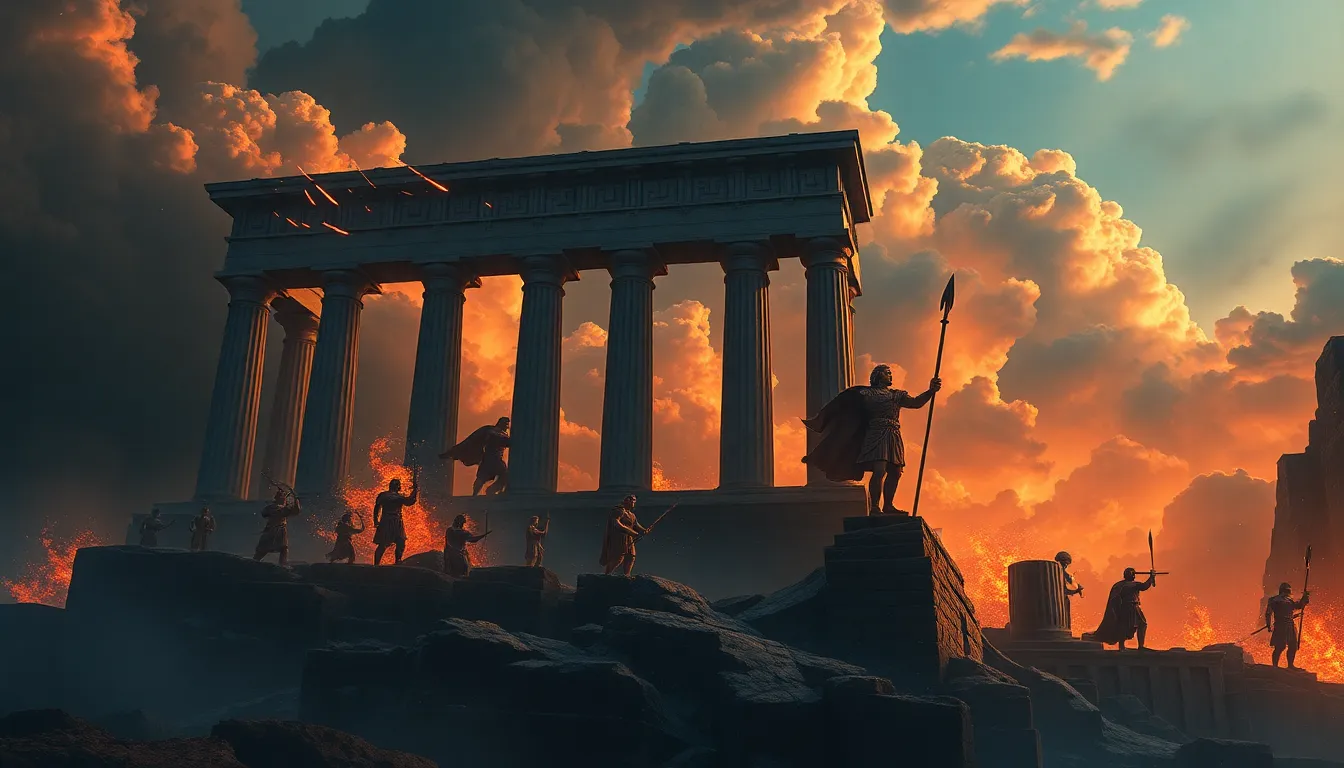
The Mythical War of the Titans: A Timeline of Chaos
I. Introduction to the Titans
The Titans are among the most significant figures in Greek mythology, representing the forces of primordial chaos that existed before the rise of the Olympian gods. Their stories are woven into the fabric of ancient Greek culture, symbolizing the struggle between the old order and the new.
Characteristically, the Titans were colossal beings with immense strength and varied powers. Each Titan had dominion over different aspects of the universe, from the sea to the sky, and even time itself. Their powers were vast, encompassing both creation and destruction, and they played crucial roles in the myths that shaped Greek cosmology.
In relation to the Olympian gods, the Titans were seen as the predecessors and often antagonists. The conflict between them and the Olympians marked a significant turning point in mythology, symbolizing the transition from chaos to order, and the establishment of a new divinity hierarchy.
II. The Origins of the Titan Conflict
The Titan conflict has its roots in the primordial beings Gaia (Earth) and Uranus (Sky). From their union came the first generation of Titans, including Cronus, Rhea, Oceanus, and Hyperion, among others. Their birth represented the emergence of order out of chaos, yet it also sowed the seeds of conflict that would later erupt into war.
A prophecy foretold that one of Uranus’s children would overthrow him, leading to a climactic struggle for power. This prophecy ignited tensions within the Titan family, with motivations deeply interwoven with themes of power, betrayal, and destiny.
- Key Figures:
- Uranus: The sky god, father of the Titans, who feared his children.
- Gaia: The Earth goddess, who instigated the rebellion against Uranus.
- Cronus: The youngest Titan, who ultimately took action to fulfill the prophecy.
III. Prelude to War: The Rise of the Olympians
The overthrow of Uranus was a pivotal moment in Titan mythology. Encouraged by Gaia, Cronus castrated his father, thus ending Uranus’s reign and allowing the Titans to rule. However, this act of violence set off a chain reaction of events leading to further conflict.
As Cronus ascended to power, he became increasingly paranoid about the prophecy that foretold his downfall at the hands of his own children. To prevent this, he swallowed each of his offspring, including Hestia, Demeter, Hera, Hades, and Poseidon, as soon as they were born.
However, Rhea, his wife, managed to save their youngest child, Zeus, by hiding him in a cave on Crete. This act would prove crucial in the unfolding of events, as Zeus grew to challenge his father and the established order.
IV. The Spark of Chaos: The Titanomachy Begins
The Titanomachy, or the War of the Titans, erupted as Zeus emerged to reclaim his siblings and fulfill the prophecy. The initial betrayals occurred within the Titan ranks, leading to a division between those who supported Cronus and those who sided with Zeus.
Key battles and turning points defined the conflict, as the Olympians, led by Zeus, fought against the Titans. The role of Prometheus and Epimetheus became significant, as they chose to side with the Olympians, providing them with the knowledge and weaponry needed to stand against their former kin.
V. Major Battles and Key Events of the Titanomachy
The Battle of Mount Olympus marked the climax of the Titanomachy. The Titans, who had the home advantage, launched their attacks from the heights. However, the Olympians, with their newfound powers and alliances, fought back fiercely.
- Powerful Weapons:
- Zeus’s Thunderbolt: A symbol of his power and authority, it became a critical weapon in battle.
- Hades’s Helm of Darkness: This allowed for stealth and surprise attacks against the Titans.
- Poseidon’s Trident: Used to create storms and earthquakes, turning the tide of battle.
- Mythical Creatures: Various creatures joined the fray, including:
- The Cyclopes, who forged powerful weapons for the Olympians.
- The Hecatoncheires, with their hundred arms, providing immense strength.
VI. The Fall of the Titans
The battle culminated in the defeat of Cronus and the Titans. Zeus and his siblings, bolstered by their allies and the powerful weapons at their disposal, overpowered the once-mighty Titans. The consequences of their loss were dire; they were imprisoned in Tartarus, a deep abyss used as a dungeon of torment.
The fall of the Titans marked the end of an era and the beginning of the Olympian reign. The Titans’ defeat not only reshaped the divine hierarchy but also established a new order in the cosmos, with Zeus as the chief deity.
VII. Aftermath and Legacy of the War
With the Titans vanquished, the Olympian gods rose to power, bringing with them a new era of mythology. Their reign was characterized by a pantheon that would influence countless stories and cultural references throughout history.
The impact of the Titanomachy was immense, as it became a foundational myth that explored themes of power, betrayal, and the cyclical nature of chaos and order. This conflict has been interpreted in various ways through literature, art, and modern storytelling.
- Interpretations:
- The Titanomachy illustrates the struggle between generations, symbolizing the inevitable rise and fall of power.
- It reflects the human condition, as themes of conflict resonate universally across cultures.
- Adaptations in literature and film often draw on the Titanomachy to explore contemporary issues of authority and rebellion.
VIII. Conclusion: The Enduring Myth of the Titan War
The Titan War remains a powerful narrative within Greek mythology, embodying the tension between chaos and order. It serves as a reminder of the cyclical nature of conflict and the transient nature of power.
In modern storytelling, the themes derived from the Titanomachy continue to resonate, often symbolizing the struggle against oppression and the quest for justice. The legacy of the Titans, despite their defeat, endures as a testament to the complexity of myth and the human experience.
Ultimately, the Titanomachy is not merely a tale of war but a rich tapestry of lessons that still hold relevance today, reflecting the timeless struggle between old and new, chaos and order, and the unyielding spirit of rebellion.