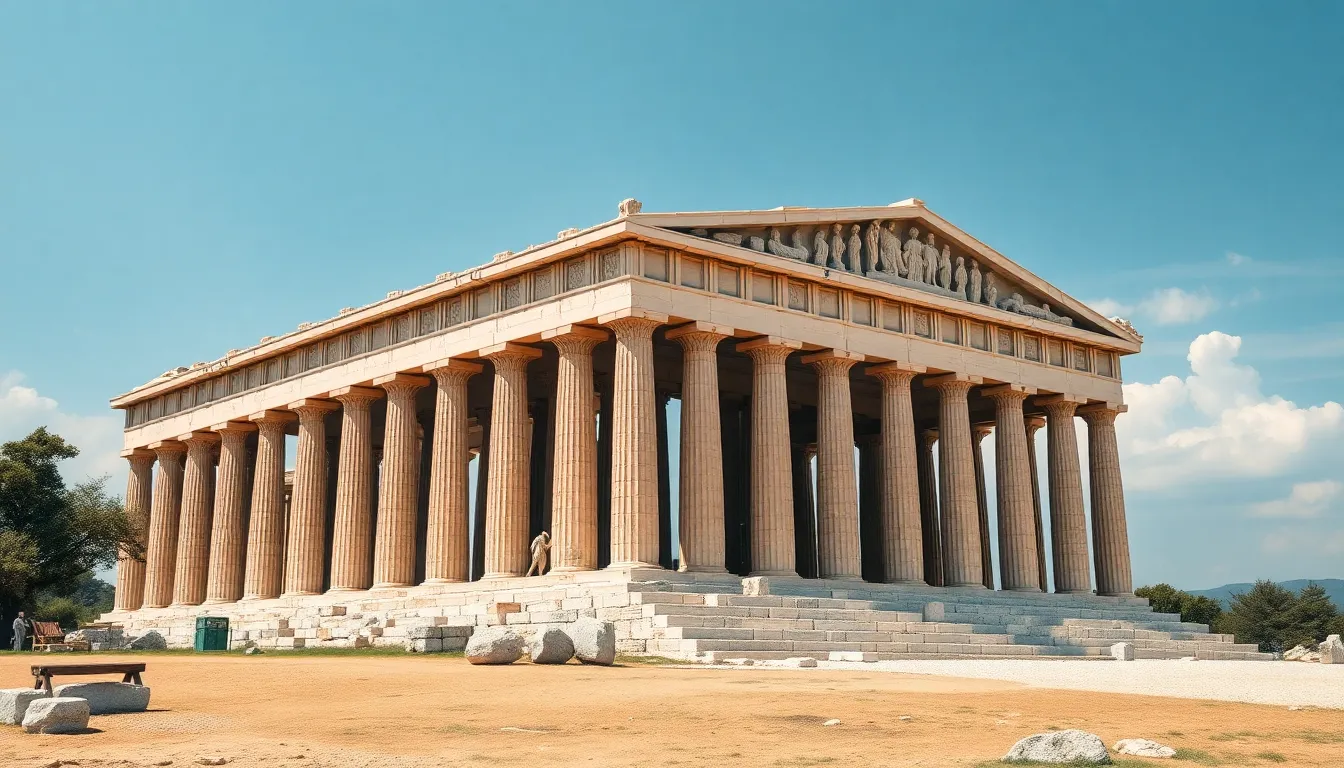
The Parthenon: A Testament to the Power of Ancient Greece
I. Introduction
The Parthenon stands as an enduring symbol of Ancient Greece, representing not only the architectural prowess of its time but also the cultural and political power of Athens during its Golden Age. This magnificent temple, dedicated to the goddess Athena, showcases the values and achievements of a civilization that laid the foundations for Western thought, art, and democracy.
In the broader context of Western civilization, Ancient Greece played a pivotal role in shaping various aspects of modern society, including philosophy, politics, and the arts. The Parthenon, therefore, is not just a relic of the past; it is a testament to the legacies that continue to influence our world today.
This article aims to explore the historical context, architectural marvel, symbolism, artistic achievements, and enduring legacy of the Parthenon, revealing its significance both in ancient times and in contemporary society.
II. Historical Context of the Parthenon
A. The rise of Athens as a powerful city-state
During the 5th century BCE, Athens emerged as one of the most powerful city-states in Greece, primarily due to its naval strength and the leadership of influential figures such as Pericles. The wealth generated from the Delian League, an alliance of Greek city-states, allowed Athens to embark on ambitious building projects, with the Parthenon being the most notable among them.

B. The role of the Parthenon in the political and cultural landscape of Ancient Greece
The Parthenon was not merely a religious structure; it was a symbol of Athenian democracy and power. It represented the unity of the city-state and its citizens, serving as a focal point for religious festivals and civic gatherings. Its construction marked a period of cultural flourishing, where art, philosophy, and science thrived in Athenian society.
C. Key events leading to its construction
- The Persian Wars and the subsequent victory of the Greek city-states.
- The establishment of the Delian League and the increasing wealth of Athens.
- Pericles’ vision for a grand project to showcase Athenian power and devotion to Athena.
III. Architectural Marvel of the Parthenon
A. Design and construction techniques
The Parthenon was designed by the architects Ictinus and Callicrates, with its construction overseen by the sculptor Phidias. Built between 447 and 432 BCE, the temple is renowned for its intricate design and precision in construction. It utilized a combination of local marble and advanced techniques to ensure stability and grandeur.
B. Use of Doric and Ionic styles
The Parthenon is primarily constructed in the Doric style, characterized by its sturdy columns and simple elegance. However, it also incorporates Ionic elements, particularly in the decorative features. The harmonious blend of these styles reflects the aesthetic values of Ancient Greece and showcases the architectural innovation of the time.
C. Innovations in architecture and engineering
The construction of the Parthenon involved several innovations, including:
- The use of entasis, a slight curvature in columns to correct optical illusions.
- The application of precise measurements and proportions to create a sense of balance.
- Advanced techniques for lifting and placing heavy marble blocks.
IV. Symbolism and Religious Significance
A. Dedication to the goddess Athena
The Parthenon was dedicated to Athena Parthenos, the patron goddess of Athens. It housed a massive statue of Athena made of gold and ivory, crafted by Phidias. This dedication reflects the religious importance of the temple and its role in the spiritual life of the Athenians.
B. The Parthenon as a symbol of Athenian democracy and power
As a symbol of Athenian democracy, the Parthenon represented the ideals of civic pride and collective responsibility. It was a manifestation of the city’s commitment to the welfare of its citizens and the celebration of their achievements. The grandeur of the Parthenon served to inspire unity and strength among the Athenian people.
C. Religious practices and rituals associated with the temple
The Parthenon was the center of various religious festivals, including the Panathenaea, which celebrated the goddess Athena. Rituals included:
- Offerings of sacrifices to Athena.
- Processions that showcased the unity of the city-state.
- Artistic performances and competitions in honor of the goddess.
V. Artistic Achievements of the Parthenon
A. Sculptures and friezes: The Parthenon Marbles
The Parthenon is celebrated for its artistic achievements, particularly the Parthenon Marbles, which include exquisite sculptures and friezes depicting various mythological scenes and historical events. These works showcase the height of classical artistry and the skill of sculptors during this period.
B. Contributions of Phidias and other artists
Phidias, as the chief sculptor, played a crucial role in the artistic accomplishments of the Parthenon. His vision and craftsmanship set a high standard for classical sculpture. Other notable artists also contributed to the decorative elements of the temple, ensuring that the Parthenon was a testament to artistic excellence.
C. Influence on art and sculpture in subsequent periods
The artistic legacy of the Parthenon has profoundly influenced subsequent generations of artists and sculptors. Its idealized forms and attention to detail set a benchmark for beauty and harmony in art, resonating through the Renaissance and into modern times.
VI. The Parthenon Through the Ages
A. Transformation from a temple to a church and later a mosque
Over the centuries, the Parthenon underwent significant transformations. After the decline of paganism, it was converted into a Christian church dedicated to the Virgin Mary in the 6th century CE. Later, during the Ottoman Empire, it was repurposed as a mosque, further altering its original function and appearance.
B. Impact of wars and natural disasters on the structure
The Parthenon has faced numerous challenges throughout its history, including:
- The destruction caused by the Venetian bombardment in 1687, which caused significant damage.
- Earthquakes that led to structural instability.
- Looting and neglect during various occupations.
C. Restoration efforts and their challenges
In recent years, extensive restoration efforts have been undertaken to preserve the Parthenon and restore its beauty. These efforts face numerous challenges, including:
- Finding authentic materials to match the original structure.
- Addressing the effects of pollution and environmental wear.
- Balancing preservation with the need for public access and tourism.
VII. The Parthenon’s Legacy
A. Influence on modern architecture and culture
The Parthenon has had a lasting impact on modern architecture, inspiring numerous buildings around the world. Its classical elements are evident in government buildings, museums, and educational institutions, symbolizing democracy and civic pride.
B. The Parthenon as a symbol of Western ideals
As a representation of Western ideals such as democracy, reason, and artistic achievement, the Parthenon continues to be a powerful symbol in contemporary culture. It embodies the aspirations of modern societies to uphold the values of freedom and equality.
C. Ongoing debates over cultural heritage and repatriation of artifacts
The Parthenon’s legacy is also marked by ongoing debates regarding cultural heritage and the repatriation of artifacts. The Parthenon Marbles, housed in the British Museum, have sparked discussions about ownership and the importance of returning cultural treasures to their places of origin.
VIII. Conclusion
In conclusion, the Parthenon is not merely an architectural marvel; it is a testament to the significance of Ancient Greece in shaping the modern world. Its historical context, architectural brilliance, and artistic achievements reflect the values and aspirations of a civilization that continues to inspire us today.
As we reflect on the enduring power of Ancient Greece, it is essential to appreciate and preserve the Parthenon. It stands as a reminder of our shared human heritage and the achievements that define our cultural identity.