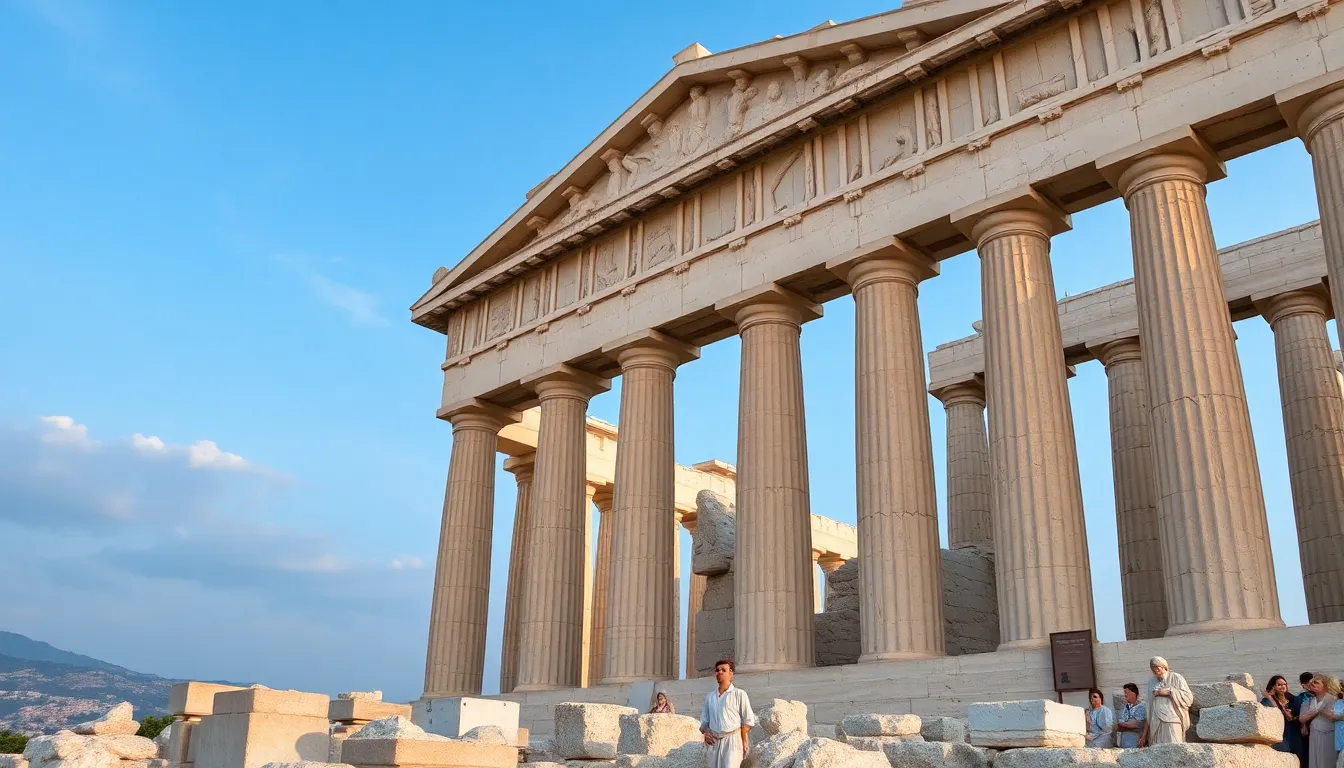
The Parthenon: The Myths of Its Historical Importance
I. Introduction
The Parthenon, a magnificent temple dedicated to the goddess Athena, stands as a lasting symbol of Ancient Greece. Perched atop the Acropolis of Athens, this architectural marvel has not only been a center of worship but has also come to embody the ideals of democracy, art, and culture that defined the Hellenic civilization. However, the narratives surrounding its significance often blur the lines between historical fact and myth. This article aims to delve into the various myths that have emerged regarding the Parthenon’s historical importance, exploring how these narratives shape our understanding of this iconic structure.
II. The Parthenon: A Brief Historical Context
The Parthenon was constructed in the 5th century BCE during the height of the Athenian empire. Commissioned by the Athenian general Pericles, this temple was built to honor Athena Parthenos, the city’s patron goddess. The architectural significance of the Parthenon is immense; it is regarded as a quintessential example of Doric order and features innovations in design that have influenced Western architecture for centuries.
Beyond its architectural prowess, the Parthenon played a crucial role in the context of Athenian democracy. It served not only as a religious site but also as a symbol of the power and wealth of Athens during its Golden Age. The temple was adorned with sculptures and friezes that depicted historical and mythological scenes, reflecting the ideals and values of Athenian society.
III. Myth #1: The Parthenon as the Ultimate Symbol of Democracy
One of the most persistent myths surrounding the Parthenon is its status as the ultimate symbol of democracy. Many view it as a representation of the democratic ideals that flourished in Athens during the 5th century BCE.
- Democratic Ideals: The Parthenon was constructed during a period when democracy was being solidified in Athens, and its grand scale was meant to reflect the power of the people.
- Public Space: Its presence on the Acropolis made it accessible to citizens, reinforcing the idea that worship and civic responsibility were interconnected.
However, while the Parthenon certainly embodies aspects of Athenian democracy, it is essential to recognize that other symbols also played significant roles. For instance, the Agora served as a bustling hub for political discourse and public gatherings, underscoring the democratic practices of the time.
IV. Myth #2: The Parthenon as a Solely Religious Structure
Another common myth is that the Parthenon functioned solely as a religious structure dedicated to Athena. While it is true that the temple was primarily a place of worship, its significance extended far beyond religion.
The Parthenon was a:
- Religious Site: It housed a massive statue of Athena, crafted by Phidias, which was central to Athenian religious life.
- Political Symbol: The temple was a statement of Athenian power and pride, especially during the time of the Delian League.
- Military Stronghold: Throughout various historical periods, including the Byzantine and Ottoman eras, the Parthenon served military functions, adapting to the needs of its time.
This multifaceted role highlights that the Parthenon was not merely a religious edifice but a dynamic structure that evolved with Athenian society.
V. Myth #3: The Parthenon as a Perfect Example of Classical Architecture
Many consider the Parthenon to be the perfect representation of classical architecture, a notion that deserves critical examination. The temple features various architectural innovations, including:
- Doric Columns: The Parthenon showcases the Doric order, characterized by simplicity and strength.
- Optical Refinements: Architects employed subtle curvature in the columns and stylobate to counteract optical illusions, creating an appearance of perfection.
However, the idea of “perfection” in classical architecture is subjective. Critics argue that the Parthenon’s perceived perfection is more a construct of modern appreciation than an absolute standard in ancient times. The variations in measurements and the adaptability of the design reflect the complexity and creativity of Greek architects rather than an unattainable standard of perfection.
VI. Myth #4: The Parthenon’s Enduring Influence Is Exclusive to the Western World
While the Parthenon is often heralded as a Western symbol of democracy and culture, its influence is far-reaching and spans numerous cultures worldwide.
Its impact can be seen in various contexts:
- Neoclassical Architecture: The Parthenon inspired the neoclassical movement in Europe and the United States, influencing the design of government buildings, museums, and monuments.
- Global Cultural Symbol: In countries like India and Japan, the Parthenon’s ideals of democracy and beauty have been appropriated in local contexts, showcasing its universal appeal.
- Political Symbolism: The Parthenon has been a symbol of resistance and national identity in various contexts, including during the Greek War of Independence.
This broader appreciation of the Parthenon underscores that its influence is not limited to the Western world but resonates globally, transcending cultural boundaries.
VII. The Modern Reinterpretation of the Parthenon
In contemporary culture, the Parthenon has been reinterpreted in various ways, often reflecting current societal values and political climates.
Some aspects of its modern reinterpretation include:
- Cultural Icon: The Parthenon is a symbol of cultural heritage, representing the rich history of Greece and its contributions to civilization.
- Political Symbol: It has been used in political rhetoric to evoke democratic ideals and national pride, especially during times of crisis.
- Art and Literature: The Parthenon continues to inspire artists, writers, and filmmakers, serving as a backdrop for discussions about beauty, power, and legacy.
These modern interpretations often reshape the myths surrounding the Parthenon, illustrating how perceptions of historical significance evolve over time.
VIII. Conclusion
In conclusion, the Parthenon stands as a monumental testament to Ancient Greece’s architectural, cultural, and political achievements. The myths surrounding its historical importance reveal much about our perceptions of democracy, religion, and beauty.
Through an examination of the myths discussed, we see that the Parthenon is more than just a relic of the past; it is a dynamic symbol that continues to inspire and provoke thought in our contemporary world. By reflecting on its true historical significance, we can better appreciate the complexities of the Parthenon and its enduring legacy.