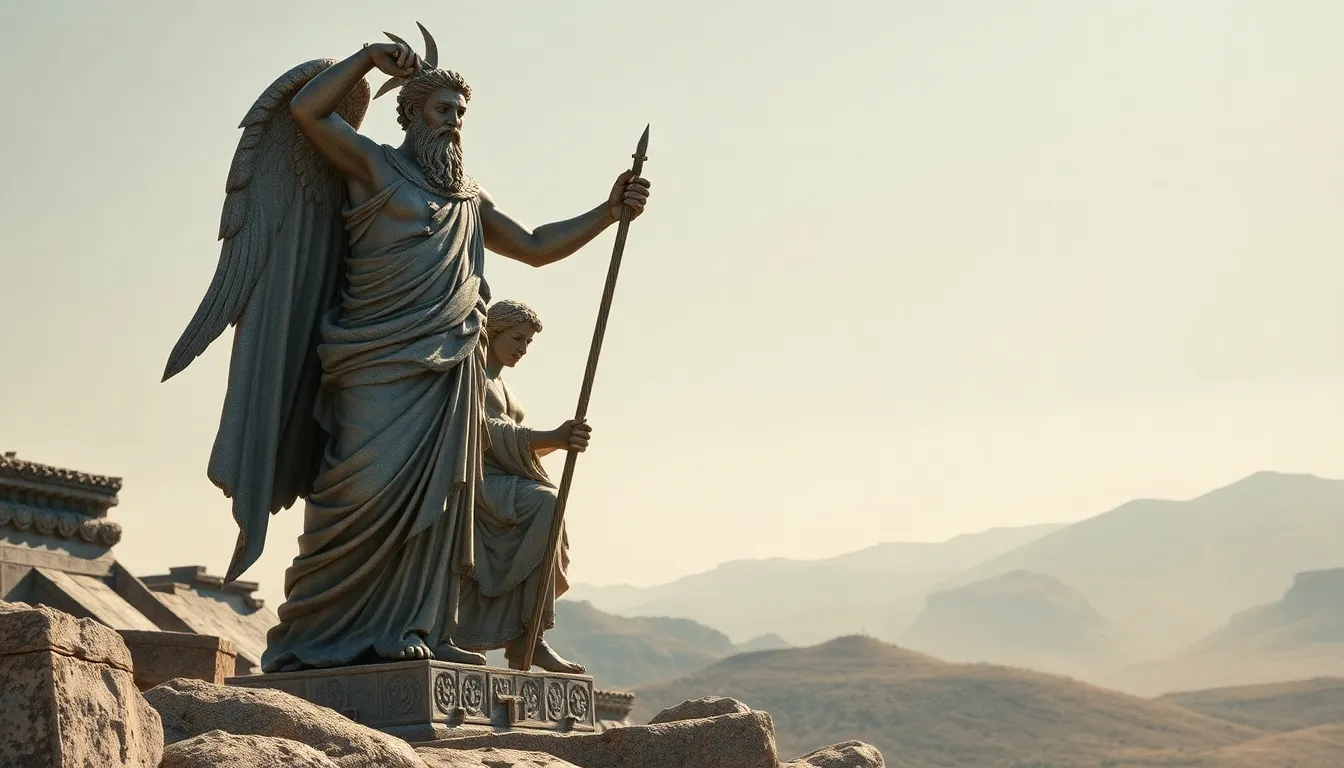
The Role of Myth in Shaping Greek Concepts of Enlightenment
I. Introduction
Enlightenment, in the Greek context, refers to a broad intellectual and cultural movement that emphasizes reason, knowledge, and the pursuit of truth. It is often associated with the emergence of philosophical thought in ancient Greece, where the interplay between myth and rationality played a crucial role in shaping societal beliefs and values.
Myth, as a cultural and philosophical tool, served various functions in ancient Greek society, from providing explanations for the natural world to reinforcing moral and ethical frameworks. Through myth, the Greeks sought to articulate their understanding of existence, the cosmos, and the human condition.
This article aims to explore the intricate relationship between myth and enlightenment in ancient Greece, examining how myths contributed to the development of philosophical thought and the quest for knowledge.
II. Historical Background of Greek Mythology
A. The Origins of Greek Mythology
Greek mythology is a collection of myths and legends that were integral to the ancient Greek worldview. These stories originated from a blend of oral traditions, cultural exchanges, and regional folklore. They often involved gods, goddesses, heroes, and mythical creatures, each representing different aspects of life and nature.
As these myths were passed down through generations, they became deeply embedded in the cultural consciousness of the Greek people, influencing their rituals, art, and literature.
B. Key Myths and Their Significance in Ancient Greek Culture
- The Myth of Creation: Explaining the origins of the world and the gods.
- The Iliad and The Odyssey: Epic tales of heroism, honor, and the human experience.
- The Twelve Labors of Heracles: Symbolizing strength, perseverance, and redemption.
- The Myth of Orpheus and Eurydice: Exploring themes of love, loss, and the afterlife.
These myths not only entertained but also provided moral lessons and cultural identity, forging a collective understanding of the universe and humanity’s place within it.
C. The Relationship Between Myth and Early Philosophical Thought
As Greek civilization evolved, so did philosophical inquiry. Early philosophers like Thales and Anaximander began to question the mythological explanations of the world, seeking rational and empirical understandings instead. This shift marked a transition from mythos to logos, from mythological narratives to philosophical reasoning.
However, even philosophers engaged with myths, interpreting them allegorically to extract ethical and metaphysical insights, demonstrating the enduring relevance of myth in their quest for enlightenment.
III. Myths as Frameworks for Understanding the World
A. How Myths Provided Explanations for Natural Phenomena
In a time when scientific understanding was limited, myths served as essential tools for explaining natural phenomena. For instance:
- The Myth of Demeter and Persephone: Explained the changing seasons and agricultural cycles.
- The Story of Zeus and the Thunderbolt: Offered an understanding of storms and lightning.
These myths provided a narrative framework that helped ancient Greeks make sense of the world around them, attributing natural events to divine actions and interventions.
B. The Role of Myth in Shaping Moral and Ethical Values
Myths were instrumental in conveying moral lessons and ethical values within Greek society. Characters in myths often faced dilemmas that highlighted virtues such as bravery, wisdom, and justice. For example:
- The Story of Odysseus: Emphasized the importance of cunning and intelligence over brute strength.
- The Fable of Aesop: Featured moral stories that taught lessons about human behavior.
These narratives reinforced societal norms and expectations, guiding individuals in their actions and decisions.
C. Myths as Tools for Social Cohesion and Identity
Myth also played a vital role in fostering social cohesion and a sense of identity among the Greek people. Shared myths created a common cultural heritage, binding communities together and providing a collective narrative. Festivals, rituals, and dramatic performances centered around these myths allowed people to connect with their heritage and each other.
Through mythology, the Greeks could articulate their values and beliefs, creating a unified identity that transcended individual differences.
IV. Enlightenment Philosophers and Their Engagement with Myth
A. Overview of Key Greek Philosophers (e.g., Plato, Aristotle)
Several key philosophers profoundly influenced Greek thought and engaged with myth in various ways:
- Plato: Explored the relationship between myth and reality in works like “The Republic,” where he used allegories and myths to convey philosophical ideas.
- Aristotle: Critiqued the mythological explanations of the natural world, advocating for empirical observation and logical reasoning.
These philosophers navigated the tension between the mythological tradition and the emerging rationalist paradigm, often intertwining both in their teachings.
B. Philosophical Interpretations of Myth in Their Works
Plato famously used the myth of the cave to illustrate his theory of forms, positing that the shadows on the wall represent the world of appearances, while the outside world symbolizes the realm of true knowledge. Aristotle, on the other hand, examined myths critically, recognizing their narrative power while emphasizing the need for logical analysis and empirical evidence.
C. The Tension Between Mythological and Rational Thought
This tension between myth and rational thought represents a significant theme in Greek philosophy. While philosophers sought to establish rational frameworks for understanding the universe, the allure of myth remained strong, highlighting the complexities of human thought. Myths continued to inform philosophical discourse, raising questions about the nature of truth, knowledge, and existence.
V. The Myth of Prometheus: A Case Study
A. Summary of the Prometheus Myth
The myth of Prometheus tells the story of the Titan who defied the gods by stealing fire and giving it to humanity. This act not only symbolizes enlightenment and the pursuit of knowledge but also incited the wrath of Zeus, leading to Prometheus’s eternal punishment.
B. Interpretations of Prometheus as a Symbol of Enlightenment
Prometheus has been interpreted as a symbol of enlightenment for several reasons:
- He represents the quest for knowledge and the defiance of divine authority.
- His gift of fire symbolizes the spark of creativity and innovation.
- Prometheus embodies the risks and consequences associated with the pursuit of enlightenment.
His story serves as a cautionary tale about the balance between ambition and humility, illustrating the dual nature of enlightenment.
C. The Myth’s Implications for Knowledge, Power, and Human Progress
The implications of the Prometheus myth extend beyond individual enlightenment to encompass broader themes of knowledge, power, and human progress. It raises questions about the ethical use of knowledge and the responsibilities that come with enlightenment. Prometheus’s punishment underscores the potential dangers of challenging the status quo and the complexities of wielding power.
VI. The Impact of Myth on Education and Knowledge
A. The Role of Myth in Ancient Greek Education Systems
Myth played an essential role in the education systems of ancient Greece. Myths were used as teaching tools in schools, where students learned moral lessons, cultural values, and historical narratives through storytelling. This method of education helped to instill a sense of identity and continuity within society.
B. How Myths Facilitated the Transmission of Knowledge
Myths acted as vehicles for transmitting knowledge across generations. They encapsulated complex ideas and experiences in memorable narratives, making them easier to understand and remember. By engaging with these stories, individuals could grasp fundamental concepts about nature, humanity, and the divine.
C. Myths as a Means of Inspiring Intellectual Pursuit
Furthermore, myths inspired philosophical inquiry and intellectual pursuit. The questions raised by mythological narratives often prompted thinkers to explore deeper truths about existence, morality, and the nature of the universe, ultimately contributing to the flourishing of philosophy in ancient Greece.
VII. The Legacy of Greek Myths in Modern Enlightenment Thought
A. Influence of Greek Mythology on Later Philosophical Movements
The influence of Greek mythology extends beyond its time, significantly impacting later philosophical movements, including the Renaissance and the Enlightenment