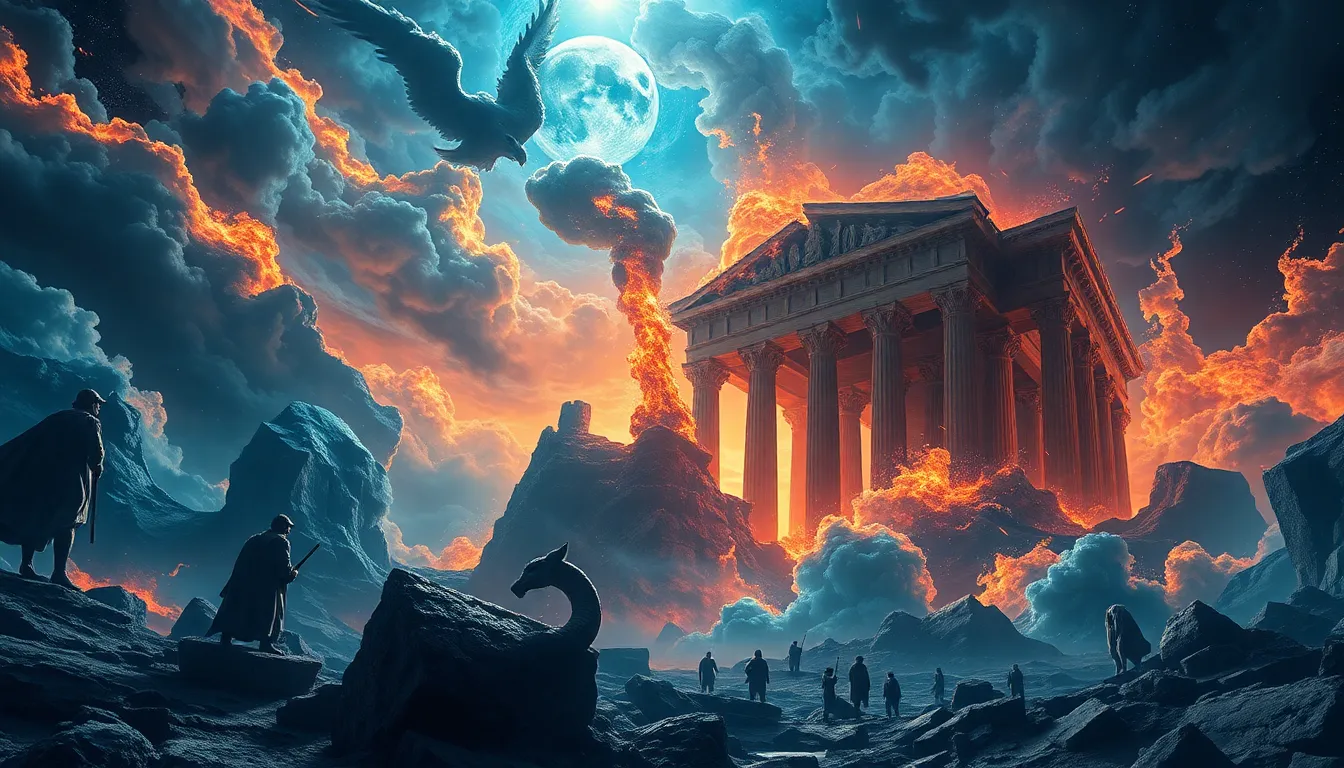
The Titanomachy: The Epic Battle for the Cosmos
I. Introduction to Titanomachy
The Titanomachy refers to the legendary battle in Greek mythology between the Titans, the elder race of gods, and the Olympians, the younger gods led by Zeus. This epic confrontation is not only a tale of warfare but also a significant myth that encapsulates themes of power, rebellion, and the cyclical nature of time and authority.
In this monumental clash, the Titans, who ruled during the Golden Age, faced their offspring, the Olympians, who sought to overthrow their rule. The Titanomachy holds great importance in ancient Greek culture, influencing literature, art, and the very understanding of divine hierarchy.
II. Origins of the Titans and Olympians
The Titans are primarily descended from the primordial deities, who emerged at the beginning of time. They are often considered the first generation of gods and include notable figures such as Cronus, Rhea, Oceanus, and Hyperion. Their reign marked a time of order before chaos ensued.
Zeus, along with his siblings—Hera, Poseidon, Hestia, Demeter, and Hades—represents the Olympians who eventually rose to challenge the Titans. Born to Cronus and Rhea, Zeus and his siblings were destined to confront their father, who had swallowed his offspring out of fear of being overthrown.
Primordial deities such as Gaia (Earth) and Uranus (Sky) played crucial roles in establishing the cosmic hierarchy that ultimately led to the Titanomachy. Their interactions and the resulting offspring set the stage for the epic conflict between the old and new orders.
III. The Prelude to War
The seeds of war were sown with a prophecy foretelling that one of Cronus’s children would overthrow him. This prophecy instilled fear in Cronus, prompting him to swallow each of his offspring at birth. However, Rhea, determined to save her youngest child, Zeus, hid him away in a cave on Crete and tricked Cronus into swallowing a stone wrapped in swaddling clothes instead.
As Zeus grew, tensions among the Titans escalated. Cronus’s fear of his offspring’s potential to overthrow him created an environment of mistrust and division. Some Titans, such as Prometheus and Epimetheus, began to question Cronus’s rule and align with Zeus, setting the stage for the impending conflict.
Alliances began to form as deities took sides. The Titans, who had once ruled with supremacy, found themselves divided in loyalty, while the Olympians united under Zeus’s leadership, ready to reclaim their rightful place in the cosmos.
IV. The Battle Begins: Key Events of the Titanomachy
The Titanomachy began with a fierce mobilization of forces. The Titans, led by Cronus, amassed their strength on Mount Othrys, while the Olympians gathered on Mount Olympus. The battle raged for ten years, characterized by intense confrontations and strategic maneuvers.
Key events included:
- The use of the Cyclopes and Hecatoncheires: Zeus freed these powerful beings from Tartarus, who then aided the Olympians with their formidable strength and weaponry.
- Major confrontations, where both sides unleashed their powers, resulting in epic clashes that shook the foundations of the earth.
- The influence of Gaia, who, feeling remorse for her children (the Titans), provided crucial support to Zeus, guiding him in his quest against Cronus.
V. The Role of Key Figures
Throughout the Titanomachy, several key figures emerged, each playing a pivotal role in the outcome of the battle.
A. Zeus: Leadership and strategy
Zeus, the youngest son of Cronus, demonstrated exceptional leadership and strategic prowess. He rallied the Olympians, forged alliances, and commanded the forces of the Cyclopes, who gifted him the thunderbolt, a symbol of his power.
B. Cronus: The last stand of the Titans
Cronus, despite being a formidable titan, faced the consequences of his tyranny. As the battle progressed, his fear turned into desperation, leading to his eventual downfall.
C. Other notable figures: Prometheus, Atlas, and more
Prometheus, known for his intelligence and foresight, sided with Zeus and became a symbol of rebellion against the oppressive rule of Cronus. Atlas, another Titan, was punished for his loyalty to Cronus, condemned to hold up the sky for eternity after the Titans’ defeat.
VI. The Aftermath of the Titanomachy
The Titanomachy concluded with the resounding defeat of the Titans. Zeus and his siblings established a new order, ruling from Mount Olympus. The victory marked a significant shift in the cosmic balance, as the Olympians became the dominant deities in the Greek pantheon.
The punishment of the Titans varied widely. Most were imprisoned in Tartarus, a deep abyss that served as a dungeon of torment. Some, like Atlas, faced eternal punishment, while others were granted limited roles within the new order.
The legacy of the Titanomachy continued to resonate throughout Greek mythology, influencing subsequent tales of gods, heroes, and the ongoing struggle for power. It set a precedent for future conflicts among deities and established the Olympians as the primary divine authority.
VII. The Titanomachy in Art and Literature
The Titanomachy has been a rich source of inspiration for artists and writers throughout history. Ancient art often depicted scenes of the battle, showcasing the dramatic confrontation between the Titans and Olympians.
Notable depictions include:
- Vases and pottery that illustrate the fierce battles, often highlighting the heroic figures of Zeus and the Cyclopes.
- Sculptures and reliefs that capture the dynamic movements and emotional expressions of the deities engaged in combat.
In literature, the Titanomachy has inspired various works, from Hesiod’s “Theogony,” which provides a detailed account of the origins of the gods and the battle, to modern adaptations that explore the themes of power and rebellion.
Comparatively, the Titanomachy can be analyzed alongside other mythological battles, such as the Norse Ragnarok or the Hindu churning of the ocean, both of which echo similar themes of conflict, creation, and the cyclical nature of divine power.
VIII. Conclusion: The Enduring Legacy of the Titanomachy
The Titanomachy has left an indelible mark on Western thought and culture, influencing not only mythology but also philosophy and storytelling. Its themes of power, rebellion, and destiny resonate deeply within the human experience.
As a narrative of transformation, the Titanomachy reflects the struggles inherent in the pursuit of authority and the inevitable shifts that occur within the divine realm. The story continues to be relevant today, inspiring modern interpretations in literature, film, and art.
Ultimately, the Titanomachy serves as a powerful reminder of the complexities of existence, the fragility of power, and the enduring legacy of mythology in shaping cultural narratives across generations.