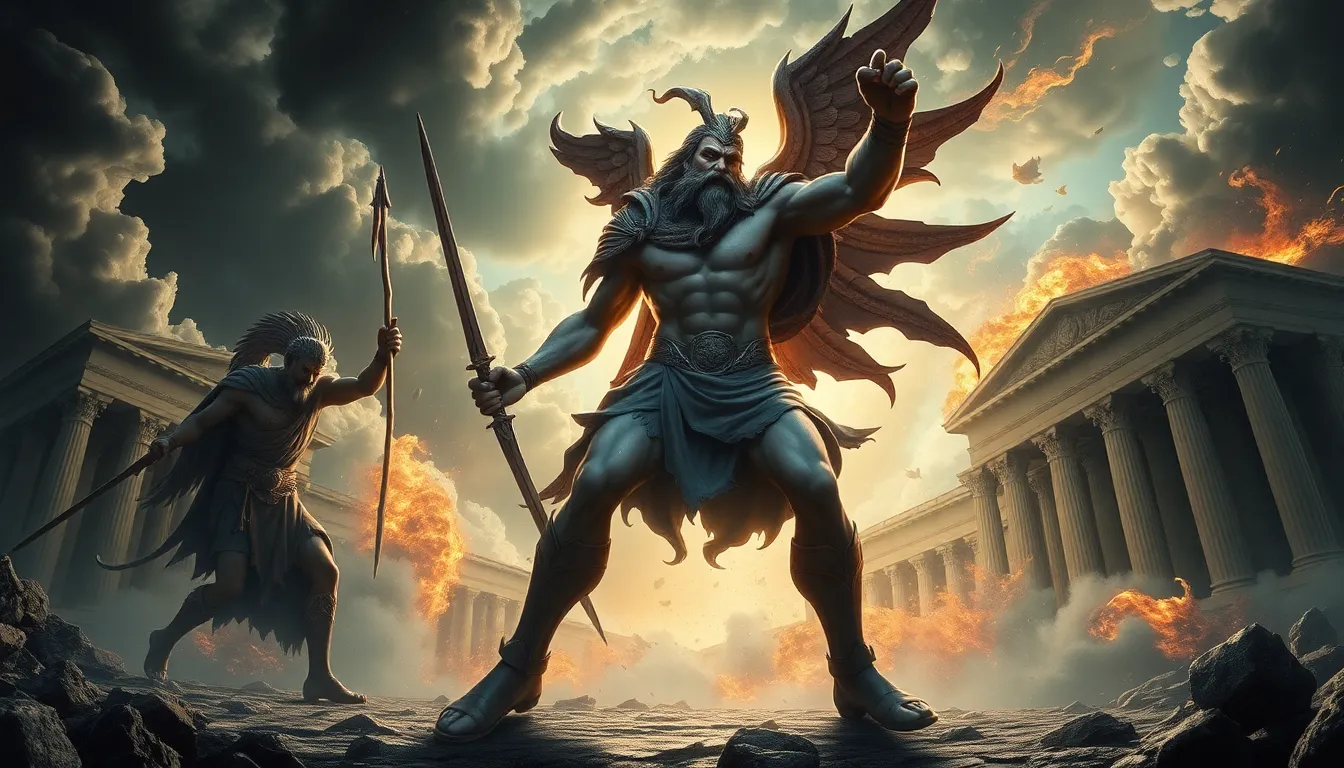
The Titanomachy: The Epic War Between Old and New Gods
I. Introduction
The Titanomachy is one of the most significant and dramatic conflicts in Greek mythology, symbolizing the clash between the old order of the Titans and the new generation of Olympian gods. This epic war was not merely a battle for supremacy but a transformative moment that reshaped the Greek pantheon and the cosmos itself.
In this article, we will explore the origins of the Titans, the rise of the Olympians, the events leading up to the war, the battles fought, and the aftermath of this monumental conflict. Through this exploration, we will uncover the significance of the Titanomachy in Greek mythology and its lasting legacy in culture.
II. The Titans: Rulers of the Primordial World
The Titans were the first generation of divine beings in Greek mythology, descendants of Gaia (Earth) and Uranus (Sky). They were powerful entities that ruled the cosmos before the rise of the Olympian gods. The Titans represented various aspects of the natural world and human experience.
A. Origin and lineage of the Titans
The Titans emerged from the primordial chaos, and their lineage is rich with complex relationships and stories. There were twelve original Titans, including:
- Cronus: The youngest Titan who overthrew Uranus.
- Rhea: The sister and wife of Cronus, known as the mother of the Olympians.
- Oceanus: The Titan of the ocean.
- Tethys: The Titaness of the nourishing flow of water.
- Hyperion: The Titan of light.
- Theia: The Titaness of sight and the shining sky.
- Coeus: The Titan of intellect.
- Phoebe: The Titaness of prophecy and intellect.
- Mnemosyne: The Titaness of memory.
- Themis: The Titaness of divine law and order.
- Iapetus: The Titan associated with mortality and craftsmanship.
- Chronos: Often confused with the personification of time.

B. Key figures among the Titans
Cronus and Rhea are notable figures among the Titans. Cronus, fearing that one of his children would overthrow him, swallowed each of them at birth. Rhea, desperate to save her youngest son, Zeus, hid him away and gave Cronus a stone wrapped in swaddling clothes instead.
C. Their dominion over the cosmos before the war
Before the Titanomachy, the Titans ruled with authority and strength, establishing order in a chaotic universe. Their reign was characterized by both creation and oppression, leading to the eventual discontent of their offspring, the Olympians.
III. The Rise of the Olympians
The Olympian gods emerged as the younger generation that would challenge the Titans. This new pantheon was characterized by their vibrant personalities and diverse powers, reflecting the complexities of the human experience.
A. Birth of the Olympian gods
The Olympians, led by Zeus, were born to Cronus and Rhea. After Zeus was hidden from Cronus, he eventually grew up and returned to confront his father, setting the stage for the Titanomachy.
B. Key figures among the Olympians
Some of the most important Olympian gods include:
- Zeus: The king of the gods, ruler of Mount Olympus, and god of the sky.
- Hera: The queen of the gods and goddess of marriage, known for her jealousy.
- Poseidon: God of the sea, known for his temperamental nature.
- Demeter: Goddess of the harvest and agriculture.
- Athena: Goddess of wisdom and war, born from Zeus’s forehead.
- Apollo: God of the sun, music, and prophecy.
- Artemis: Goddess of the hunt and the moon.
- Ares: God of war, known for his chaotic nature.
- Hephaestus: God of fire and craftsmanship.
- Aphrodite: Goddess of love and beauty.
- Dionysus: God of wine and festivity.
C. The prophecy that foretold the Titan’s downfall
According to prophecy, Cronus would be overthrown by one of his children. This prophecy fueled Cronus’s fears and actions, creating a cycle of violence that would ultimately lead to his downfall.
IV. The Prelude to War
The tensions between the Titans and Olympians grew as Zeus and his siblings sought to reclaim their rightful place in the universe. The conflict was not born from mere ambition but also from deep-rooted familial strife and betrayal.
A. Tensions between Titans and Olympians
As Zeus and his siblings began to unite, the Titans sensed the impending threat. The conflict escalated as the Olympians sought allies and strategized their approach to challenge Cronus’s rule.
B. Key events leading up to the conflict
Several key events set the stage for the Titanomachy:
- Zeus’s rebellion against Cronus.
- The gathering of allies among the Olympians.
- The awakening of the Cyclopes and Hecatoncheires, who were imprisoned by Cronus.
C. The role of Gaia and Uranus in the unfolding drama
Gaia, disillusioned by the Titans’ tyranny, played a crucial role in supporting her grandchildren, the Olympians. She provided counsel and even weapons, such as the thunderbolts forged by the Cyclopes, to aid Zeus in his quest.
V. The Epic Battle: Key Events and Strategies
The Titanomachy was characterized by epic battles and strategic maneuvers that determined the fate of the cosmos. The battlefield, often depicted as Mount Olympus and the surrounding lands, became a site of cataclysmic clashes.
A. Description of the battlefield and its significance
The battlefield was not just a physical space but a representation of the struggle between old and new powers. The Titans, with their brute strength, faced the cunning and strategic prowess of the Olympians.
B. Major battles and turning points
Some of the significant battles included:
- The initial confrontations where Olympians, led by Zeus, used surprise tactics.
- The decisive moment when the Cyclopes and Hecatoncheires joined forces with the Olympians.
- The final battle on Mount Olympus, where Zeus unleashed his thunderbolts against Cronus and the Titans.
C. The use of allies (e.g., Cyclopes, Hecatoncheires)
The Olympians’ success can be attributed to their alliances. The Cyclopes provided Zeus with his iconic thunderbolts, while the Hecatoncheires, with their hundred arms, fought valiantly against the Titans, turning the tide of the battle.
VI. The Aftermath of the Titanomachy
The Titanomachy resulted in a significant shift in power within the Greek pantheon, leading to the establishment of the Olympian rule and the imprisonment of the Titans.
A. Consequences for the Titans and the Olympians
The Titans were defeated and imprisoned in Tartarus, a deep abyss used as a dungeon of torment. The Olympians took over the governance of the cosmos, bringing a new era of order and justice.
B. The fate of the defeated Titans
Most Titans were banished to Tartarus, where they would be watched over by the Hecatoncheires. Some, such as Oceanus, managed to remain neutral and were spared from punishment.
C. Establishment of the new order among the gods
With the victory of