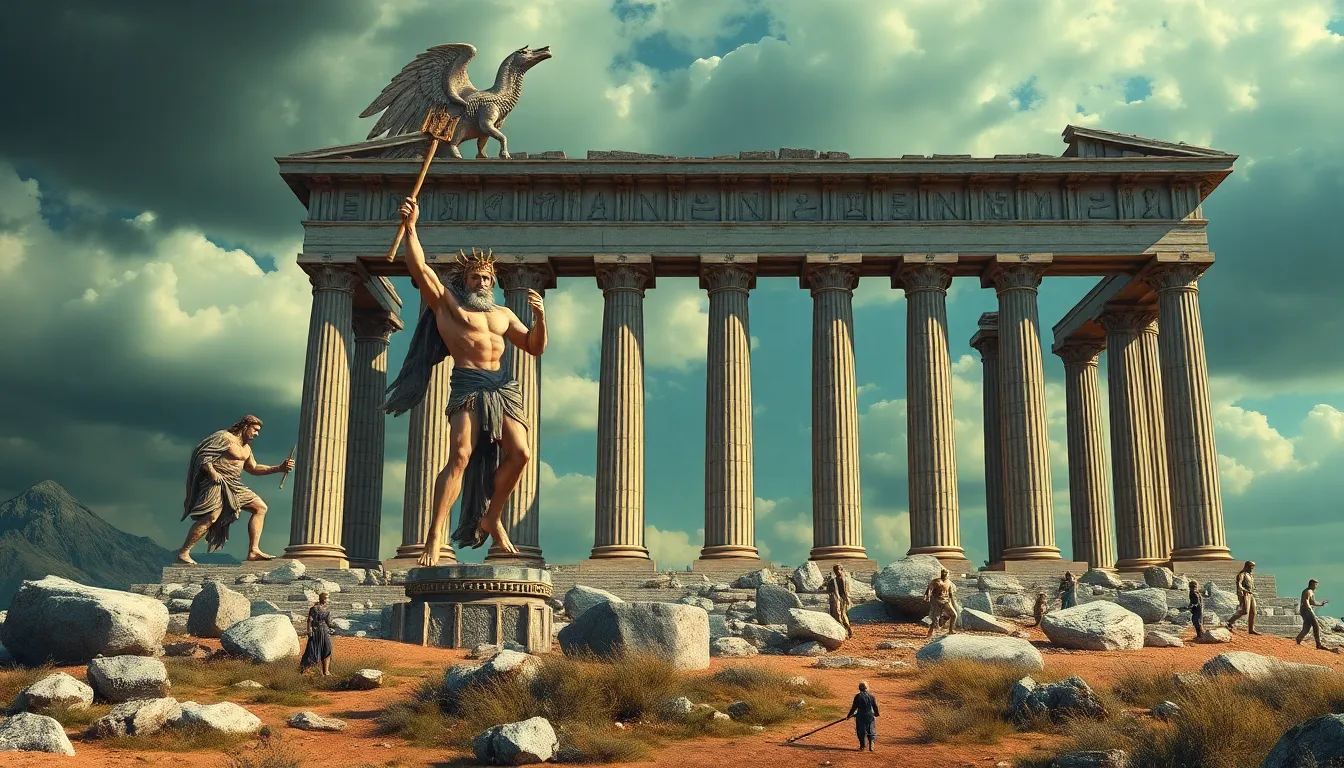
The Titanomachy: The Titans’ Challenge to the Olympian Order
I. Introduction
Greek mythology is a complex tapestry of stories and deities that has captivated human imagination for centuries. It serves not only as a reflection of ancient Greek culture but also as a source of timeless themes such as power, fate, and the struggle between order and chaos. Among the many narratives within this rich tradition, the Titanomachy stands out as a pivotal conflict that shaped the landscape of divine governance in the mythological world.
The Titanomachy, or the War of the Titans, was a monumental battle between the Titans, the elder gods, and the Olympians, the younger generation of deities led by Zeus. This epic confrontation was not merely a clash of powers but a fundamental reshaping of the cosmos itself, marking the transition from the reign of the Titans to the establishment of the Olympian order. Understanding this conflict requires a closer examination of both the Titans and the Olympians, their origins, motivations, and the consequences that followed this epic struggle.
II. The Titans: Origins and Characteristics
The Titans were primordial beings born from the union of Uranus (the sky) and Gaia (the Earth). They represented various aspects of the natural world and human experience, embodying the forces of nature and the fundamental principles of existence. Their lineage is significant, as it sets the stage for the epic confrontations that follow.
Key figures among the Titans include:
- Cronus: The leader of the Titans, known for his ruthless ambition and fear of being overthrown by his children.
- Rhea: The sister and wife of Cronus, who played a crucial role in preserving the Olympian lineage.
- Oceanus: The Titan of the ocean, representing the vast and uncharted waters of the world.
- Tethys: The wife of Oceanus, personifying the nourishing flow of freshwater.
- Hyperion: The Titan of light, often associated with the sun.
- Themis: The embodiment of divine law and order.
- Iapetus: The Titan associated with mortality and craftsmanship.
The Titans ruled during the Golden Age, a time characterized by peace and prosperity, before the ascendancy of the Olympian gods. Their reign, however, was marked by internal strife, ambition, and a growing discontent that would ultimately lead to their downfall.
III. The Rise of the Olympians
The rise of the Olympians began with the birth of Zeus, the youngest son of Cronus and Rhea. Prophecy foretold that one of Cronus’s children would overthrow him, leading him to swallow his offspring as soon as they were born. However, Rhea managed to save Zeus by hiding him in a cave on the island of Crete and presenting Cronus with a stone wrapped in swaddling clothes instead.
As Zeus grew, he was determined to challenge his father and liberate his siblings from Cronus’s belly. With the help of Metis, the goddess of wisdom, he devised a plan to force Cronus to regurgitate his siblings: Hestia, Hera, Demeter, Poseidon, and Hades. This act of defiance marked the beginning of the Olympian order.
Significantly, the rise of Zeus was intertwined with the themes of prophecy and fate. His ascent was not merely a personal victory but a fulfillment of destiny, as foretold by the Oracles. The establishment of the Olympian order brought about a new era in which the gods would reign with a more structured hierarchy and governance.
IV. The Prelude to War: Causes of the Titanomachy
The Titanomachy was not an arbitrary conflict; it was the result of deep-seated discontent among the Titans. As the younger generation of gods began to gain power and popularity, the Titans felt increasingly threatened. Several key events contributed to the buildup of tensions:
- The prophecy regarding Cronus’s downfall created paranoia and mistrust among the Titans.
- Rhea’s secretive actions to save Zeus amplified the divide between the Titans and the Olympians.
- Zeus’s growing power and influence among the other deities drew more followers to his cause.
- The betrayal of certain Titans, such as Prometheus, who sided with the Olympians, further fueled the conflict.
This atmosphere of betrayal and shifting alliances ultimately culminated in the Titanomachy, a war that would determine the fate of the cosmos.
V. The Titanomachy: Key Events of the Conflict
The Titanomachy was an epic battle that lasted for ten years, characterized by fierce confrontations and elaborate strategies on both sides. The Titans, with their immense strength and power, faced the Olympians, who were driven by unity and the desire for freedom from their oppressive rule.
Key events during the conflict included:
- Initial Clashes: The war began with intense skirmishes, as both sides tested their strengths and weaknesses.
- Alliances Formed: The Olympians received crucial support from the Cyclopes and the Hecatoncheires, who were imprisoned by Cronus. The Cyclopes forged powerful weapons, including Zeus’s thunderbolt, while the Hecatoncheires provided immense strength in battle.
- The Final Battle: The decisive confrontation took place on the plains of Phthia, where the Titans and Olympians clashed in a cataclysmic struggle that shook the foundations of the earth.
Ultimately, the Olympians emerged victorious, thanks in large part to their allies and Zeus’s cunning strategies. The defeat of the Titans marked a turning point in the mythology, establishing the Olympians as the dominant force in the Greek pantheon.
VI. The Aftermath of the Titanomachy
The consequences of the Titanomachy were profound, leading to significant changes in the divine order. The Titans who survived the war faced severe punishment; Zeus and the Olympians imprisoned them in Tartarus, a deep abyss used as a dungeon of torment. This act symbolized the complete overthrow of the old order and the establishment of the new.
With the Titans defeated, the Olympians established their rule over the cosmos, bringing about a new era characterized by a more organized and hierarchical structure among the gods. Zeus became the supreme ruler, while his siblings each took their respective domains:
- Hera: Queen of the gods and goddess of marriage.
- Poseidon: God of the sea.
- Hades: God of the underworld.
- Demeter: Goddess of agriculture.
- Hestia: Goddess of the hearth and home.
This shift in power dynamics not only affected the gods but also the mortals who worshipped them, as new myths and stories emerged to reflect the changing relationships between humanity and the divine.
VII. Cultural Impact and Legacy of the Titanomachy
The Titanomachy has left a lasting mark on ancient literature and art, influencing countless works throughout history. This epic conflict has been depicted in various forms, from epic poems and tragedy plays to sculptures and pottery. The themes of the Titanomachy resonate through time, reflecting the universal struggles of power, rebellion, and destiny.
Some notable representations include:
- Hesiod’s “Theogony”: This ancient text provides one of the earliest accounts of the Titanomachy, detailing the genealogy of the gods and the events leading up to the war.
- Ovid’s “Metamorphoses”: The Roman poet Ovid recounts the Titanomachy in a narrative that highlights its significance in the broader context of transformation and change.
- Visual Arts: Numerous ancient artifacts depict scenes from the Titanomachy, showcasing the dramatic clashes between the Titans and Olympians.
The enduring themes of the Titanomachy continue to inspire contemporary works in literature, film, and art, illustrating the timeless nature of its narrative and the fundamental human concerns it addresses.
VIII. Conclusion
In summary, the Titanomachy represents a crucial turning point in Greek mythology, encapsulating the battle between the old order of the Titans and the new order of the