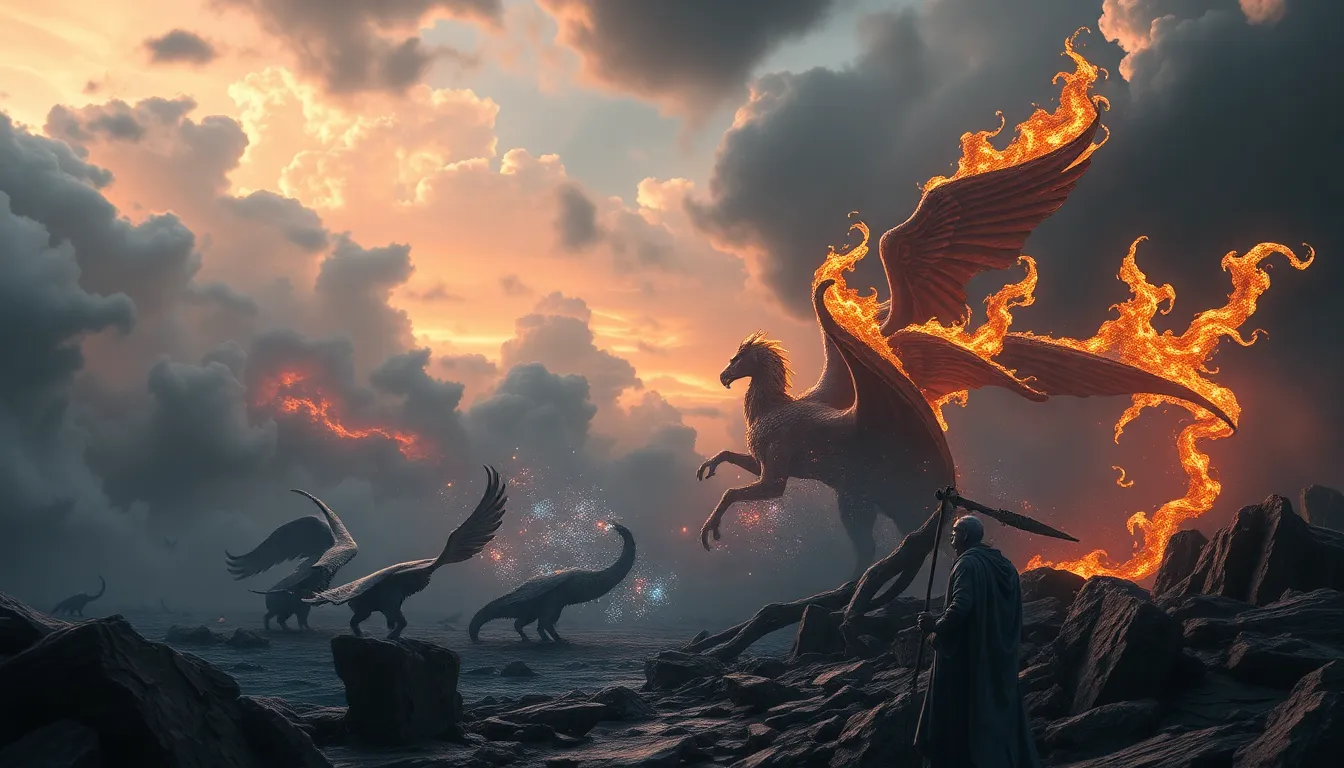
The Titanomachy: The Unfolding of a Legendary Conflict
I. Introduction to the Titanomachy
The Titanomachy, a pivotal event in Greek mythology, refers to the epic battle between the Titans, the elder gods, and the Olympian gods, who were their descendants. This conflict is not just a tale of war; it embodies the struggle for power, the clash of generations, and the quest for supremacy in the cosmos.
The significance of the Titanomachy lies in its role as a foundational myth that explains the rise of the Olympians and the eventual establishment of their rule over the universe. It is a story steeped in themes of ambition, betrayal, loyalty, and the inexorable force of fate, which resonates throughout Greek mythology and informs much of its subsequent narratives.
II. The Titans: Origins and Characteristics
The Titans were a race of powerful deities who predated the Olympians. They are often depicted as colossal beings with immense strength, embodying various aspects of the natural world and human experience. In Greek cosmology, the Titans represent the primordial forces that shaped the Earth and the heavens.
Key Titan figures include:
- Chronos: Often confused with the personification of time, he is the leader of the Titans and associated with the concept of cyclical time.
- Cronus: The youngest Titan, who overthrew his father Uranus, only to be overthrown by his own son, Zeus.
- Rhea: The sister and wife of Cronus, she is the mother of the Olympian gods.
- Oceanus: The Titan of the ocean, representing the vast bodies of water surrounding the Earth.
- Hyperion: The Titan of light, who personifies the sun and the heavenly bodies.
III. The Rise of the Olympian Gods
The Olympian gods, led by Zeus, emerged from the lineage of the Titans but represented a new order of divine beings. Their rise was not merely a matter of succession but a result of rebellion against the oppressive rule of the Titans, particularly against Cronus, who had swallowed his children to prevent them from usurping his throne.
Key events that led to the emergence of the Olympians include:
- The birth of Zeus, who was hidden by Rhea to protect him from Cronus.
- The gathering of Zeus and his siblings—Hestia, Hera, Demeter, Poseidon, and Hades—who would later challenge Cronus.
- The fulfillment of prophecy, which foretold that one of Cronus’ offspring would overthrow him.

IV. The Catalyst for Conflict
The Titanomachy was ignited by a series of events steeped in prophecy and familial betrayal. The critical catalyst was the birth of Zeus, who, after being raised in secret, returned to confront his father. With the aid of his siblings, Zeus sought to end Cronus’ tyrannical rule.
Prophecy played a significant role in this conflict, with the Oracle of Gaia foretelling that Cronus would be overthrown by one of his children. This prophecy instilled fear in Cronus, prompting him to act against his own offspring, which ultimately sowed the seeds of rebellion.
V. The War: Key Battles and Strategies
The Titanomachy was marked by a series of fierce battles that lasted for ten years. The conflict was not only a test of strength but also a demonstration of strategy and alliances.
Key battles during the Titanomachy included:
- The initial confrontations, where the Olympians, though initially outnumbered, utilized cunning tactics to ambush the Titans.
- The climactic battle on the plains of Thessaly, where Zeus unleashed thunderbolts against his enemies.
- The decisive moments when the Cyclopes and Hecatoncheires, whom Zeus freed from Tartarus, joined the Olympian cause, providing powerful weapons and aid.
Strategies employed included:
- Utilizing the element of surprise in early skirmishes.
- Forming alliances with other deities and monsters, such as the Cyclopes who forged Zeus’s thunderbolts.
- Employing guerrilla tactics to overcome the Titans’ brute strength.
VI. Key Figures in the Titanomachy
The Titanomachy featured numerous significant characters, each with their own motivations and contributions to the conflict.
Key figures included:
- Zeus: The central figure of the Olympians, whose leadership and power were pivotal in defeating the Titans.
- Cronus: The leader of the Titans, whose fear of losing power drove him to cruel actions against his own children.
- Rhea: The mother of the Olympians, whose support for Zeus was crucial in the rebellion.
- Prometheus: A Titan who sided with the Olympians, known for his intelligence and for gifting humanity with fire.
- Atlas: A Titan condemned to hold up the sky, who played a role in the aftermath of the war.
These characters exemplified the complexities of loyalty and betrayal, as alliances were formed and broken during the tumultuous conflict.
VII. The Aftermath of the Titanomachy
The Titanomachy culminated in the defeat of the Titans, leading to profound consequences for both sides. The Olympians emerged victorious, establishing their dominance over the cosmos and ushering in a new age of gods. This victory was not without its costs, as the war left scars on the land and in the hearts of the defeated.
Consequences for the Titans included:
- The imprisonment of many Titans in Tartarus, a deep abyss used as a dungeon of torment.
- The shift of power to the Olympians, who redefined the structure of the divine hierarchy.
Long-term effects on Greek mythology and culture included:
- The establishment of Olympus as the home of the gods, where the Olympians would reside and rule.
- The continuation of the theme of generational conflict, as seen in later myths.
- The portrayal of the Olympians as both benevolent and vengeful, reflecting human nature.
VIII. Conclusion: The Legacy of the Titanomachy
The Titanomachy remains a cornerstone of Greek mythology, symbolizing the struggle for power and the inevitable change that comes with each generation. Its enduring themes of conflict, ambition, and the consequences of divine actions echo throughout literature, art, and modern interpretations of mythology.
This legendary conflict has inspired countless works of art, from ancient pottery depicting the battles to modern adaptations in literature and film. The Titanomachy serves as a reminder of the complexities of power dynamics and the cyclical nature of history, where the old must give way to the new.
Ultimately, the legacy of the Titanomachy is a testament to the richness of Greek mythology, where every story interweaves with lessons about humanity, the gods, and the cosmos.