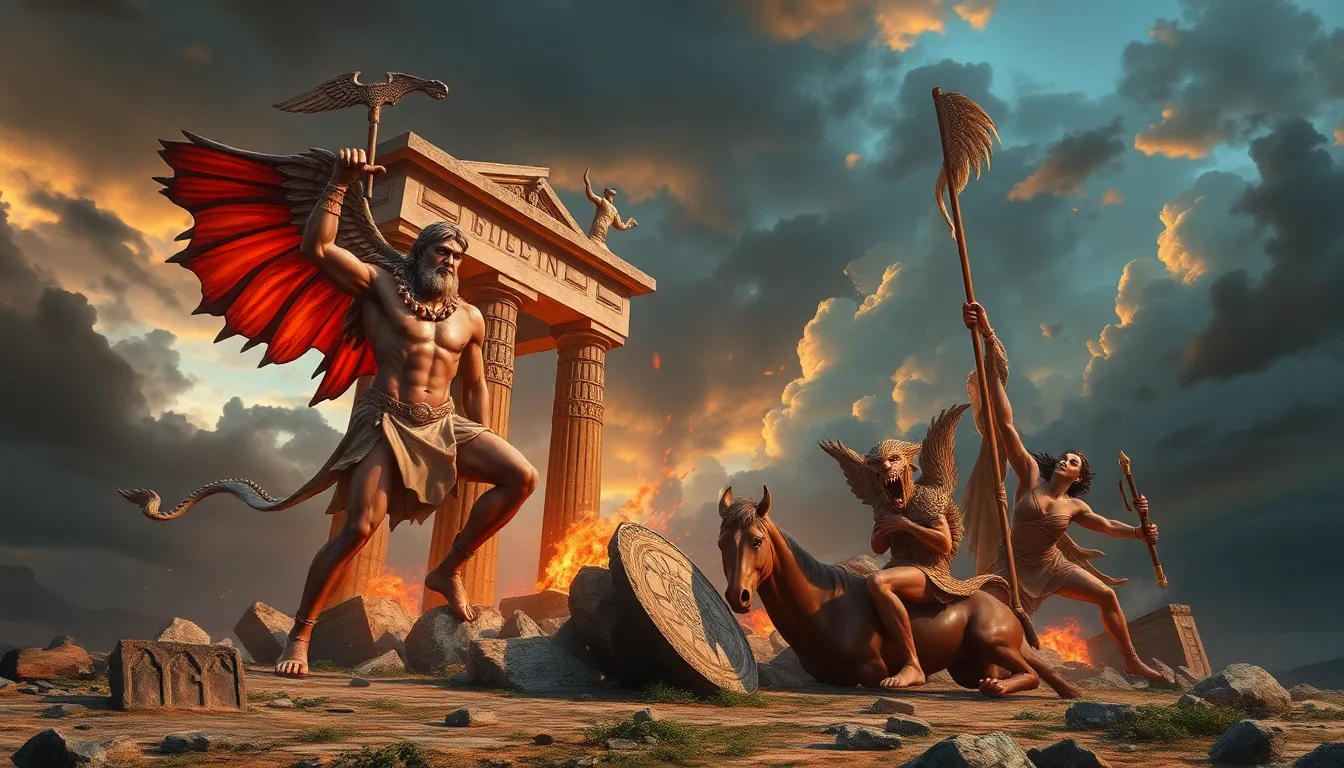
The Titanomachy: Unraveling the Epic Clash of Titans and Olympians
I. Introduction
The Titanomachy is one of the most significant and iconic conflicts in Greek mythology, representing the epic struggle between the Titans, the elder gods, and the Olympians, the new generation of deities led by Zeus. This monumental war not only shaped the hierarchy of divine beings but also established the dynamics of power and rebellion that resonate throughout Greek mythological narratives.
This article will explore the origins of the Titans, the rise of the Olympians, the build-up to the war, the battle itself, its aftermath, and the lasting legacy of the Titanomachy in culture and literature. Through this exploration, we will uncover the themes of power, rebellion, and transformation that are central to this mythological saga.
II. The Origins of the Titans
The Titans were the progeny of Gaia (Earth) and Uranus (Sky), representing the primal forces of nature. Their lineage is significant as it sets the stage for the conflict with the Olympians.
A. Birth and lineage of the Titans
According to myth, the Titans were born from the union of Gaia and Uranus and included twelve principal figures:
- Coeus – Titan of intellect
- Crius – Titan of the constellations
- Hyperion – Titan of light
- Oceanus – Titan of the ocean
- Lapetus – Titan of mortality
- Theia – Titaness of sight
- Rhea – Titaness of fertility
- Themis – Titaness of divine law
- Mnemosyne – Titaness of memory
- Phoebe – Titaness of prophecy
- Tethys – Titaness of the nourishing flow of water
- Chronos – Titan of time

B. Key Titan figures and their roles
Among the Titans, several figures stand out due to their importance in mythological narratives:
- Chronos: Often conflated with time itself, he was a primordial being who played a crucial role in the creation of the cosmos.
- Rhea: The mother of the Olympians, she is often depicted as a nurturing figure who ultimately aids her children in their rebellion against the Titans.
- Oceanus: Representing the vast ocean, he embodies the idea of the all-encompassing nature of water.
C. The Golden Age of the Titans
Before the Titanomachy, the Titans ruled during a period known as the Golden Age, characterized by peace, prosperity, and abundance. This age was marked by:
- Harmony between the Titans and mortals.
- The absence of greed or strife among humans.
- The governance of the cosmos under the Titans’ authority.
III. The Rise of the Olympians
As the generations passed, the Titans’ reign faced challenges, particularly from their own offspring, the Olympians, who were destined to overthrow them.
A. The emergence of Zeus and his siblings
Zeus, the youngest son of Cronus and Rhea, emerged as the central figure in this new generation of gods. His siblings—Hestia, Hera, Demeter, Poseidon, and Hades—played vital roles in the unfolding drama. Zeus’s birth was shrouded in prophecy, which foretold the downfall of his father, Cronus, who devoured his children out of fear of being overthrown.
B. The prophecy and the motivation to challenge the Titans
According to the prophecy, Cronus would be overthrown by one of his children. To prevent this, he swallowed each child at birth. However, Rhea managed to save Zeus by hiding him in a cave on Crete and giving Cronus a stone wrapped in swaddling clothes instead. This act of rebellion set the stage for the eventual conflict.
C. Key Olympian figures and their attributes
The Olympians, characterized by their distinct personalities and domains, included:
- Zeus: King of the gods, god of the sky and thunder.
- Hera: Queen of the gods, goddess of marriage and family.
- Poseidon: God of the sea, earthquakes, and horses.
- Demeter: Goddess of agriculture and the harvest.
- Hades: God of the underworld, ruling over the dead.
- Hestia: Goddess of the hearth and domesticity.
IV. The Prelude to War
The tension between the Titans and the Olympians escalated as Zeus and his siblings grew in power and resolve to reclaim their rightful place in the cosmos.
A. The tension between Titans and Olympians
As the Olympians matured, they began to form their own identities and alliances, which led to growing discontent with the Titans’ rule. The Titans, particularly Cronus, became increasingly tyrannical, leading to dissatisfaction among the younger gods.
B. Major events leading to the Titanomachy
Several key events precipitated the Titanomachy:
- Zeus’s secret gathering of allies, including the Cyclopes and the Hecatoncheires.
- The growing unrest among the other Olympians regarding Cronus’s oppressive rule.
- The eventual release of Zeus’s siblings from Cronus’s belly, which solidified their unity.
C. The alliances formed before the conflict
Before the war, Zeus forged crucial alliances that would prove pivotal. He allied with:
- The Cyclopes, who provided powerful weapons such as the thunderbolt.
- The Hecatoncheires, formidable giants with a hundred arms, who offered their strength in battle.
- The sea nymphs and other lesser gods who opposed the tyranny of the Titans.
V. The Epic Battle: Titan vs. Olympian
The Titanomachy was an epic clash, fought over ten years on the plains of Phthia, where the forces of the Titans and Olympians battled for supremacy.
A. Description of the battlefield
The battlefield was characterized by the rugged terrain of Thessaly, with mountains and valleys providing a dramatic backdrop for the titanic struggle. The sky was filled with thunder and lightning as Zeus unleashed his fury upon the Titans.
B. Key battles and strategies deployed
The war involved numerous skirmishes, but a few key strategies and battles stood out:
- Zeus’s Thunderbolts: The Cyclopes forged powerful weapons for the Olympians, with Zeus’s thunderbolts being the most devastating.
- Hecatoncheires’ Might: The hundred-handed giants overwhelmed the Titans with their sheer strength, hurling boulders and debris.
- Ambush Tactics: The Olympians utilized guerrilla tactics, launching surprise attacks on the Titans to disrupt their formations.
C. Notable confrontations and turning points
Several notable confrontations defined the Titanomachy:
- Zeus vs. Cronus: The ultimate showdown between father and son symbolized the struggle for control of the cosmos.
- Poseidon’s Challenge: Poseidon engaged in fierce battles against Oceanus, the Titan of the sea, asserting his dominion over the oceans.
- Themis’s Betrayal: Some Titans, such as Themis, sided with the Olympians, leading to confusion among Titan ranks.
VI. The Aftermath of the Titanomachy
The Titanomachy concluded with a resounding victory for the Olympians, leading to significant changes in the cosmic order.
A. The fate of the Titans post-war
After their defeat, most Titans were