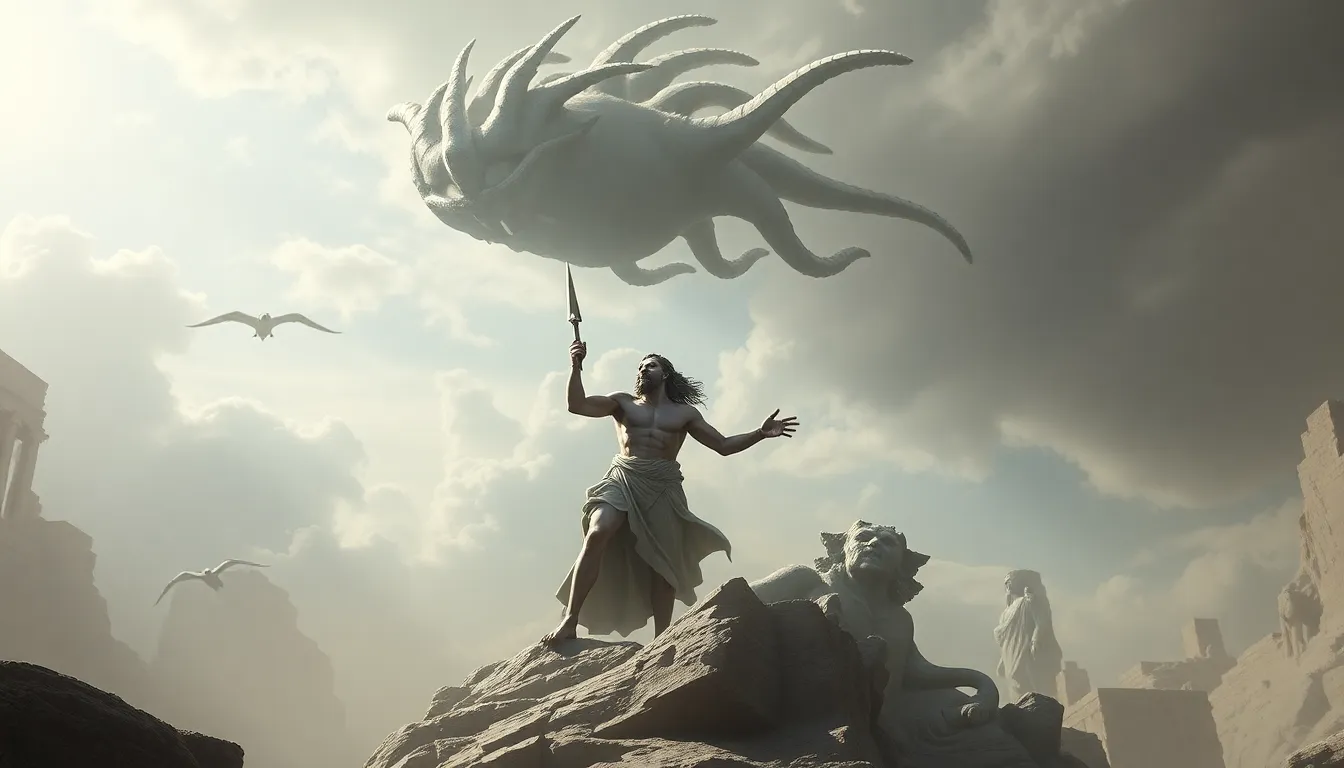
The Tragic Fate of Uranus: A Titan’s Story of Betrayal
I. Introduction
In the vast tapestry of Greek mythology, Uranus stands out as a primordial deity, embodying the sky and the heavens. His significance cannot be overstated; as one of the first beings to emerge from Chaos, he played a crucial role in the formation of the universe and the lineage of the gods. However, his story is not just one of creation and power—it is also a tale steeped in themes of betrayal and tragedy, illustrating the darker aspects of familial relationships among the gods.
II. The Origins of Uranus
Uranus was born from Chaos, the void that existed before the cosmos took shape. His emergence marked the beginning of order in the universe, as he rose to become the sky god, enveloping the earth (Gaia) in a celestial embrace. Together, Gaia and Uranus would give birth to the Titans, Cyclopes, and other primordial beings, establishing a foundational mythos for the ancient Greeks.
- Birth from Chaos: Uranus was one of the first entities to manifest.
- Creation of the Titans: He fathered twelve Titans, who would later play significant roles in Greek mythology.
- Sky God: He became synonymous with the heavens, representing the vastness above.
III. The Rise of Power
Uranus ruled over the heavens with a mighty presence, his dominion stretching across the sky. His marriage to Gaia was both powerful and fruitful, resulting in the birth of the Titans. Under his reign, the world flourished, with the Titans overseeing various aspects of life and nature. However, the seeds of discontent were sown in the shadows.
- Dominion over the Heavens: Uranus controlled the celestial bodies and weather.
- Relationship with Gaia: Their union was pivotal in the creation of the next generation of deities.
- Early Reign: For a time, Uranus enjoyed a prosperous rule, but this would not last.
IV. The Seeds of Betrayal
As time passed, Uranus’s oppressive rule began to take its toll on his offspring. He feared the power of the Titans and, in a bid to maintain control, he imprisoned some of his children deep within the earth. This act of oppression sowed resentment among the Titans, leading to a growing desire for rebellion. Gaia, witnessing her children’s suffering, decided to take matters into her own hands, encouraging the Titans to rise against their father.
- Oppressive Rule: Uranus’s fear of losing power led him to imprison his children.
- Growing Resentment: The Titans, particularly Cronus, began to harbor resentment towards their father.
- Gaia’s Role: She fueled the flames of rebellion, seeking to free her children.
V. The Titanomachy: The Rebellion Against Uranus
The stage was set for a monumental confrontation. Cronus, the youngest of the Titans, took the lead in the rebellion against Uranus. Armed with a sickle forged by Gaia, he ambushed his father during the night. The sickle symbolized both the power of the Titans and the betrayal of familial bonds, as Cronus severed Uranus’s genitals, casting him from the heavens, thus marking the end of his reign.
- The Plot by Cronus: Driven by vengeance and the desire for freedom, Cronus plotted against Uranus.
- Significance of the Sickle: The sickle became a powerful symbol of rebellion and betrayal.
- Confrontation: The overthrow of Uranus marked a significant shift in the cosmic order.
VI. The Aftermath of Betrayal
The defeat of Uranus had far-reaching consequences. With his overthrow, Cronus ascended as the new ruler of the Titans, establishing a new order. However, Uranus’s legacy did not vanish; instead, he was exiled to the depths of the earth, where he continued to exist as a powerful, albeit diminished, figure. His defeat also set the stage for future conflicts among the gods, as the cycle of power continued.
- Consequences of Defeat: Uranus’s fall led to a new era under Cronus.
- Rise of Cronus: Cronus became the new ruler, but his reign would also be marked by betrayal.
- Legacy of Uranus: Though exiled, his influence persisted in the myths that followed.
VII. Themes of Betrayal and Tragedy in Uranus’s Story
Uranus’s tale is rich with themes of betrayal and tragedy, reflecting the complexities of familial relationships in mythology. The story illustrates how power can corrupt, leading to betrayal among even the closest of kin. It also showcases the cyclical nature of power and downfall, as those who rise often face the same fate as their predecessors.
- Familial Betrayal: The story exemplifies how betrayal can arise within families, even among gods.
- Cyclical Nature of Power: The rise and fall of Uranus and later Cronus reflect a perpetual cycle.
- Tragic Hero: Uranus can be viewed as a tragic figure, whose fear of losing power led to his downfall.
VIII. Conclusion
The story of Uranus remains a powerful narrative in Greek mythology, highlighting the enduring impact of betrayal and the complexities of power dynamics within families. Through his tragic fate, we learn valuable lessons about the consequences of oppression and the inevitability of rebellion. Uranus’s story resonates in contemporary discussions about power, family dynamics, and the potential for betrayal that exists in every relationship.