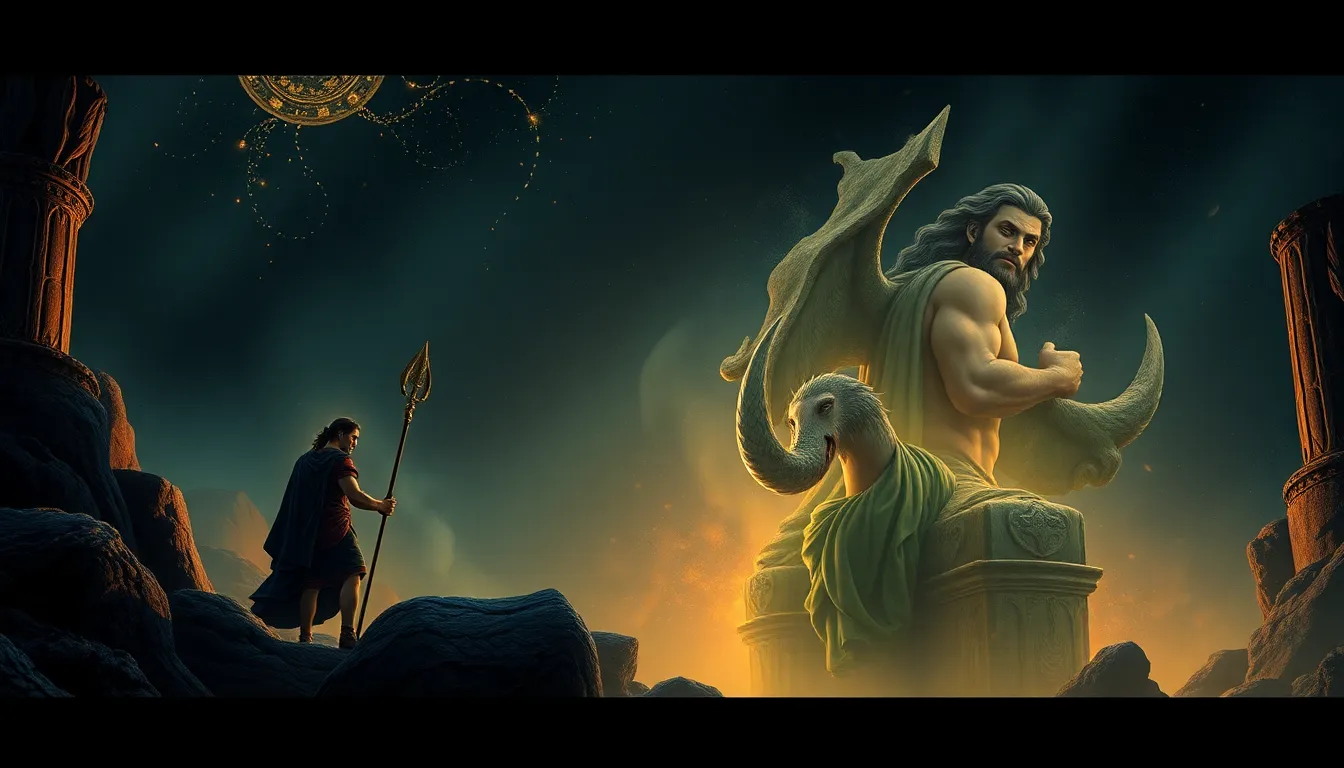
Theseus and the Minotaur: A Hero’s Journey Through Greek Mythology
I. Introduction to Greek Mythology
Greek mythology is a rich tapestry of stories and characters that have shaped Western literature and culture. It encompasses a wide range of tales involving gods, heroes, and mythical creatures, each serving to explain natural phenomena, human behavior, and cultural practices. At the heart of many of these narratives lies the hero archetype, representing ideals of courage, sacrifice, and the quest for identity. One of the most enduring heroes in this tradition is Theseus, whose adventures, particularly his encounter with the Minotaur, illustrate the complexities of heroism in Greek mythology.
II. The Origins of Theseus
Theseus was born into a lineage of significance, being the son of Aegeus, the king of Athens, and Aethra, a daughter of Pittheus, the king of Troezen. His birth is shrouded in myth, with Aegeus leaving a sword and sandals beneath a heavy rock for his son to retrieve when he was strong enough to do so, symbolizing his royal heritage and destiny. Theseus’s early life was marked by numerous adventures and formative experiences that showcased his strength, intelligence, and moral integrity.
- He killed bandits and monsters along the way to Athens, including the notorious Procrustes.
- Each challenge he overcame further solidified his reputation as a hero.
- Theseus’s journey to Athens was not just a physical one but also a rite of passage into manhood.
III. The Labyrinth and the Minotaur
The Labyrinth, a complex maze designed by Daedalus, was constructed to contain the Minotaur, a monstrous hybrid creature with the body of a man and the head of a bull. The Minotaur, born from the union of Pasiphaë and a divine bull, became a symbol of the chaos and darkness lurking within humanity. The Labyrinth itself represents the intricate challenges one must navigate through life, with the Minotaur embodying the fears and obstacles that must be confronted.
IV. The Athenian Tribute to Crete
The myth of Theseus cannot be understood without addressing the historical context of the tribute that Athens was forced to pay to King Minos of Crete. After the death of Minos’s son Androgeus, who was killed in Athens, Minos demanded a tribute of seven young men and seven maidens every nine years to be sent into the Labyrinth as sacrifices to the Minotaur. This grim arrangement reflected the political power dynamics of the era and the desperation of Athens in the face of Crete’s might.
V. Theseus’s Decision to Face the Minotaur
When the time came for the next tribute, Theseus volunteered to be one of the youths sent to Crete, motivated by a desire to end the cycle of sacrifice. His choice was driven by:
- A deep sense of responsibility for his city and its people.
- A determination to confront his own fears and the monstrous Minotaur.
- A belief in destiny, as he sought to prove himself as a true hero.
Theseus’s decision exemplifies the themes of courage and personal sacrifice that are central to hero narratives.
VI. The Journey into the Labyrinth
Before entering the Labyrinth, Theseus met Ariadne, the daughter of King Minos, who fell in love with him and provided him with a ball of thread. This thread would allow him to navigate the maze and find his way back after confronting the Minotaur. The acquisition of Ariadne’s thread symbolizes:
- The importance of guidance and support in overcoming life’s challenges.
- The notion that cleverness and strategy can complement physical strength.
The Labyrinth itself serves as a powerful metaphor for the complexities of life, representing the trials and tribulations that individuals must face on their journey to self-discovery and fulfillment.
VII. The Confrontation with the Minotaur
Upon entering the Labyrinth, Theseus encountered the Minotaur, leading to a dramatic battle that tested his bravery and intellect. Utilizing both his strength and the thread provided by Ariadne, Theseus was able to defeat the beast, demonstrating key themes of heroism:
- Bravery in the face of overwhelming odds.
- The importance of intelligence and strategy over sheer force.
This confrontation marked a pivotal moment in Theseus’s journey, symbolizing the triumph of order over chaos and the hero’s ability to confront his fears.
VIII. Legacy of Theseus: The Hero’s Return
After slaying the Minotaur and escaping the Labyrinth, Theseus returned to Athens as a hero. His success not only saved the lives of the youths but also freed Athens from the oppressive tribute to Crete. However, in his journey back, he neglected to change the sails of his ship from black to white, a signal to his father Aegeus. Upon seeing the black sails, Aegeus, believing Theseus to be dead, plunged into the sea, leading to Theseus becoming the new king of Athens.
The enduring impact of Theseus’s myth is seen throughout various aspects of culture and literature. His story has inspired countless adaptations and interpretations, symbolizing the eternal struggle against adversity and the quest for identity. Theseus stands as a testament to the hero’s journey, embodying the ideals of bravery, sacrifice, and the pursuit of justice within the rich tapestry of Greek mythology.