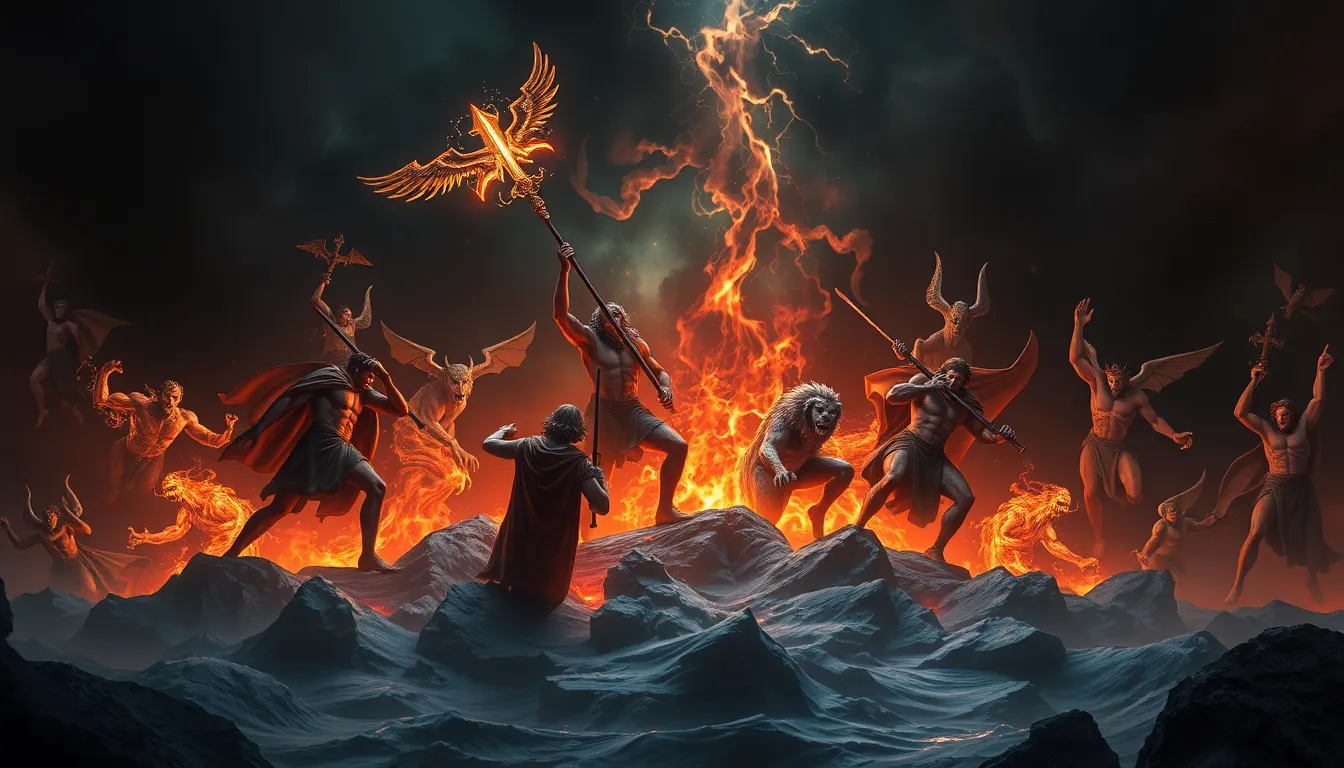
Titans Unleashed: The Dark Side of Greek Mythology
I. Introduction
Greek mythology is a rich tapestry of stories that has shaped Western culture for centuries. It is a complex narrative filled with gods, heroes, and creatures, each embodying specific human traits and moral lessons. One of the most fascinating aspects of this mythology is the Titans, primordial figures who predate the Olympian gods and represent fundamental forces of nature and existence.
The Titans, often depicted as powerful and sometimes malevolent beings, embody themes of darkness, chaos, and moral ambiguity. Their stories reflect the struggle between order and chaos, a recurring motif in human history and psyche. In this article, we delve into the world of the Titans, exploring their origins, their conflicts with the Olympians, and their lasting legacy in both ancient and modern contexts.
II. The Titans: Origins and Characteristics
The Titans were born from Gaia (the Earth) and Uranus (the Sky), emerging at the dawn of the cosmos. They were the first beings to exist, and their creation marked the beginning of a new era in the mythological narrative.
A. The Creation of the Titans in Greek Myths
In Greek mythology, the Titans are often depicted as personifications of various aspects of the natural world. The original twelve Titans include:
- Cronus – The leader of the Titans, associated with time.
- Rhea – The mother of the Olympian gods, symbolizing fertility and motherhood.
- Oceanus – The Titan of the ocean, representing the vast and uncharted waters.
- Tethys – The personification of the nourishing flow of water.
- Hyperion – The Titan of light, associated with heavenly bodies.
- Theia – The Titaness of sight and the shining sky.
- Coeus – The Titan of intelligence and the axis of heaven.
- Pheobe – The Titaness associated with prophecy and the moon.
- Chronos – The Titan of time, often confused with Cronus.
- Mnemosyne – The goddess of memory.
- Prometheus – The Titan known for his intelligence and for stealing fire for humanity.
- Epimetheus – The Titan of afterthought, often portrayed as foolish.
B. Key Titans and Their Roles in the Cosmos
Each Titan had specific roles that contributed to the structure of the cosmos. For instance, Cronus, who overthrew his father Uranus, symbolizes the cyclical nature of time and power. Rhea, as the mother of the gods, represents the nurturing aspect of creation. The duality of the Titans—both creators and destroyers—illustrates the complexity of their characters and the moral ambiguity inherent in their stories.
C. The Symbolism of the Titans in Relation to Chaos and Order
The Titans embody the chaotic forces of nature that precede order. Their existence challenges the notion of a harmonious universe, emphasizing the struggle between chaos and the imposed order of the Olympian gods. This tension reflects the human experience, highlighting the dualities present in life—creation and destruction, love and hate, knowledge and ignorance.
III. The Titanomachy: War Against the Olympians
The Titanomachy, the great war between the Titans and the Olympian gods, is one of the central conflicts in Greek mythology. This epic battle not only determined the fate of the cosmos but also set the stage for the relationships between gods and mortals.
A. Overview of the Titanomachy Conflict
The conflict arose when Cronus, fearing a prophecy that foretold his downfall at the hands of his children, swallowed each of his offspring. However, Rhea saved Zeus by hiding him in a cave and giving Cronus a stone to swallow instead. When Zeus grew up, he rallied his siblings and led a rebellion against the Titans.
B. Key Battles and Strategies Employed by the Titans
The Titanomachy lasted for ten years and was marked by fierce battles. The Titans, despite their immense power, were ultimately outmatched by the Olympians, who had the advantage of strategy and unity. Key events included:
- The use of Cyclopes and Hecatoncheires: The Olympians enlisted these creatures, who provided Zeus with thunderbolts and immense strength.
- Zeus’s cunning tactics: Instead of relying solely on brute strength, Zeus utilized strategy, gathering allies and fostering loyalty among other beings.
- The final battle: The Titans were eventually defeated and imprisoned in Tartarus, a deep abyss used as a dungeon of torment.
C. Consequences of the War for Both Titans and Olympians
The aftermath of the Titanomachy had profound implications:
- The Titans were banished to Tartarus, symbolizing their fall from power and the establishment of order by the Olympians.
- The Olympians solidified their power and established a new order, with Zeus as the supreme ruler.
- This conflict set the stage for future tensions between gods and mortals, as the Olympians dealt with their own insecurities and the potential for rebellion.
IV. Dark Narratives of Betrayal and Revenge
The stories of the Titans are rife with themes of betrayal and revenge, highlighting the darker aspects of their nature. These narratives expose the complexities of their characters, illustrating how ambition and jealousy can lead to tragic consequences.
A. Stories of Betrayal Among the Titans
One of the most notable tales of betrayal involves Cronus, who betrayed his father Uranus by castrating him with a sickle given to him by Gaia. This act of violence set a precedent for the cycle of betrayal that would follow, as Cronus would later betray his own children.
B. The Role of Prophecy and Fate in Their Downfall
Prophecy plays a crucial role in the stories of the Titans. The fear of fate drives many of their actions, leading to tragic outcomes. Cronus’s attempt to avoid his prophesied downfall by consuming his children ultimately led to the very outcome he sought to avoid.
C. Themes of Revenge and Its Implications in Titan Narratives
Revenge is a recurring theme in Titan stories, often leading to cycles of violence and retribution. The conflict between the Titans and Olympians can be seen as a manifestation of these themes, with each side seeking to assert their dominance and avenge perceived wrongs.
V. The Titans in Modern Interpretations
The legacy of the Titans continues to resonate in contemporary culture, influencing literature, film, and art. Their stories have been reimagined to reflect modern themes of heroism, villainy, and moral complexity.
A. How Contemporary Culture Portrays Titans
In modern interpretations, Titans are often depicted as complex characters. They are portrayed not merely as antagonists but as tragic figures whose actions stem from deep-seated fears and desires. This nuanced portrayal invites audiences to empathize with their struggles.
B. The Influence of Titans in Literature, Film, and Art
The Titans have inspired countless works across various mediums. Notable examples include:
- Rick Riordan’s “Percy Jackson” series, where Titans play a significant role in the conflicts faced by young heroes.
- The film “Clash of the Titans,” which reimagines the ancient tales for a modern audience.
- Artistic representations in paintings and sculptures that explore the themes of power and downfall.
</ul