Unveiling the Secrets of the Parthenon: A Journey Through Time
I. Introduction
The Parthenon stands as one of the most iconic symbols of ancient Greece, embodying the height of Athenian democracy and cultural achievement. This magnificent temple dedicated to the goddess Athena is not only an architectural marvel but also a testament to the historical significance of Athens during its Golden Age. In this article, we will explore the architectural, cultural, and historical aspects of the Parthenon, unraveling its secrets and understanding its enduring legacy.
II. The Origins of the Parthenon
A. Historical context of ancient Athens
In the 5th century BC, Athens emerged as a powerful city-state, a center of art, philosophy, and politics. The city flourished under the leadership of Pericles, who championed the construction of monumental structures that would symbolize Athenian power and cultural superiority. The Parthenon, completed in 432 BC, was built in the wake of the Persian Wars, serving as both a religious sanctuary and a symbol of resilience.
B. Commissioning and design by Pericles and Phidias
Pericles commissioned the Parthenon, entrusting the design to the renowned architect Ictinus and the sculptor Phidias. The temple was to be a grand homage to Athena Parthenos, the virgin goddess, reflecting the values of the Athenian people. Phidias was responsible for the sculptural decoration, including the monumental statue of Athena that once stood inside the temple.
C. Construction timeline and techniques used
The construction of the Parthenon began in 447 BC and was completed in 432 BC, taking approximately 15 years. The builders employed advanced techniques for the time, including:
- Use of local Pentelic marble
- Precision in column placement and alignment
- Employing the entasis technique to create a slight curvature in columns for optical illusion
These innovations not only showcased the architectural genius of the era but also contributed to the structural integrity of the Parthenon.
III. Architectural Marvel: Design and Structure
A. Doric order and its significance in Greek architecture
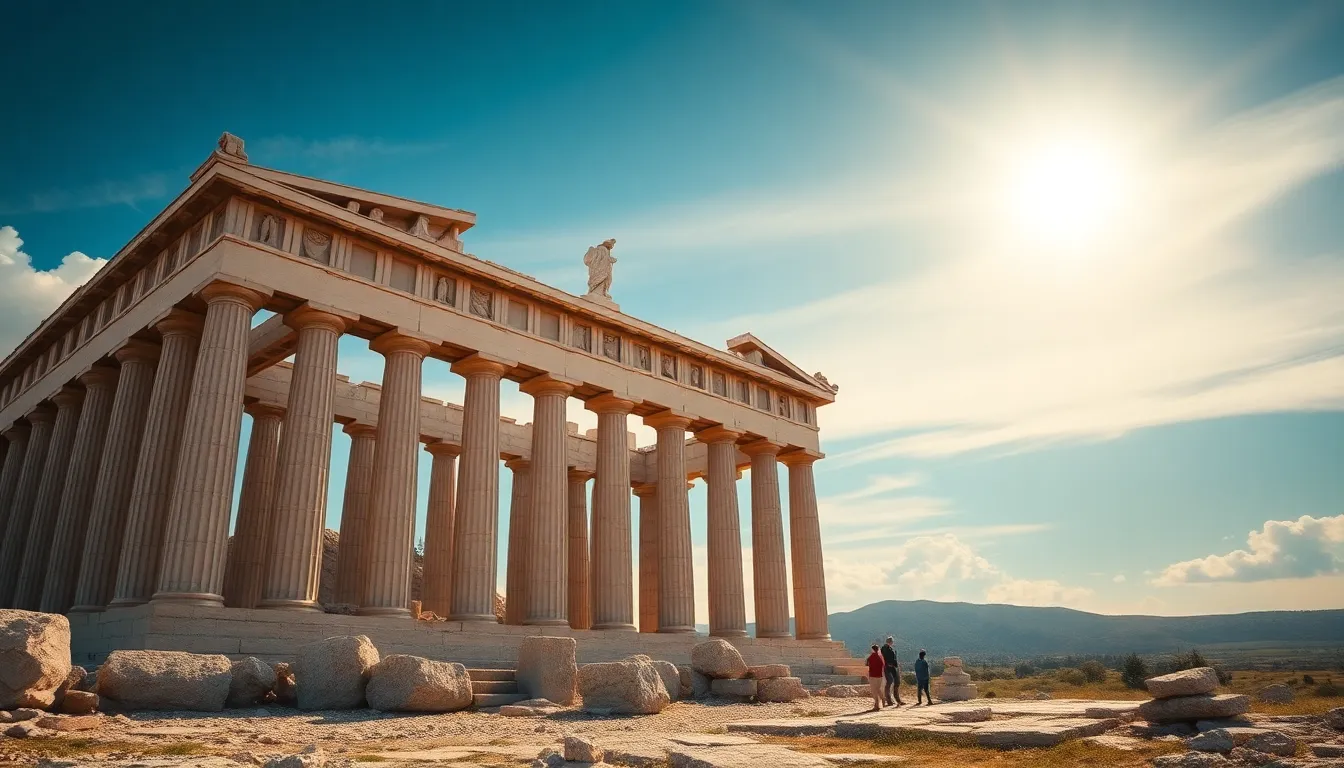
The Parthenon is a prime example of Doric order, the simplest and most robust of the classical orders. Characterized by its sturdy columns without bases and fluted shafts, the Doric style conveys strength and simplicity. The Parthenon’s use of this order reflects the values of the Athenian society—strength, order, and harmony.
B. Unique features: Columns, friezes, and sculptures
The Parthenon features 46 outer columns and 19 inner columns, creating a grand and harmonious facade. Notable features include:
- The frieze, depicting the Panathenaic procession
- The metopes, showcasing battles between gods and giants
- The pediments, illustrating the birth of Athena and her contest with Poseidon
These elements combine to narrate the mythology and history of Athens, making the Parthenon not only a temple but a storytelling canvas.
C. Innovations in construction and engineering methods
The Parthenon exemplifies several engineering innovations, including:
- The use of optical refinements to correct visual distortions
- Advanced techniques in marble cutting and transportation
- Innovative use of post-and-lintel construction methods
These techniques have influenced countless structures throughout history, cementing the Parthenon’s place as a blueprint for future generations.
IV. The Parthenon as a Religious Symbol
A. Significance of the Parthenon to Athena and Athenian identity
The Parthenon served as the center of worship for Athena, the patron goddess of Athens. It represented the Athenian identity, reflecting the city’s values of wisdom, warfare, and civic pride. The temple was more than a religious site; it was a symbol of the city’s power and cultural supremacy.
B. Rituals and ceremonies held within its walls
Numerous rituals and ceremonies took place at the Parthenon, including:
- The Panathenaic Festival, celebrating Athena’s birthday
- The presentation of the peplos, a ceremonial robe for the goddess
- Various sacrifices and offerings to ensure the city’s prosperity
These events reinforced the citizens’ devotion to Athena and their shared identity as Athenians.
C. The role of the Parthenon in ancient Greek religion
The Parthenon was not only a temple but also a vital part of the religious landscape of ancient Greece. It housed the colossal statue of Athena, made of gold and ivory, which was a focal point for worship. The temple’s architecture and sculptures conveyed religious narratives, reinforcing the connection between the divine and the mortal realm.
V. The Parthenon Through the Ages
A. Transformation from a temple to a Christian church and then a mosque
After the fall of the Roman Empire, the Parthenon underwent significant transformations. In the 6th century AD, it was converted into a Christian church dedicated to the Virgin Mary. Later, during Ottoman rule, it became a mosque, illustrating the evolving religious landscape of the region.
B. Impact of wars, looting, and restoration efforts
The Parthenon has suffered greatly through the centuries, particularly during the Ottoman-Venetian Wars when it was bombed, leading to significant damage. Additionally, Lord Elgin’s removal of sculptures in the early 19th century sparked international controversy, leading to ongoing debates about the rightful ownership of these treasures.
C. Preservation challenges in modern times
Today, the Parthenon faces numerous preservation challenges, including pollution and structural deterioration. Restoration efforts have been ongoing since the 1970s, focusing on:
- Stabilizing the structure
- Replacing damaged stones with original materials
- Implementing modern conservation techniques
These efforts aim to ensure that the Parthenon can be appreciated by future generations.
VI. The Art of the Parthenon: Sculptures and Reliefs
A. Overview of the Parthenon Marbles and their significance
The Parthenon Marbles, also known as the Elgin Marbles, are a collection of classical Greek marble sculptures that adorned the Parthenon. They are significant not only for their artistic merit but also for their historical context, providing insight into ancient Greek culture and religion.
B. Artistic styles and themes depicted in the sculptures
The sculptures of the Parthenon exemplify the high classical style of Greek art, characterized by:
- Realistic human forms
- Dynamic poses and movement
- Complex drapery and intricate detailing
The themes depicted include mythological battles, the Panathenaic procession, and the life of Athena, showcasing the cultural values of the time.
C. The ongoing debate over the Elgin Marbles
The removal of the Parthenon Marbles by Lord Elgin has sparked a heated debate over cultural heritage and ownership. Greece has long sought the return of the marbles, arguing that they are an integral part of its national heritage. The controversy raises important questions about the ethics of cultural artifacts and their rightful place in history.
VII. The Parthenon in Modern Culture
A. Influence on Western architecture and art
The Parthenon has had a profound influence on Western architecture, serving as a model for countless buildings, including:
- The British Museum in London
- The United States Capitol Building
- Numerous neoclassical structures around the world
Its design elements have become synonymous with democracy and civic virtue, inspiring architects for centuries.
B. Symbol of democracy and cultural heritage
The Parthenon symbolizes the ideals of democracy, reason, and cultural heritage. It represents the achievements of human civilization and the enduring quest for knowledge and beauty. As a result, it has become a universal symbol of the democratic ideals that emerged from ancient Athens.