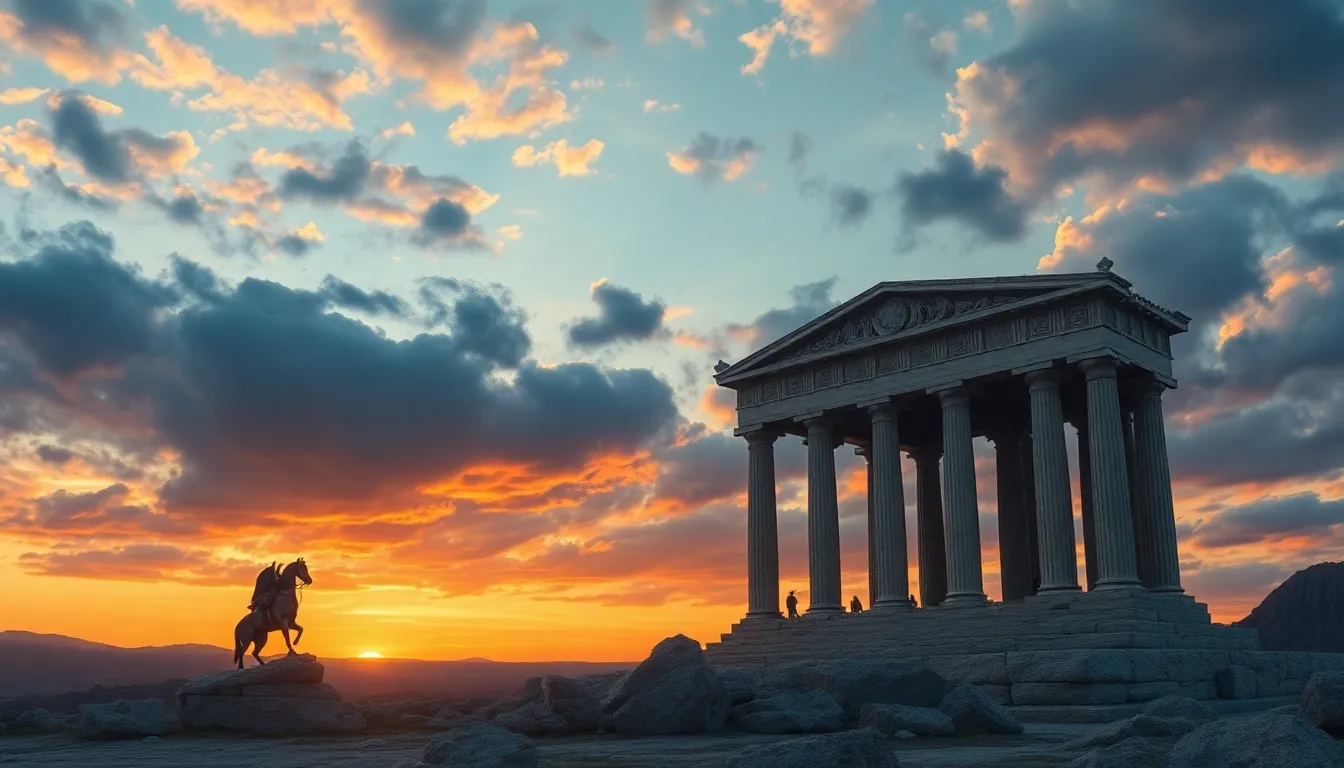
The Nature of Time in Greek Myths: A Philosophical Analysis
I. Introduction
The concept of time holds a significant place in Greek mythology, serving not only as a backdrop for the unfolding of myths but also as a crucial element that shapes the narratives and the characters within them. Time in Greek mythology is multifaceted, intertwining with themes of fate, eternity, and the human condition. It invites philosophical inquiry into its nature and implications, revealing the complexities of existence and the universe.
This article aims to explore the philosophical implications of time as presented in Greek myths, examining how these ancient narratives reflect broader concerns regarding the nature of time, existence, and human experience. We will analyze the various conceptions of time present in these myths, the roles played by key figures, and the enduring philosophical reflections that continue to resonate in contemporary thought.
II. Conceptualizing Time in Greek Myths
Greek myths present a rich tapestry of ideas regarding the nature of time, often depicting it as a cyclical phenomenon that contrasts with the more linear perceptions prevalent in modern thought.
A. The cyclical nature of time
Many Greek myths illustrate the cyclical nature of time, suggesting that events and experiences are not merely linear progressions but part of a repetitive cycle. This cyclical view is often symbolized by natural phenomena such as the seasons, life cycles, and the eternal return of certain events. For example:
- The changing seasons reflect the cycle of life, death, and rebirth.
- The myth of Persephone illustrates the cyclical nature of time through her descent into the Underworld and return, marking the seasons.

B. Linear versus cyclical time in myths
While some myths emphasize cyclical time, others hint at a more linear progression, particularly in narratives concerning creation and destruction. For example, the creation myths suggest a definitive beginning, while the concept of fate implies a linear trajectory towards predetermined ends.
C. Time as a divine construct vs. human perception
In Greek mythology, time can be viewed as both a divine construct and a human perception. The gods, particularly those associated with time, often manipulate time according to their will, while mortals experience time in a more subjective manner, influenced by their emotions, actions, and existential dilemmas.
III. The Role of Chronos and Kairos
Two critical figures in understanding time within Greek mythology are Chronos and Kairos, each representing different aspects of time.
A. Definitions and distinctions between Chronos and Kairos
Chronos embodies chronological or quantitative time, representing the measurable passage of time. In contrast, Kairos signifies the qualitative aspects of time, often interpreted as the right or opportune moment for action.
B. The implications of Chronos (chronological time) in myth narratives
Chronos serves as a reminder of the inevitability of time’s passage, influencing the fate of characters and the unfolding of events. Myths that revolve around Chronos often highlight the themes of aging, decay, and the relentless march towards destiny.
C. The significance of Kairos (opportune moments) in human experience
Kairos, on the other hand, emphasizes the importance of seizing moments of opportunity. This notion is crucial in heroic narratives where characters must recognize and act upon critical junctures that can lead to success or failure.
IV. Mythological Characters and Their Relationship with Time
Numerous mythological characters embody various aspects of time, illustrating the complex interplay between fate, free will, and the human experience.
A. The Titan Cronus and the theme of inevitability
Cronus, the Titan who devoured his children to prevent them from overthrowing him, symbolizes the inevitability of time and fate. His actions reflect a desperate attempt to control time, ultimately leading to his downfall and the rise of Zeus, illustrating the inescapable nature of destiny.
B. Prometheus and the challenge of foresight
Prometheus, known for stealing fire from the gods, represents the tension between foresight and the consequences of actions. His gift to humanity signifies the struggle against time and fate, as he foresaw the suffering his actions would bring upon himself but chose to act nonetheless.
C. Orpheus and the quest to transcend temporal limits
Orpheus, the legendary musician, embodies the desire to transcend the constraints of time. His journey to the Underworld to retrieve Eurydice showcases the limits of human agency against the inexorable flow of time, culminating in a poignant reminder of mortality and loss.
V. Temporal Themes in Major Greek Myths
Greek myths are replete with themes centered around time, revealing profound insights into existence, fate, and the nature of heroism.
A. The creation myths and the beginnings of time
The creation myths in Greek mythology, such as the ones involving Chaos and the primordial deities, address the origins of time itself. These narratives often depict a universe emerging from a formless void, highlighting the transformative power of time and creation.
B. The role of fate and destiny in shaping time
Fate plays a pivotal role in Greek mythology, often depicted as an inexorable force guiding the destinies of gods and mortals alike. The Moirai (Fates) weave the threads of life, underscoring the idea that time is not merely a backdrop but a determining factor in the unfolding of events.
C. The impact of time on heroism and mortality
Time significantly influences heroism in Greek myths, where the mortality of heroes is juxtaposed with their legendary deeds. The inevitability of death and the passage of time add a layer of poignancy to the exploits of figures like Achilles and Heracles, whose legacies endure despite their mortal limitations.
VI. Philosophical Reflections on Time in Greek Thought
Greek philosophers engaged deeply with the concept of time, offering varied interpretations that resonate through history.
A. Pre-Socratic views on time (Heraclitus, Pythagoras)
Heraclitus famously proposed that everything is in flux, encapsulating the dynamic nature of time. Pythagoras, on the other hand, viewed time more mathematically, suggesting a harmonious structure to the cosmos that includes temporal dimensions.
B. Platonic ideals of time and eternity
Plato distinguished between the transient world of appearances and the eternal realm of forms. In his view, time is a moving image of eternity, suggesting that while time is experienced linearly, it is ultimately connected to a timeless reality.
C. Aristotelian concepts of time and change
Aristotle approached time as a measure of change, defining it in terms of before and after. His insights laid the groundwork for later philosophical inquiries, emphasizing the relationship between time, motion, and existence.
VII. Modern Interpretations of Time in Greek Myths
The enduring legacy of Greek mythology continues to influence contemporary philosophical discourse and artistic expression regarding time.
A. Contemporary philosophical perspectives on time
Modern philosophers, such as Henri Bergson and Martin Heidegger, have revisited the concepts of time, exploring its relational and subjective dimensions. They draw parallels between ancient ideas and contemporary understandings of temporality.
B. Influence of Greek mythology on modern literature and art
Greek myths have inspired countless works of literature and art, where themes of time are often central. Authors and artists reinterpret these myths, exploring the human experience of time through a modern lens.
C. Relevance of ancient concepts of time in today’s philosophical discourse
The ancient Greek understanding of time remains relevant in discussions of existence, identity, and the human experience. The interplay between fate, free will, and the passage of time continues to spark philosophical debates in various fields, including ethics, metaphysics, and psychology.
VIII. Conclusion
The exploration of time in Greek mythology reveals a rich and complex tapestry of ideas that continue to resonate with contemporary thought. From the cyclical nature of existence to the linear trajectories defined by fate, the Greeks provided profound insights into the human condition and the universe.
As we reflect on these themes, we recognize the lasting impact of Greek thought on our understanding of time, as well as the interplay between myth, philosophy, and human experience. The myths serve as a reminder of the eternal questions surrounding existence and the inevitability of time, inviting us to contemplate our place within the grand narrative of life.