The Quest for the Lost City: Myths of Atlantis
I. Introduction
Atlantis, the legendary island mentioned by the ancient Greek philosopher Plato, has captivated the imagination of countless generations. Its significance extends beyond mere myth; it has become a cultural touchstone, a symbol of lost civilizations, and a subject of fascination in popular culture. From literature to film, the tale of Atlantis continues to inspire and provoke thought about the nature of human society and its potential for greatness or destruction.
This article delves into the myths and theories surrounding the existence of Atlantis, exploring its historical origins, cultural representations, and the ongoing quest to uncover its secrets. By examining the allure of this enigmatic city, we seek to understand why Atlantis remains a focal point of intrigue and speculation.
II. Historical Origins of the Atlantis Legend
A. Plato’s accounts: “Timaeus” and “Critias”
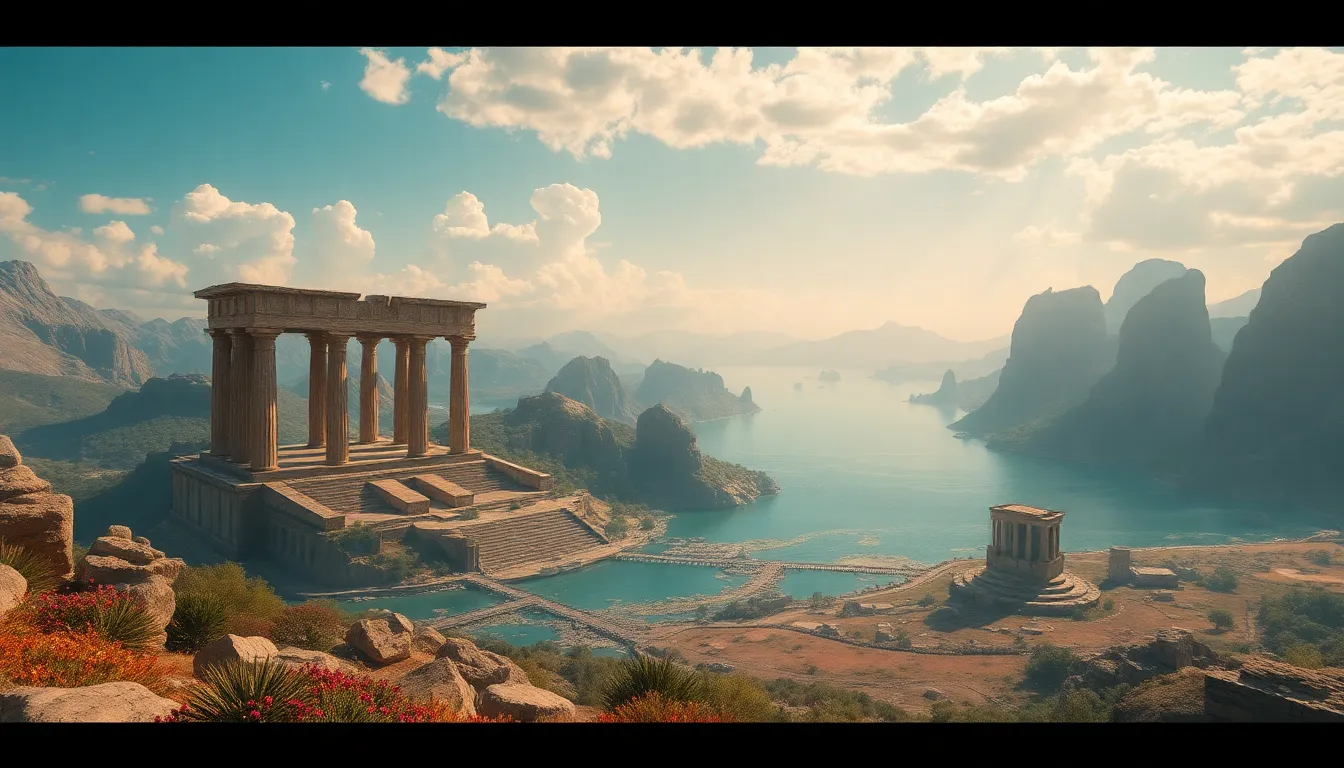
The story of Atlantis originates from the works of Plato, specifically in his dialogues “Timaeus” and “Critias,” written around 360 BCE. In these texts, Plato describes a powerful civilization that existed about 9,000 years before his time. According to him, Atlantis was an advanced society located beyond the “Pillars of Hercules” (modern-day Strait of Gibraltar), characterized by grand architecture, vast resources, and a strong navy.
Plato narrates how Atlantis eventually fell out of favor with the gods due to its moral decline and ambition, leading to its catastrophic demise, submerged beneath the ocean in a single day and night of misfortune. This tale serves not only as a historical account but also as a philosophical allegory about hubris and the moral responsibilities of societies.

B. The historical context of ancient Greece
To fully appreciate the significance of Atlantis, it’s essential to consider the historical context of ancient Greece. During Plato’s time, Greece was experiencing a flowering of culture, philosophy, and exploration. The Greeks were fascinated by the idea of lost civilizations and often drew on historical events to create their myths.
Atlantis can be seen as a reflection of the Greek ideals of civilization, governance, and the consequences of moral decay. It reflects the Greek concerns of their era, particularly the tension between progress and ethical responsibility.
C. Early interpretations and translations of the texts
Plato’s dialogues have been subject to various interpretations and translations over the centuries. Early scholars attempted to dissect the allegorical and literal meanings of Atlantis, with many viewing it as a cautionary tale rather than a historical account. The Renaissance sparked renewed interest in ancient texts, leading to a resurgence of Atlantis theories, often blending fact with fiction.
III. The Allure of Atlantis in Popular Culture
A. Atlantis in literature and art
The myth of Atlantis has inspired countless works of literature and art throughout the ages. Writers such as Sir Francis Bacon, Jules Verne, and H.G. Wells have drawn from the Atlantis legend, weaving it into their narratives to explore themes of civilization, technology, and moral dilemmas.
- Sir Francis Bacon: In “New Atlantis,” Bacon imagines a society dedicated to scientific discovery and moral rectitude.
- Jules Verne: His novel “The Mysterious Island” features references to Atlantis as a lost civilization of advanced technology.
- H.G. Wells: In “The Time Machine,” Wells evokes the idea of lost civilizations, echoing the Atlantis myth.
B. Film and television representations
Film and television have played a significant role in popularizing the Atlantis myth. From the classic Disney animated film “Atlantis: The Lost Empire” to the modern series “Stargate Atlantis,” the story has been reimagined in various forms. These adaptations often blend adventure with elements of science fiction and fantasy, capturing the imagination of audiences worldwide.
C. Influence on modern fantasy and science fiction
Atlantis has also influenced the realms of modern fantasy and science fiction. Its themes of advanced technology, lost knowledge, and the consequences of moral failings resonate with contemporary narratives. Many authors and creators continue to draw from the Atlantis myth, using it as a backdrop for exploring broader themes of humanity’s relationship with nature, technology, and morality.
IV. Theories and Hypotheses on the Location of Atlantis
A. Proposed locations: from the Mediterranean to Antarctica
The search for Atlantis has led to numerous theories regarding its possible location. Scholars and enthusiasts have proposed various sites, each with unique arguments and evidence:
- Critias: Some suggest that the island of Santorini in the Aegean Sea, known for its volcanic eruption, could be the remnants of Atlantis.
- Spain: The region of Andalusia has been proposed as the site for Atlantis, citing similarities in geography and culture.
- Antarctica: Some fringe theories suggest that Atlantis was located in Antarctica, buried beneath ice, and that the continent was once habitable.
B. Scientific and archaeological perspectives
Scientific research and archaeological findings have contributed to the debate surrounding the location of Atlantis. While many theories lack concrete evidence, some archaeological sites, such as the Minoan civilization on Crete, have drawn comparisons to Plato’s descriptions of Atlantis.
Geologists and oceanographers have also explored the possibility of submerged landmasses that could correspond to the mythical island, but conclusive evidence remains elusive.
C. The role of geology and climate change in the search for Atlantis
Geological studies suggest that significant climate changes and cataclysmic events, such as tsunamis or volcanic eruptions, could have led to the sinking of landmasses in the Mediterranean and beyond. These natural phenomena may have inspired the legends of Atlantis and other lost civilizations across cultures. Understanding these geological processes adds a layer of complexity to the quest for Atlantis.
V. The Psychological and Cultural Significance of Atlantis
A. Symbolism of Atlantis in human imagination
Atlantis symbolizes humanity’s quest for knowledge, the pursuit of utopia, and the inevitable downfall that can accompany ambition and moral decline. It serves as a reminder of the fragility of civilizations and the consequences of straying from ethical paths. This symbolism resonates deeply in the human psyche, prompting reflections on our own societies.
B. Themes of utopia and dystopia in the myth
The duality of Atlantis as both a utopia and a dystopia is central to its narrative. Initially depicted as a perfect society, it ultimately collapses due to its hubris and ethical failures. This dichotomy reflects the complexities of human nature and the challenges faced by societies in striving for greatness.
C. Atlantis as a metaphor for lost civilizations
The myth of Atlantis serves as a powerful metaphor for lost civilizations throughout history. It embodies the idea that even the most advanced societies can fall into decline due to moral failings, environmental factors, or external pressures. This theme resonates with the stories of numerous cultures that have risen and fallen over time.
VI. Modern Expeditions and Research
A. Overview of notable archaeological expeditions
In recent years, numerous archaeological expeditions have sought to uncover evidence of Atlantis. Projects such as underwater explorations in the Mediterranean and excavations in potential sites have garnered attention. While many expeditions have yielded fascinating findings, none have definitively identified the lost city.
B. Technological advancements aiding the search
Advancements in technology have revolutionized the search for Atlantis. Techniques such as remote sensing, sonar mapping, and underwater drones have enabled researchers to explore submerged landscapes more effectively than ever before. These tools provide valuable insights into potential locations and help to visualize ancient topographies.
C. Successes and failures in uncovering evidence
While some expeditions have made significant discoveries, such as ancient ruins and artifacts, the search for Atlantis has also faced setbacks. Many proposed sites have turned out to be mere geological formations or misidentified structures. The ongoing quest highlights the challenges of archaeological research and the thin line between myth and reality.
VII. Critiques and Skepticism Surrounding Atlantis
A. Arguments against the existence of Atlantis
Despite the allure of the Atlantis myth, many scholars and scientists remain skeptical about its existence. Critics argue that there is insufficient evidence to support the idea of a highly advanced civilization existing in the distant past. They suggest that Plato’s account is primarily allegorical, designed to convey philosophical ideas rather than historical truths.
B. The role of pseudoscience and sensationalism
The search for Atlantis has often been marred by pseudoscience and sensationalist claims. Some proponents have made extravagant assertions without scientific backing, leading to criticism from the academic community. This sensationalism can detract from genuine research efforts and cloud public perception of the quest for