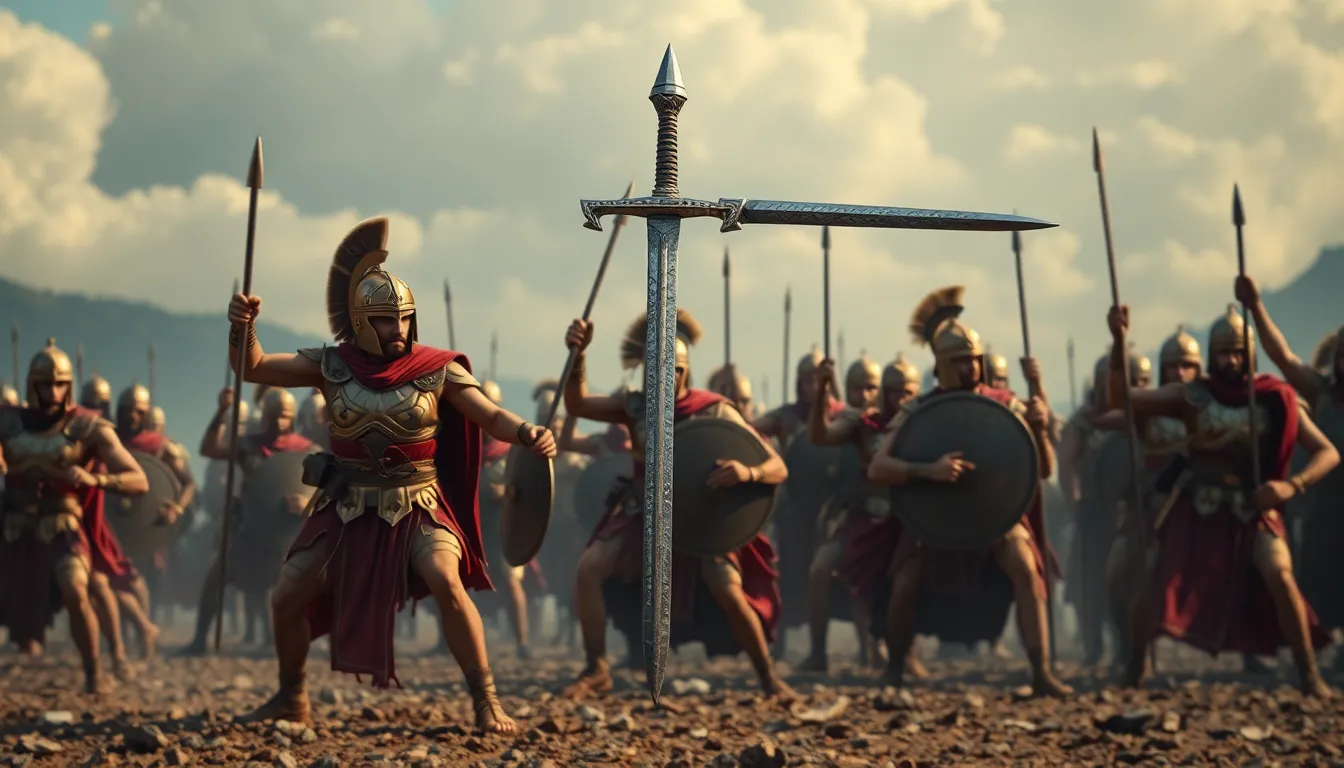
The Role of the Sword in Greek Warfare: Myths of Valor
I. Introduction
Greek warfare has played a pivotal role in shaping the history and culture of Ancient Greece. The conflicts between city-states, invasions by foreign powers, and the legendary battles that have been immortalized in literature reflect a society that valued valor and heroism. At the heart of this martial culture is the sword, a weapon that symbolizes not only physical power but also the ideals of courage and honor that were central to Greek identity.
This article aims to explore the myths and realities surrounding the sword in Greek warfare. By examining its historical context, types, symbolism, and the myths associated with it, we will uncover how the sword served as a powerful emblem of valor throughout Greek history.
II. The Historical Context of Greek Warfare
To understand the significance of the sword in Greek warfare, it is essential to look at the timeline of key wars and battles that defined the ancient Greek world.
A. Timeline of key Greek wars and battles
- Battle of Marathon (490 BC): A significant Athenian victory against the Persians.
- Battle of Thermopylae (480 BC): Famous last stand of King Leonidas and his Spartans against a vast Persian army.
- Battle of Salamis (480 BC): A decisive naval battle that led to the decline of Persian naval power.
- Peloponnesian War (431-404 BC): A protracted conflict between Athens and Sparta that reshaped Greek politics.
B. Overview of military organization and tactics in ancient Greece
The Greek military was characterized by its city-state structure, with each polis maintaining its own army. The phalanx formation, a dense grouping of soldiers armed with spears and shields, was central to Greek tactics. Swords were typically used as secondary weapons in close combat situations.
C. The evolution of weaponry leading to the prominence of the sword
Initially, the spear was the primary weapon of the Greek warrior, but as combat evolved, so did the need for effective close-combat weapons. The sword emerged as a crucial tool for survival on the battlefield, especially in situations where the phalanx formation broke down.
III. Types of Swords in Ancient Greece
Greek swords came in various forms, each designed for specific purposes and styles of combat.
A. Description of major sword types: xiphos, kopis, and others
- Xiphos: A double-edged sword, typically around 60-80 cm in length, designed for quick slashing and stabbing.
- Kopis: A single-edged sword with a curved blade, ideal for slashing attacks, favored by cavalry.
- <strong<Short Sword: A shorter sword used for close combat and by soldiers in confined spaces.
B. Materials and craftsmanship of Greek swords
Greek swords were often made from bronze or iron, with skilled craftsmen producing high-quality blades that were both functional and beautiful. The aesthetic design often included elaborate hilts and engravings.
C. The sword’s role in different types of combat (phalanx, skirmishes, etc.)
In a phalanx, swords were secondary to the spear, but in skirmishes or when the formation broke down, the sword became essential for survival. The swift and deadly nature of sword combat allowed for individual heroism to shine through, embodying the valor of the Greek warrior.
IV. Symbolism of the Sword in Greek Culture
The sword transcended its role as a mere weapon; it became a potent symbol within Greek culture.
A. The sword as a symbol of power, honor, and virtue
In Greek society, wielding a sword was synonymous with bravery and virtue. A warrior’s ability to fight and defend his city-state was a mark of honor, and swords represented the courage to uphold these ideals.
B. Representation of swords in mythology and literature (e.g., Homeric epics)
In works such as Homer’s “Iliad,” swords are often portrayed as extensions of their wielders’ identities. The epic tales of heroes, such as Achilles and Hector, emphasize the significance of their swords in both battle and personal honor.
C. The connection between swords and Greek heroism
Swords were not just tools of war; they were integral to the narrative of heroism. The act of drawing a sword often symbolized the readiness to confront fate, embodying the struggle for glory and recognition in the face of death.
V. Myths of Valor Associated with the Sword
The myths surrounding Greek swords are rich and varied, reflecting the cultural significance of these weapons.
A. Legendary heroes and their iconic swords (e.g., Achilles’ sword)
- Achilles’ Sword: Forged by Hephaestus, it symbolizes his unmatched prowess in battle.
- Hector’s Sword: Represents the tragic heroism of the defender of Troy.
- Theseus’ Sword: A symbol of Athenian identity and heroism.
B. The portrayal of swords in myths as instruments of fate and destiny
Swords in Greek mythology often represented more than mere weapons; they were instruments through which fate could be fulfilled. The act of drawing a sword was frequently tied to the inevitability of destiny, as seen in the tales of heroes who faced their fates with courage.
C. Analysis of the impact of these myths on Greek society and military ethos
The emphasis on heroic narratives reinforced the societal values of bravery and honor. These myths served to inspire soldiers, instilling a sense of purpose that transcended individual battles and contributed to the collective identity of the Greek people.
VI. The Sword in Greek Art and Iconography
Artistic representations of swords in ancient Greece provide valuable insights into how these weapons were perceived culturally.
A. Depictions of swords in pottery, sculpture, and frescoes
Swords are depicted in a variety of artistic forms, from pottery illustrations of battles to sculptures honoring heroic figures. These artworks often highlight the sword as a central element of the heroic narrative.
B. The role of the sword in portraying heroism and valor in art
In many artistic representations, swords are depicted in ways that emphasize the valor and strength of the figures wielding them. The presence of a sword often signifies the readiness for battle and the valor associated with martial prowess.
C. How artistic representations reflect societal attitudes towards warfare
The way swords were depicted in Greek art reflects the society’s admiration for warriors and the ideals of heroism. These works often served to glorify the past and inspire future generations to emulate their heroes.
VII. The Decline of the Sword’s Prominence
Despite its central role in Greek warfare, the prominence of the sword eventually declined as military technology and tactics evolved.
A. Transition to other weapons and military technology (e.g., the rise of the spear)
As warfare became more organized and focused on formations, the spear regained its status as the primary weapon of choice. The development of better armor also made the sword less effective in direct combat scenarios.
B. Historical events that led to changes in warfare tactics
The rise of new military strategies, such as the use of cavalry and ranged weaponry, diminished the role of swords on the battlefield. This shift was evident in the later stages of the Peloponnesian War and beyond.
C. The lasting legacy of the sword in the context of Greek military history
Although the sword became less prominent as a weapon, its legacy endured in the form of cultural memory, literature, and art. The ideals associated with swordsmanship and heroism continued to influence Greek thought and identity.
VIII. Conclusion
In summary, the sword played a multifaceted role in Greek warfare, serving as a symbol of valor and heroism that transcended its practical function as a weapon. From its historical context to its representation in mythology and art, the sword embodies the ideals of courage and honor that were central to Greek identity.
The myths of valor surrounding the sword continue to influence modern perceptions of heroism, reminding us of the enduring legacy of these ancient narratives. As we reflect on the role of the