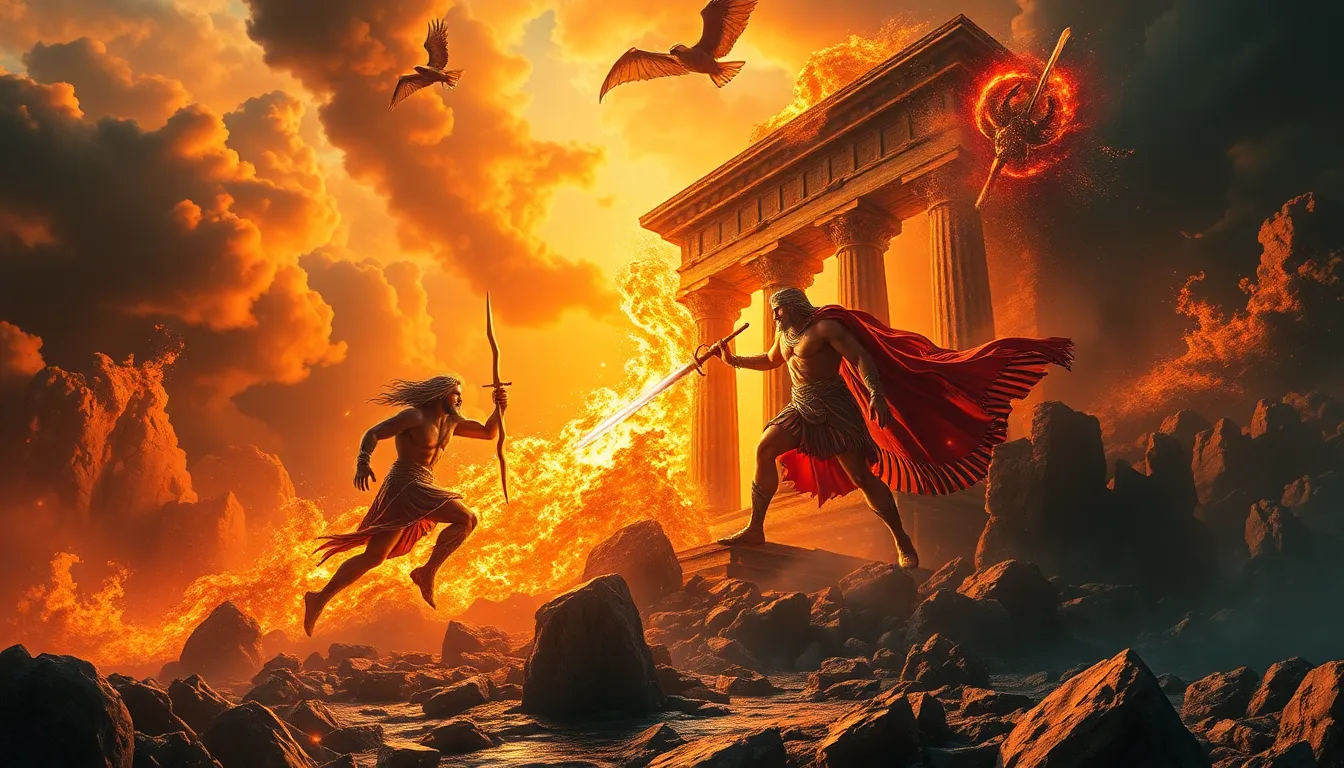
The Titanomachy: The Epic Conflict of Gods and Titans
I. Introduction
The Titanomachy, a cornerstone of Greek mythology, refers to the monumental war between the Titans, the elder gods, and the Olympians, the younger generation of deities led by Zeus. This epic conflict symbolizes the struggle for power and the transition from the old order to a new regime in the pantheon of Greek gods.
Understanding the Titanomachy is crucial for comprehending the broader narrative of Greek mythology, as it sets the stage for many subsequent myths and legends. This article will explore the origins of the Titans, the rise of the Olympians, the events leading to war, the battles fought, and the aftermath of this epic conflict. We will also reflect on its cultural impact and legacy in both ancient and modern contexts.
II. The Titans: Origins and Key Figures
A. Who are the Titans?
The Titans were primordial deities in Greek mythology, born from Gaia (the Earth) and Uranus (the Sky). They represented various natural phenomena and aspects of the world. The Titans were often seen as powerful and often capricious, embodying the raw forces of nature.

B. Prominent Titans and their attributes
- Cronus: The leader of the Titans, known for his role in the prophecy that foretold his overthrow by his own children.
- Rhea: Sister and wife of Cronus, she played a crucial role in saving her youngest son, Zeus.
- Oceanus: The Titan god of the ocean, representing both the physical ocean and the vastness of the sea.
- Tethys: The wife of Oceanus, associated with the nourishing flow of fresh water.
- Hyperion: The Titan of light, often associated with the sun.
- Themis: The Titaness of divine law and order, representing justice.
- Coeus: The Titan of intellect and the axis of heaven.
- Mnemosyne: The Titaness of memory, and mother of the Muses.
C. The role of Cronus and Rhea
Cronus, fearing a prophecy that one of his children would overthrow him, swallowed each of his offspring at birth. Rhea, devastated by the loss of her children, devised a plan to save her youngest son, Zeus. She concealed him on the island of Crete and gave Cronus a stone wrapped in swaddling clothes, which he swallowed, believing it to be his son. This act set the stage for the eventual rebellion against the Titans.
III. The Rise of the Olympian Gods
A. Introduction to the Olympians
The Olympian gods emerged as the new generation of deities, led by Zeus, who would ultimately challenge the Titans for supremacy. These gods were characterized by their human-like traits and personalities, making them relatable to mortals and central to many myths.
B. Key figures: Zeus, Hera, Poseidon, and Hades
- Zeus: The king of the Olympians and god of the sky, thunder, and justice.
- Hera: Zeus’s wife and sister, goddess of marriage and family.
- Poseidon: God of the sea, earthquakes, and horses, brother of Zeus.
- Hades: God of the underworld and brother of Zeus, ruling over the realm of the dead.
C. The prophecy and the rise against the Titans
After growing up in secrecy, Zeus returned to confront his father. With the help of his siblings, whom Rhea freed from Cronus’s stomach, Zeus initiated a rebellion against the Titans. This was not just a personal vendetta; it represented a cosmic shift towards a new order of gods who would govern with a different ethos.
IV. The Prelude to War
A. Tensions between Titans and Olympians
The tensions between the Titans and the Olympians escalated as Zeus and his siblings gathered allies and resources. The Olympians sought to overthrow the Titans, who had ruled for ages and were seen as tyrannical and oppressive.
B. Key events leading to the Titanomachy
- The release of the Cyclopes and Hecatoncheires from Tartarus, who had been imprisoned by Cronus.
- The forging of weapons by the Cyclopes, including Zeus’s thunderbolt, which would become vital in the battle.
- The gathering of allies, including the former enemies of the Titans, such as the Giants and other primordial beings.
C. The role of Gaia and Uranus
Gaia, the mother of the Titans, played a significant role in the conflict. She supported the Olympians in their quest, as she was opposed to Cronus’s rule due to his tyranny. Uranus, while not directly involved in the war, represented the older generation and the order that the Titans had upheld. The conflict can thus be seen as a struggle not just for power, but also for the favor of the primordial forces of nature.
V. The Titan War: Key Battles and Strategies
A. Overview of the conflict
The Titanomachy lasted for ten years, characterized by fierce battles and strategic maneuvers. The Olympians, led by Zeus, fought against the Titans, who were formidable opponents due to their strength and experience.
B. Major battles and turning points
- The Battle of Mount Olympus: The initial confrontations took place on the heights of Olympus, where both sides clashed fiercely.
- The Siege of Tartarus: The Olympians launched a coordinated attack on the Titans’ stronghold, seeking to imprison them.
- The use of thunderbolts: Zeus’s thunderbolt proved to be a game-changer, allowing the Olympians to gain the upper hand.
C. The involvement of allies: Cyclopes and Hecatoncheires
The Cyclopes, skilled craftsmen, provided the Olympians with powerful weapons, while the Hecatoncheires, with their hundred arms, fought valiantly on the front lines. Their involvement was crucial in turning the tide of the war in favor of the Olympians.
VI. The Aftermath of the Titanomachy
A. Consequences for the Titans
After their defeat, the Titans were imprisoned in Tartarus, a dark abyss beneath the Earth. This imprisonment served as a reminder of their failed attempt to retain control over the cosmos and the emergence of a new order.
B. The establishment of Olympian rule
The victory of the Olympians marked the beginning of their reign over the cosmos. Zeus became the supreme ruler, establishing a new hierarchy among the gods and ensuring that the balance of power shifted away from the Titans.
C. Changes in the cosmos and mythology
The Titanomachy led to significant changes in the structure of the universe in mythological terms. The Olympians established their domain on Mount Olympus, and new myths and stories emerged surrounding their exploits, relationships, and conflicts with mortals and other divine beings.
VII. Cultural Impact and Legacy
A. The Titanomachy in ancient literature and art
The Titanomachy has been a subject of fascination in ancient literature, appearing in works by Hesiod, Homer, and other classical poets. Artistic representations of the conflict can be found in pottery, sculpture, and paintings, showcasing the dramatic nature of the battles.
B. Influence on later myths and storytelling
The themes of rebellion, struggle for power, and the rise of a new order in the Titanomachy influenced countless myths and stories throughout history. It served as a template for narratives involving