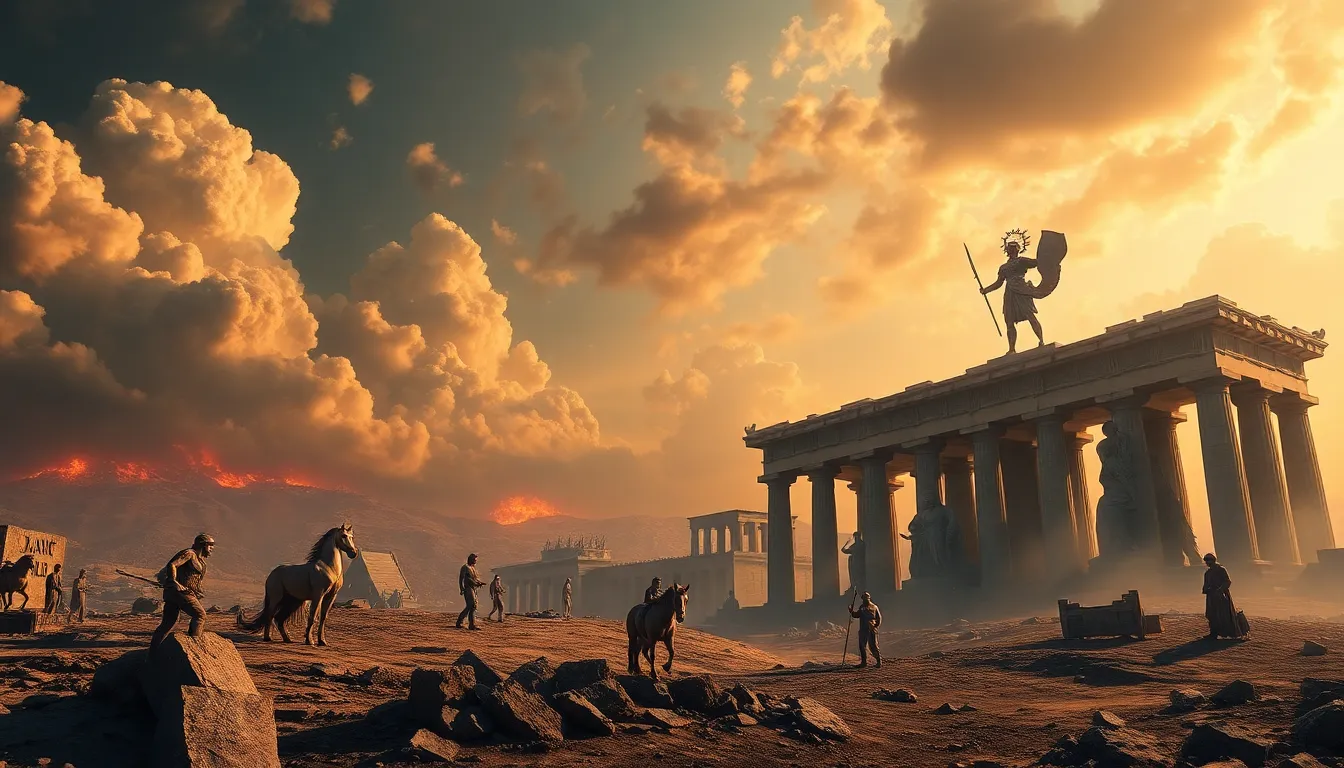
The Titanomachy: The Myths and Legends of the Great War
I. Introduction to the Titanomachy
The Titanomachy, a defining conflict in Greek mythology, represents the epic struggle between the Titans, the ancient deities who ruled before the Olympian gods, and the Olympians, led by Zeus. This monumental war is not only a tale of power and rebellion but also a foundational story that shapes the entire Greek mythological narrative.
The significance of the Titanomachy lies in its themes of generational conflict, the quest for power, and the establishment of order after chaos. It serves as a crucial turning point in mythic history, illustrating how the Olympians rose to power and the consequent fall of the Titans. This article will explore the origins, key figures, battles, and aftermath of the Titanomachy, as well as its lasting impact on culture and mythology.
II. The Origins of the Titans
The Titans are often considered the first generation of divine beings in Greek mythology, born from the primordial entities Gaia (Earth) and Uranus (Sky). Their lineage and the myths surrounding their creation provide essential context for understanding their role in the Titanomachy.
A. Creation myths related to the Titans
According to various myths, the Titans were born from Gaia and Uranus, who personified Earth and Sky, respectively. The Titans are often depicted as powerful and larger-than-life figures, embodying various aspects of the natural world.

B. Key figures among the Titans: Cronus, Rhea, Oceanus, and others
- Cronus: The leader of the Titans, known for overthrowing his father Uranus. He is often associated with time and is infamous for swallowing his children to prevent them from taking his power.
- Rhea: The sister and wife of Cronus, she is the mother of the first generation of Olympians, including Zeus, Hera, and Poseidon.
- Oceanus: The Titan of the ocean, he personifies the great river that encircles the earth.
- Hyperion: The Titan of light, often associated with the sun.
- Themis: The Titaness of divine law and order, representing justice and fairness.
C. The role of Gaia and Uranus in Titan lineage
Gaia and Uranus played crucial roles in the creation of the Titans and the subsequent conflict. Their union produced not only the Titans but also other formidable creatures, like the Cyclopes and the Hecatoncheires. However, Uranus’s fear of being overthrown led him to imprison many of his offspring, prompting Gaia to conspire with Cronus to overthrow him.
III. The Rise of the Olympians
The Olympians, the second generation of deities, emerged from the lineage of the Titans, specifically from Cronus and Rhea. Their rise to power is marked by rebellion, prophecy, and the quest for dominion over the cosmos.
A. The birth of Zeus and his siblings
Rhea, determined to save her children from Cronus, hid her youngest child, Zeus, in a cave on Crete while giving Cronus a stone wrapped in swaddling clothes. Zeus was raised by nymphs, and upon reaching adulthood, he returned to challenge his father.
B. The prophecy of the overthrow of the Titans
A prophecy foretold that Cronus would be overthrown by one of his children, instilling fear in him and leading to his tyrannical actions. This prophecy became a significant motivator for the events that unfolded during the Titanomachy.
C. Key figures among the Olympians: Zeus, Hera, Poseidon, and others
- Zeus: The king of the Olympians, god of the sky, and wielder of thunderbolts. He led the charge against Cronus and the Titans.
- Hera: The queen of the Olympians, goddess of marriage and family, and Zeus’s wife.
- Poseidon: The god of the sea and Zeus’s brother, he played a significant role in the war.
- Hestia: The goddess of the hearth and home, representing domesticity.
- Demeter: The goddess of agriculture and fertility, also Zeus’s sister.
IV. The Prelude to War
The lead-up to the Titanomachy was fraught with tension, betrayal, and the gathering of allies, setting the stage for one of the most significant conflicts in Greek mythology.
A. The circumstances leading to the Titanomachy
As Zeus grew older and learned of his fate, he sought to liberate his siblings from Cronus’s belly. With the help of Metis, he concocted a potion that caused Cronus to regurgitate his swallowed children. This act of rebellion marked the beginning of the confrontation between the Titans and Olympians.
B. The gathering of allies: Giants, Cyclopes, and Hecatoncheires
In preparation for the war, Zeus and his siblings sought allies among other powerful beings:
- Giants: Fierce warriors born from Gaia, who fought to defend the Titans.
- Cyclopes: One-eyed giants who were imprisoned by Cronus but freed by Zeus. They provided Zeus with his thunderbolts.
- Hecatoncheires: Hundred-handed giants who were also liberated and became fierce allies in the battle against the Titans.
C. The division of power and the stakes involved
The stakes of the Titanomachy were immense. The outcome would determine the rulers of the cosmos. The Olympians sought to establish a new order, while the Titans, having ruled for generations, aimed to maintain their dominance. This conflict was not only a battle for power but also represented a generational struggle between the old and new.
V. The Great War: Battles and Strategies
The Titanomachy was marked by numerous battles and strategic maneuvers, showcasing the might and cunning of both sides.
A. Major battles and turning points in the conflict
The war lasted for ten years, with several key battles that shifted the tide:
- The Battle of Mount Olympus: The initial clashes occurred on the peaks of Olympus, where the Titans attempted to defend their dominion.
- The Siege of Tartarus: As the war progressed, Zeus and his allies launched assaults against the Titans’ stronghold in Tartarus.
- The final showdown: The decisive battle saw the combined forces of the Olympians overpowering the Titans, leading to their ultimate defeat.
B. The use of divine weapons and tactics
Both sides employed formidable weapons and strategies during the Titanomachy:
- Thunderbolts: Zeus wielded his thunderbolts, created by the Cyclopes, as his primary weapon against the Titans.
- Earthquakes: Poseidon unleashed powerful earthquakes to disrupt enemy formations.
- Strategy: The Olympians capitalized on their numbers and the strength of their allies, such as the Hecatoncheires, to overwhelm the Titans.
C. The role of fate and prophecy during the war
Throughout the conflict, fate and prophecy played crucial roles. The prophecies regarding Cronus’s downfall motivated both sides, influencing their actions and decisions. Ultimately, it was the fulfillment of these prophecies that ensured the Olympians’ victory.
VI. The Aftermath of the Titanomachy
The conclusion of the Titanomachy brought significant changes to the cosmic order of Greek mythology.
A. The defeat of the Titans: consequences and punishments
After their defeat, the Titans faced severe consequences. Zeus condemned many of them to eternal imprisonment in Tartarus, where they would remain for eternity, watched over by the Hecatoncheires.
B. The establishment of the Olympian reign
With the Titans vanquished, the Olympians established their rule, setting up a new hierarchy of gods. Zeus became the supreme ruler, with his siblings assuming significant roles in governing various aspects of the world.
C. The significance of the Titanomachy in Greek mythology
The Titanomachy is not just a war story; it symbolizes the struggle between generations, the transition from chaos to order