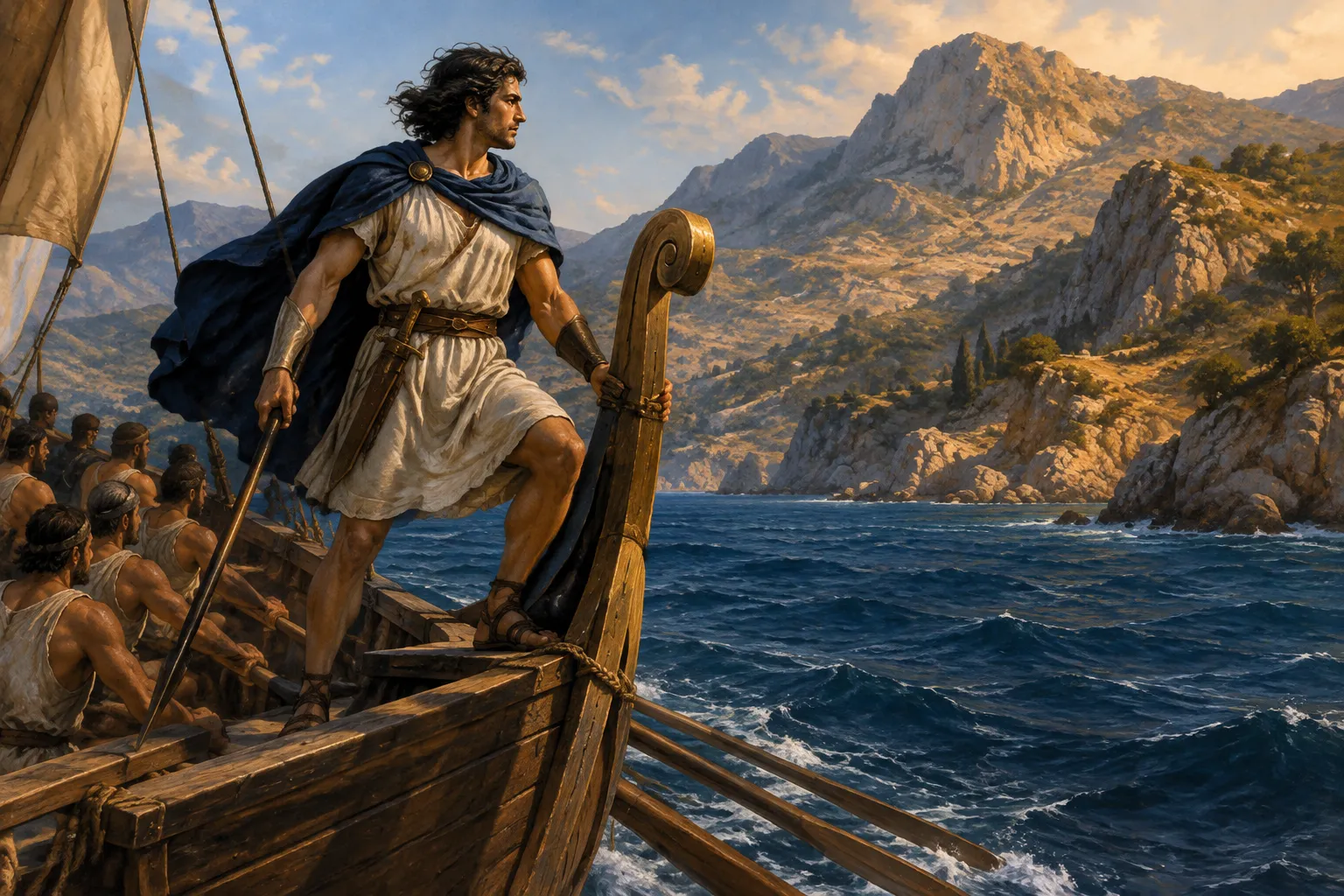
Pegasus does not have wings in every Greek explanation of Bellerophon’s adventures. In the account attributed to Palaephatus, Pegasus is not even a horse: it is a ship. The Chimaera, meanwhile, becomes a mountain with dangerous approaches rather than a single fire-breathing animal. These striking substitutions appear in chapter 28 of On Unbelievable Tales, a Greek work that asks how extraordinary stories might have developed from less extraordinary events.
The point is not that this account reveals what really happened. Its value lies elsewhere: it shows a Greek writer actively arguing with a Greek myth. Read beside Pindar’s poetry and the mythographic Library, the chapter offers three different answers to a deceptively simple question: what kind of story is Bellerophon’s victory?
1. The flying horse before the floating ship
A useful starting point is Pindar’s thirteenth Olympian ode, dated to 464 BCE. Its selected passages place Bellerophon near the springs of Peirene, struggling to master Pegasus until Athena brings him a bridle. The hero’s eventual success depends on receiving something he could not supply through determination alone.
One interpretation of this episode is that courage requires the right relationship with divine power. The horse is not merely a convenient vehicle waiting for its rider. Mastering it is itself an achievement, and Athena makes that achievement possible. That distinction matters when we compare Pindar with a writer who rejects the animal altogether.
Pindar then makes flight part of the hero’s military advantage: mounted on Pegasus, Bellerophon attacks from above and defeats formidable opponents. His aerial victories include the fire-breathing Chimaera. In this telling, the extraordinary mount belongs to the explanation of success, not to a misunderstanding that needs correction.
Readers interested in the monster’s family background can also explore the site’s discussion of the myth of Medusa. Here, however, the crucial question is not Pegasus’s ancestry but what happens when an interpreter decides that a winged horse cannot exist.
2. Palaephatus puts the impossible on trial
The Palaephatus chapter begins by challenging physical possibility. Its writer objects that a horse could not fly even if supplied with birds’ feathers. He also rejects the idea that lion, serpent, and goat could function together as one fire-breathing creature.
We should distinguish the reasoning from its reliability. An objection to a fabulous animal does not establish the historical truth of whatever replaces it. Nevertheless, the opening tells us how to read what follows. The author is not simply offering another adventure with different scenery. He is setting a test that the conventional story cannot pass, then rebuilding the account under different rules.
Notice the change in the reader’s role. Pindar’s audience can admire a divine gift and an astonishing conquest. Palaephatus asks the reader to scrutinize a report: what could someone actually have seen, and how could later speech have transformed it? Wonder becomes a problem of explanation.
This is why the chapter is more interesting than a flat denial. Its author does not discard every recognizable feature. Names and actions survive, but their connections change. We can read the resulting narrative as an attempt to preserve a story’s outline while removing its impossible machinery.
3. Pegasus becomes a raiding vessel
In the replacement account, Bellerophon is a Corinthian exile who equips a long ship called Pegasus and raids coastal settlements. The ship’s name supplies the bridge between the familiar hero and the revised explanation. Pegasus still carries him, but now by sea.
The substitution has an important interpretive consequence. A ship does not need supernatural biology. It needs builders, equipment, and a crew—even though the chapter is interested chiefly in its commander. The revised adventure therefore invites us to imagine practical movement through a maritime landscape rather than effortless movement through the air.
It also changes the moral atmosphere. Calling the vessel a raiding ship complicates any uncomplicated picture of a beneficent monster-killer. Read this way, the hero’s effectiveness need not make him harmless to everyone he encounters. That is an interpretation of the revised narrative, not proof that an actual pirate stands behind the myth.
We should resist turning the proposal into an archaeological claim. The passage supplies a literary explanation, not an excavated hull, an inscription naming a vessel, or independent testimony from a crew. “Pegasus was a ship” is what this particular account asks us to consider. It is not a fact we can transfer from the page into history without further evidence.
4. The Chimaera becomes a landscape
The same chapter relocates the monster’s danger to a mountain called Chimaera. A lion and a serpent threaten its approaches; a fiery opening belongs to the terrain. Bellerophon’s destructive intervention then replaces combat against one composite beast.
This is the most revealing part of the reconstruction. Instead of merely shrinking the monster into an ordinary animal, the author distributes its features across a place. What had been one body becomes an arrangement of separate hazards. The explanation changes the relationship between the ingredients while keeping enough familiar material for the original tale to remain recognizable.
As interpretation, that move suggests a useful distinction between naming and describing. If someone says that a hero destroyed “Chimaera,” the listener must know whether Chimaera names an animal, a mountain, or something else. A name can travel intact while its imagined referent changes. Palaephatus makes that potential ambiguity do much of the explanatory work.
But an ingenious explanation is not necessarily a demonstrated one. Recognizing how a story could be reconstructed does not establish how it actually originated. The chapter is strongest as evidence for an ancient interpretive practice: a writer can retain a celebrated adventure while challenging the terms in which others understand it.
5. Why the versions should remain separate
The Greek-language Library, conventionally attributed to Apollodorus and dated approximately to 100 CE on the Exeter source page, offers a useful contrast. In its account of the battle, the Lycian king Iobates sends Bellerophon against a creature he expects will kill him. The Chimaera devastates the country and livestock; Bellerophon mounts Pegasus, rises above it, and shoots it with arrows.
This account supplies a concrete tactical answer to the monster’s overwhelming power: distance and height. It also explicitly makes Pegasus the winged offspring of Medusa and Poseidon. Although the text belongs to the Roman imperial period, the passage presents a Greek mythographic narrative; its date is not a reason to substitute Roman divine names.
The three witnesses therefore should not be blended into one seamless biography. Pindar’s selected verses foreground divine assistance and aerial victory. The Library gives the dangerous commission and the method of attack. Palaephatus reconstructs the adventure by rejecting its fabulous creatures. Each tells us something different about how the story can work.
The reader’s payoff is not a verdict that one version cancels the others. It is a sharper way of reading. Ask who is speaking, what explanation that writer wants, and what the text actually supplies. Pegasus can be a divine mount in one account and a ship in another without either passage becoming a confused attempt to tell the same fixed story.
Sources and further reading
- Palaephatus, On Unbelievable Tales 28: Greek text, vocabulary, and commentary by R. J. Barnes and Matthew Gorey.
- Pindar, Olympian 13.60–66 and 84–90: selected Greek passages on Athena, Pegasus, and Bellerophon’s victories.
- Apollodorus, Library 2.3.2: selected Greek passage on the Chimaera and the aerial attack.