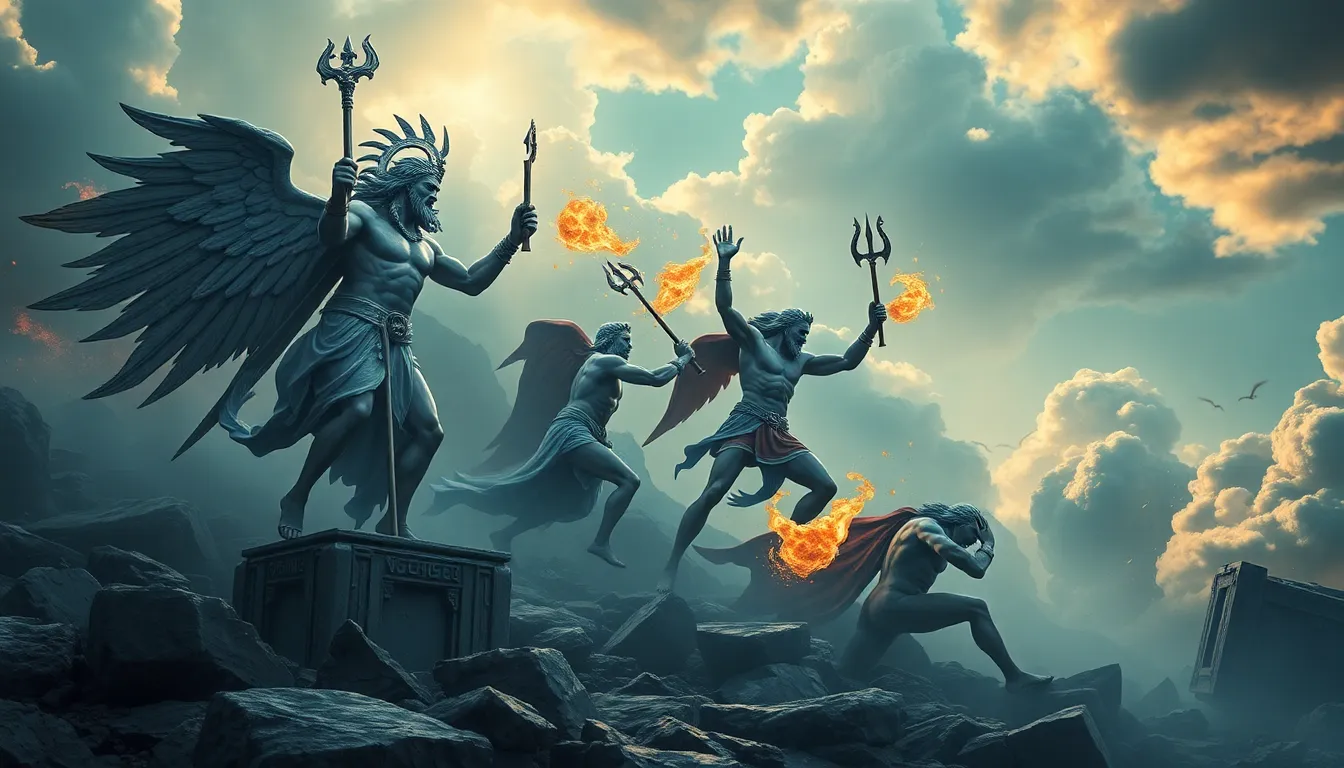
The Titanomachy: A Clash of Gods and Titans in Greek Mythology
I. Introduction to the Titanomachy
The Titanomachy, a pivotal event in Greek mythology, represents the great battle between the Titans and the Olympian gods. This conflict not only signifies a dramatic power shift in the ancient Greek pantheon but also serves as a backdrop for understanding the relationships and hierarchies among various deities.
At its core, the Titanomachy illustrates the struggle for supremacy, showcasing the clash between the older generation of Titans, led by Cronus, and the younger Olympian gods, spearheaded by Zeus. This epic confrontation is chronicled in various ancient texts, notably Hesiod’s “Theogony,” which serves as a primary source for understanding the myth’s intricacies.
II. The Origins of the Titans
The Titans, a group of powerful deities, emerged from the primordial chaos at the dawn of creation. They were born from Gaia (Earth) and Uranus (Sky), and their lineage represents the fundamental forces of the universe.
- Cronus: The leader of the Titans, known for his ruthless ambition.
- Rhea: Sister and wife of Cronus, she symbolizes fertility and motherhood.
- Oceanus: The Titan god of the ocean, representing the vast waters that surrounded the earth.
- Tethys: The goddess of the nourishing flow of water.
- Hyperion: The Titan of light, representing the sun.
- Themis: The embodiment of divine law and order.
During their reign, the Titans governed the cosmos with Cronus at the helm, representing the chaotic forces of nature. However, their dominance would soon be challenged, leading to a significant upheaval in the mythological landscape.
III. The Rise of Zeus and the Olympians
The Titanomachy’s origins can be traced back to a prophecy that foretold the downfall of Cronus at the hands of one of his children. In fear of this prophecy, Cronus swallowed each of his offspring at birth, preventing the prophecy from coming to fruition. However, Rhea managed to save her youngest child, Zeus, by hiding him away in a cave on Mount Ida.
As Zeus grew, he gathered allies to challenge his father and liberate his siblings. This coalition included:
- Hestia: Goddess of the hearth.
- Demeter: Goddess of the harvest.
- Hera: Goddess of marriage and family.
- Hades: God of the underworld.
- Poseidon: God of the sea.
Each of these Olympians possessed unique powers that would prove crucial in the impending battle against the Titans.

IV. The Prelude to War
The tensions between the Titans and the Olympians escalated as Zeus and his siblings grew in strength and determination. Key events leading to the Titanomachy included Zeus’s successful rebellion against Cronus and the subsequent release of his swallowed siblings. This act of defiance marked the beginning of organized resistance against the Titans.
Another significant player in the conflict was Gaia, who, feeling betrayed by the Titans, encouraged her children to revolt against Cronus. Her role as a primordial deity added complexity to the conflict, as she sought to restore balance in the universe.
V. The Great War: Key Battles and Strategies
The Titanomachy was characterized by epic battles and strategic maneuvers. The war lasted for ten years, with both sides employing unique tactics and weapons.
- Major Battles: The initial confrontations were fierce, with both sides showing immense power.
- Unique Weapons: The Olympians received help from the Cyclopes, who forged powerful weapons such as Zeus’s thunderbolt, Hades’s helmet of invisibility, and Poseidon’s trident.
- Monsters and Allies: Various mythological creatures, including the Hecatoncheires (giants with a hundred hands), sided with Zeus, tipping the scales in favor of the Olympians.
The strategies employed by the Olympians, combined with their newfound allies, ultimately led to a turning point in the war.
VI. The Aftermath and Consequences of the Titanomachy
The Titanomachy culminated in the defeat of the Titans, who were subsequently imprisoned in Tartarus, a deep abyss used as a dungeon of torment. This imprisonment solidified Zeus’s position as the king of the gods, ushering in a new era of governance among the deities.
The aftermath of the Titanomachy had profound implications for the cosmos:
- Establishment of Order: The victory of the Olympians brought a new order to the divine hierarchy.
- Creation of the Olympian Council: The Olympian gods established a council to govern the affairs of the world.
- Impact on Mortals: The outcome shaped the relationship between gods and humans, influencing religious practices and societal norms.
VII. Themes and Symbolism in the Titanomachy
The Titanomachy is rich in themes and symbolism that resonate throughout Greek mythology. Key themes include:
- Struggle for Power: The conflict highlights the nature of authority and the dynamics of power.
- Chaos vs. Order: The battle represents the transition from chaos (the Titans) to order (the Olympians).
- Human Struggles: The Titanomachy serves as an allegory for human conflicts and societal changes, reflecting the timeless nature of power struggles.
VIII. Conclusion: The Legacy of the Titanomachy
The Titanomachy has left an enduring legacy in literature, art, and religious practices. This myth continues to inspire countless works, shaping the narratives of power, rebellion, and transformation. Its influence is seen in various forms of art, from ancient pottery to modern films.
Moreover, the Titanomachy has played a crucial role in shaping Greek religious practices, as rituals and worship often centered around the Olympian gods who triumphed in the war. It serves as a reminder of the ever-present struggle for balance between chaos and order, power and subjugation.
In contemporary culture, the Titanomachy remains relevant, reflecting the complexities of authority and governance in modern society. Its themes resonate with audiences, reminding us that the fight for power is a universal human experience.